
If you have a criminal record in Ontario, you can apply directly to the Parole Board of Canada for a record suspension once your waiting period has passed, typically several years after your sentence is fully completed, with longer wait times for indictable offences than for summary convictions. The application fee is a modest fixed amount set by the Parole Board of Canada, and you do not need a lawyer to submit it yourself.
TL;DR:
- The waiting period begins only after every sentence condition, including fines and probation, is complete: five years for summary convictions and ten for indictable offenses.
- Schedule 1 offenses and more than three indictable convictions carrying sentences of at least two years can bar eligibility, while outstanding charges pause applications.
- Submit electronic fingerprints, certified court records proving all payments, and original police checks from every place you lived, worked, or studied; missing records delay review.
- The $50 CAD fee excludes fingerprinting, court copies, police checks, and shipping; review targets are six months for summary and twelve for indictable convictions.
- A suspension keeps most convictions off standard checks, but some suspended sexual convictions may still appear on vulnerable sector checks without affecting U.S. entry decisions.
Table of Contents
- Who is eligible to apply and how to calculate waiting periods
- What a record suspension does and its limits
- Step-by-step application process through the Parole Board of Canada
- Exact documents to gather before you start
- Fees to expect and PBC processing timeframes
- Schedule 1 exceptions, conditional pardons and expungement differences
- Practical help in Ontario and how PAC supports applicants
- How to handle common application errors and avoid delays
- Detailed timeline of the entire record suspension process from application submission to approval
- Clarification on maintaining the suspension once granted and potential consequences of reoffending
- Author perspective from PAC on common application bottlenecks
- How PAC helps: eligibility assessment, full application support and submission
- FAQ
- Sources
Who is eligible to apply and how to calculate waiting periods
Before you gather a single document, confirm that you actually qualify. You are generally eligible if your offence was prosecuted under a federal act, you have fully completed every part of your sentence, including fines, restitution, and probation, and you have no outstanding charges anywhere in Canada.
The waiting period is where most applicants stumble. It does not start on your conviction date. It starts only once your entire sentence is closed out, meaning the last payment is made and any probation order has expired. According to the Parole Board of Canada’s eligibility page, the clock runs 5 years for summary conviction offences and 10 years for indictable offences, and when the method of trial cannot be confirmed, the board applies the longer of the two periods. If your court records are vague on this point, it is worth contacting the originating court to get explicit written confirmation rather than losing an extra five years by default.
Offences from before March 13, 2012, fall under slightly different rules than more recent convictions, so the date of your offence matters as much as the date of your sentence.
A few situations take you out of the standard process entirely:
- Convictions listed under Schedule 1, which generally covers sexual offences against minors.
- More than three indictable convictions carrying sentences of two years or more, which can bar eligibility altogether.
- Outstanding charges or warrants anywhere in Canada, which pause the process until resolved.
If any of these apply to your file, you are not necessarily shut out, but you will need to look at the exceptions covered further down before you apply.
What a record suspension does and its limits
A record suspension removes your criminal record from the Canadian Police Information Centre (CPIC) database, so it will not surface on most background or employment checks. It does not erase the record permanently, and it can be reinstated under certain conditions.
Under Ontario’s police record check framework, a suspension keeps most convictions off standard checks, but vulnerable sector checks may still disclose certain suspended sexual offence records, according to the Government of Ontario. That distinction matters if you plan to work or volunteer with children or vulnerable adults.
A few other limits are worth knowing upfront:
- A Canadian record suspension carries no weight with U.S. border officials, who can still deny entry based on a past conviction. A U.S. Entry Waiver is a separate process entirely.
- A suspension can be revoked if you are convicted of a new indictable offence or if the board later discovers the application contained false information.
Step-by-step application process through the Parole Board of Canada
The board’s Record Suspension Application Guide lays out a fixed sequence, and following it in order saves you from the back-and-forth that stalls so many files.
- Confirm your eligibility and waiting period using the dates on your court documents and sentence records.
- Request your RCMP criminal record (Form C-216C) through RCMP-accredited fingerprinting services; electronic fingerprint submission is now required, as outlined by the RCMP.
- Obtain Proof of Conviction and court information for every conviction on your record, including dates, sentences imposed, and proof that all fines or surcharges were paid.
- Request local police record checks from every police service where you lived, worked, or attended school, and ask for originals rather than photocopies.
- Complete Schedule 1 exception forms or Measurable Benefit and Sustained Rehabilitation forms, if your record requires them.
- Pay the $50.00 CAD application fee by certified cheque, money order, or credit card, as specified in the guide.
- Mail the complete package to the Parole Board of Canada’s processing centre address listed in the application guide.
Pro Tip: Make a photocopy of every document before you mail the originals, and track your envelope with a trackable courier service so you know exactly when the board receives your package.
Readers who need an apostille or notarization for a document used outside Canada, such as an RCMP certificate for an international employer, can find practical guidance on authentication timelines and fees from Speedy Apostille Services.
Exact documents to gather before you start
A returned application almost always comes down to a missing or incorrectly formatted document. Before you mail anything, confirm you have:
- The completed application form along with the consent and privacy waiver forms from the official guide.
- Your RCMP criminal record or a certification of no criminal record, supported by electronically submitted fingerprints.
- Proof of Conviction and court information for each offence, including documented evidence that every fine, surcharge, or restitution payment was made in full.
- Local police record checks from each jurisdiction where you have lived, plus a copy of government-issued photo identification.
- A military conduct sheet, if you served and were discharged with a service offence on record.
Court documents and record checks generally need to be originals or certified copies rather than plain photocopies, so request certified versions directly from the issuing court or police service to avoid a rejected submission.
Fees to expect and PBC processing timeframes
The Parole Board of Canada’s application guide sets the official processing fee at $50.00 CAD, payable by certified cheque, money order, or credit card. That figure covers the board’s review only. Budget separately for fingerprinting, certified court copies, local police check fees, and courier shipping, all of which vary by province and provider.
Processing time depends on the type of offence and whether your file raises any concerns.
These targets come from the Parole Board of Canada’s performance reporting, which also notes that the board weighs sustained law-abiding conduct during your waiting period, not just elapsed time. If your file has been sitting past the target window, contacting the board directly for a status update is reasonable; doing so earlier rarely speeds things up.
Schedule 1 exceptions, conditional pardons and expungement differences
Some offences require extra proof before the board will even consider your file.
- Schedule 1 exception applicants must satisfy a three-part test under section 4(3) of the Criminal Records Act, showing they were not in a position of trust or authority, used no violence, threats, or deception, and demonstrate no history suggesting a pattern of sexual offending against minors.
- Conditional pardons are a narrower remedy available for cases of undue hardship when standard eligibility is not yet met, as described in the Parole Board’s Clemency Schedule A.
- Expungement is a separate, much more limited remedy reserved for historical injustices, as explained by the Parole Board of Canada; it is not an alternative route for most applicants.
If your offence looks ineligible on its face, check these exceptions before assuming the door is closed.
Practical help in Ontario and how PAC supports applicants
You do not have to navigate this alone. The Parole Board’s own helpline, RCMP-accredited fingerprinting services, and your local police record check office are the official starting points for forms and procedural questions. Community organizations such as the John Howard Society and Elizabeth Fry Society also offer low-cost guidance for people assembling their own applications.
For readers who would rather hand the paperwork to someone else, we built our service around exactly that gap.
- We have extensive experience preparing Canadian pardon and record suspension applications.
- We conduct personalized eligibility consultations before any paperwork begins.
- We keep clients updated through support channels for the full length of the process.
A paid service tends to save the most time for applicants juggling multiple convictions, unclear court records, or Schedule 1 exception requirements.
How to handle common application errors and avoid delays
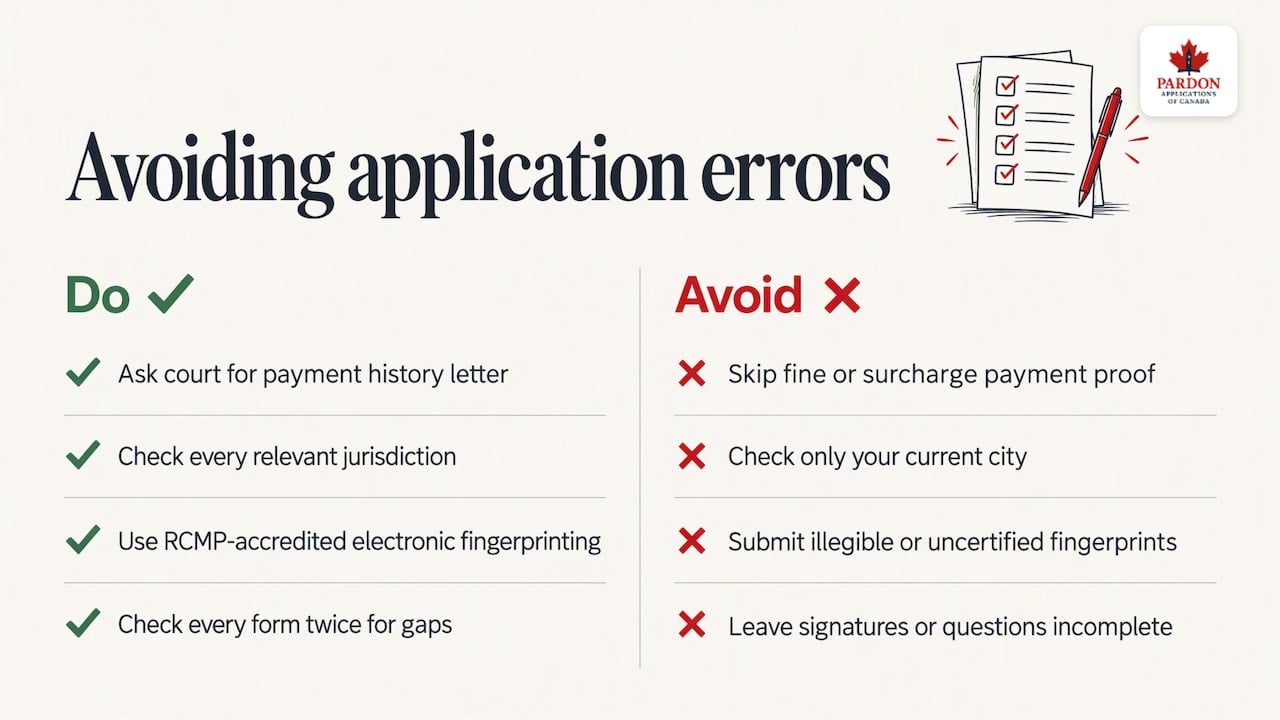
Most rejected or stalled applications trace back to a handful of avoidable mistakes. Missing proof of payment for fines or surcharges is the single biggest culprit, since the board cannot confirm your waiting period start date without it. If you cannot locate a receipt, request a payment history letter directly from the court that handled your case.
Incomplete police record checks come next. Requesting a check from only your current city, while skipping a province you lived in years ago, is a common oversight that triggers a request for additional information and adds months to your file.
Illegible or uncertified fingerprints also cause rejections. Electronic fingerprint submission through an RCMP-accredited agency avoids the smudging and quality issues that paper cards sometimes produce.
Finally, double-check every form for a missing signature or an unanswered question. The board returns incomplete forms rather than processing them with gaps, which resets your place in the queue. Our article on reasons applications get refused breaks down these pitfalls in more detail if you want to see the full list before you submit.
Building a checklist before you start, and confirming every document against it twice, catches the overwhelming majority of these problems before they cost you months.
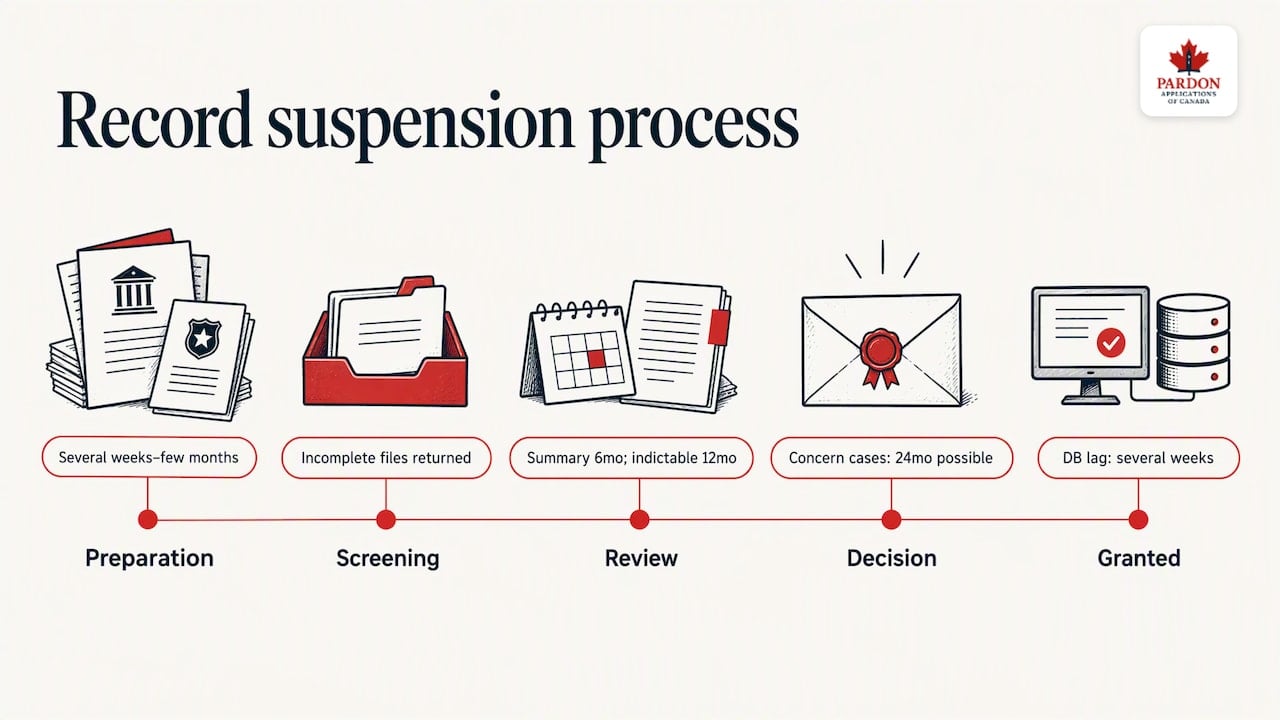
Detailed timeline of the entire record suspension process from application submission to approval
The timeline breaks into distinct phases, and knowing what happens in each one helps you set realistic expectations.
Preparation phase: Gathering fingerprints, court documents, and police checks typically takes several weeks to a few months, depending on how many jurisdictions are involved and how quickly each office responds to records requests.
Screening phase: Once the board receives your application, staff confirm it is complete before opening a file. An incomplete package is returned at this stage, which is why the documents checklist matters so much.
Review phase: For summary conviction offences, the board aims to complete its review within 6 months of accepting a complete file. Indictable offences target 12 months, according to the Parole Board of Canada’s reporting.
Decision phase: If the board identifies a concern, such as a question about your conduct during the waiting period, it may propose a refusal, giving you a chance to respond before a final decision. These cases can stretch to 24 months.
Post-decision phase: Once granted, your record suspension takes effect and CPIC is updated, though updates to other databases can lag behind the board’s decision by several weeks.
Our timeline breakdown walks through each of these phases with more context if you want a closer look at what happens behind the scenes at each stage.
Clarification on maintaining the suspension once granted and potential consequences of reoffending
Getting your record suspension approved is not the final step. The suspension stays in effect as long as you keep your record clean, but it is not an unconditional guarantee.
A new conviction for an indictable offence can cause the board to revoke your suspension automatically, reinstating your criminal record exactly as it stood before. The board can also revoke a suspension if it later discovers that your application contained false or misleading information, which is one more reason to be exact and honest about every detail when you apply.
A summary conviction after your suspension is granted does not automatically revoke it, but it can still trigger a review of your file. Staying out of further legal trouble is the simplest way to protect the outcome you worked to achieve.
If your suspension is ever revoked, you generally have to wait out a new period before reapplying, so the stakes of maintaining good conduct extend well beyond the day your application is approved.
Author perspective from PAC on common application bottlenecks
In our experience, the single biggest bottleneck is missing proof of payment for old fines. Applicants assume a receipt from a decade ago is long gone, but a letter from the court confirming payment usually resolves it in days, not months. Getting that proof together before you submit anything is the difference between a smooth file and a stalled one.
— PAC
How PAC helps: eligibility assessment, full application support and submission

We built our service around removing the guesswork from this process. When you work with us, we assess your eligibility, prepare every document to the board’s exact standards, and keep you updated from submission through to decision.
- A personalized consultation with an accredited pardon officer to confirm your eligibility and waiting period.
- Complete preparation of your forms, fingerprint consent, and supporting documents.
- Ongoing updates through a dedicated client support channel until your file is decided.
If you are ready to move forward, apply now or schedule a call with our team to get started.
This article is general information, not a substitute for advice from a qualified lawyer. Consult a qualified legal professional about your own circumstances before acting on anything here.
FAQ
How long does an Ontario record suspension take to process?
Processing targets typically fall within several months for summary offences and up to a year for indictable offences, with longer times possible when refusal is proposed, according to the Parole Board of Canada. Your preparation time before submission adds to this timeline.
How much does a record suspension application cost in Ontario?
The official Parole Board of Canada processing fee is $50.00 CAD, payable by certified cheque, money order, or credit card, as stated in the application guide. Additional costs for fingerprinting, court documents, and police checks vary by provider.
Can I apply for a record suspension without a lawyer?
Yes, you can prepare and submit your application directly to the Parole Board of Canada without hiring a lawyer. Many applicants choose paid preparation assistance instead to reduce the risk of errors or missing documents that cause delays.
Does a record suspension let me travel freely to the United States?
No, a Canadian record suspension has no legal effect on U.S. border decisions, and a past conviction can still result in denied entry. Travellers in this situation generally need a separate U.S. Entry Waiver to enter the United States legally.
What is the difference between a record suspension and expungement?
A record suspension seals most of your record from standard checks while keeping it on file, whereas expungement permanently destroys records tied to specific historical injustices, as explained by the Parole Board of Canada. Expungement eligibility is far narrower and does not apply to most applicants.
Sources
- PBC Record Suspension Application Guide (PDF)
- Determining your eligibility for a record suspension — Parole Board of Canada
- Record suspension decisions and clemency recommendations — PBC performance report 2022–23
- Police record checks — Government of Ontario