

A record suspension is an order from the Parole Board of Canada that keeps an eligible conviction separate and apart from other criminal records. If you have completed every part of your sentence, including fines and probation, and the required waiting period has passed, you can apply directly to the Parole Board of Canada, along with an RCMP-verified criminal record and a $50 federal processing fee.
TL;DR:
- For offences committed on or after March 13, 2012, summary convictions require five years and indictable convictions ten, measured from sentence completion.
- Unpaid fines, restitution, or victim surcharges delay the eligibility clock, while weapons and driving prohibitions do not affect its start date.
- Ambiguous court records can trigger the longest waiting period, while Schedule 1 child sexual offence cases require evidence of measurable benefit and sustained rehabilitation.
- The Board’s six month and twelve month service standards begin only after it accepts a complete file, and proposed refusals can extend decisions to 24 months.
- Gather court conviction records early, submit required originals, and track expiry dates: police checks and signed forms remain valid for 12 months.
Table of Contents
- Who is eligible and how the waiting period is determined
- Processing timelines and how refusal proposals change timing
- Definitive documents checklist you must collect before you start
- Step-by-step application: completing forms, signing, and submitting
- Fees and extra costs: budgeting for fingerprints, police checks and court copies
- What a record suspension does and what it doesn’t
- How to submit: using the PBC Service Portal and document validity rules
- Common mistakes that delay or return applications
- Where applicants usually need help and how professional support helps
- What matters most in this process
- How Pardon Applications of Canada can help with your record suspension application
- FAQ
- Sources
- Official guides and forms to download or consult
Who is eligible and how the waiting period is determined
Eligibility starts with one requirement: you must have completed every component of your sentence. That means more than finishing a jail term or a probation order. It includes paying fines in full, settling restitution owed to a victim, and clearing any victim surcharge. The clock on your waiting period does not start ticking until the last of these obligations is paid, so an unpaid surcharge can delay your eligibility far longer than the original sentence itself.
Weapons prohibitions and driving prohibitions are treated differently. These conditions can remain in effect without pushing back the start of your waiting period, which surprises many applicants who assume every lingering restriction counts against them.
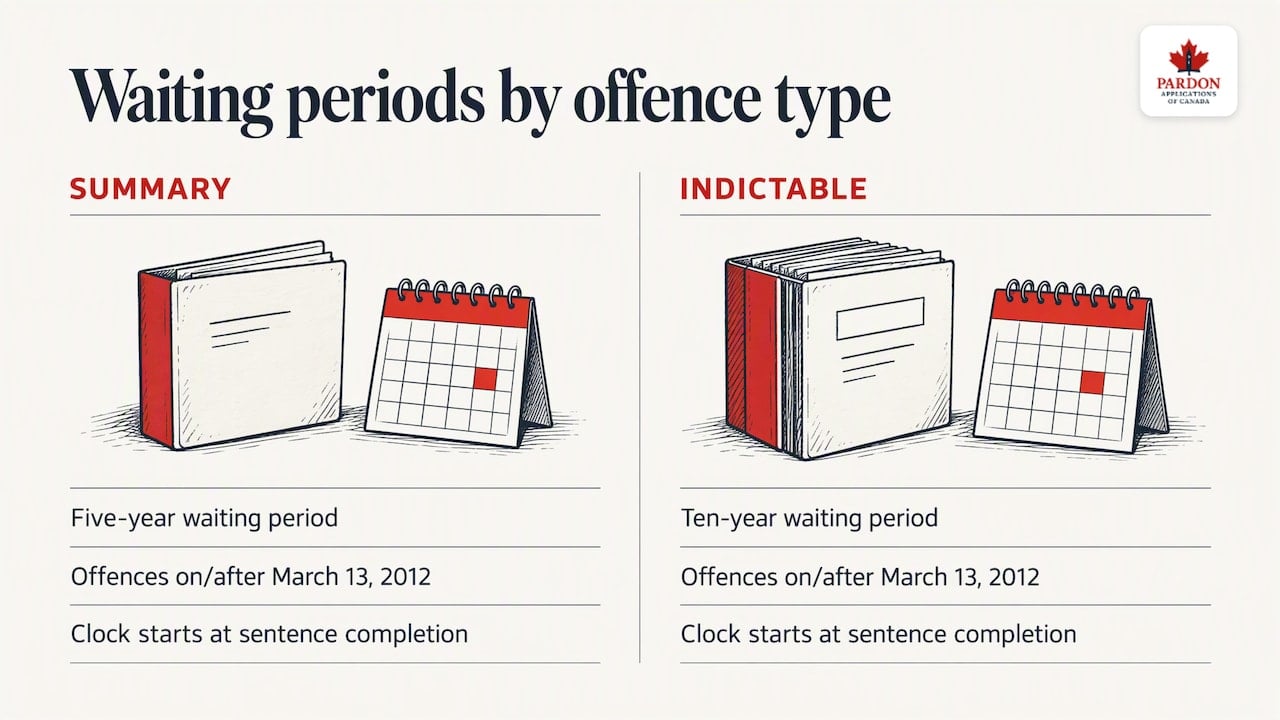
For offences committed on or after March 13, 2012, the Parole Board of Canada applies a five-year waiting period for summary conviction offences and a ten-year waiting period for indictable offences, measured from the date you completed your sentence. Offences from before that date can fall under earlier rules, so the date of the offence, not the date of sentencing or conviction, is what determines which timeline applies.
Here is a detail that catches people off guard: when court records do not clearly show whether an offence was prosecuted summarily or by indictment, the Board defaults to the longest applicable waiting period. If your court records are ambiguous or incomplete, you may be held to a longer wait than the offence itself would otherwise require, which is one more reason to request clear documentation from the court as early as possible.
Not every eligible offence is treated the same way once the waiting period has passed. The Criminal Records Act sets out Schedule 1 exceptions for certain sexual offences involving a child. Applicants in this category must demonstrate a measurable benefit to themselves, such as employment, education, or community involvement, and show that granting the suspension would not bring the administration of justice into disrepute. This requires a dedicated Measurable Benefit and Sustained Rehabilitation form, and the Board applies closer scrutiny to these files than to a standard application.
Understanding where you stand matters before you spend a single dollar on fingerprinting or court copies. If your situation involves any of these layered conditions, work through them in order: completion of sentence first, offence date and classification second, then any Schedule 1 considerations.
Processing timelines and how refusal proposals change timing
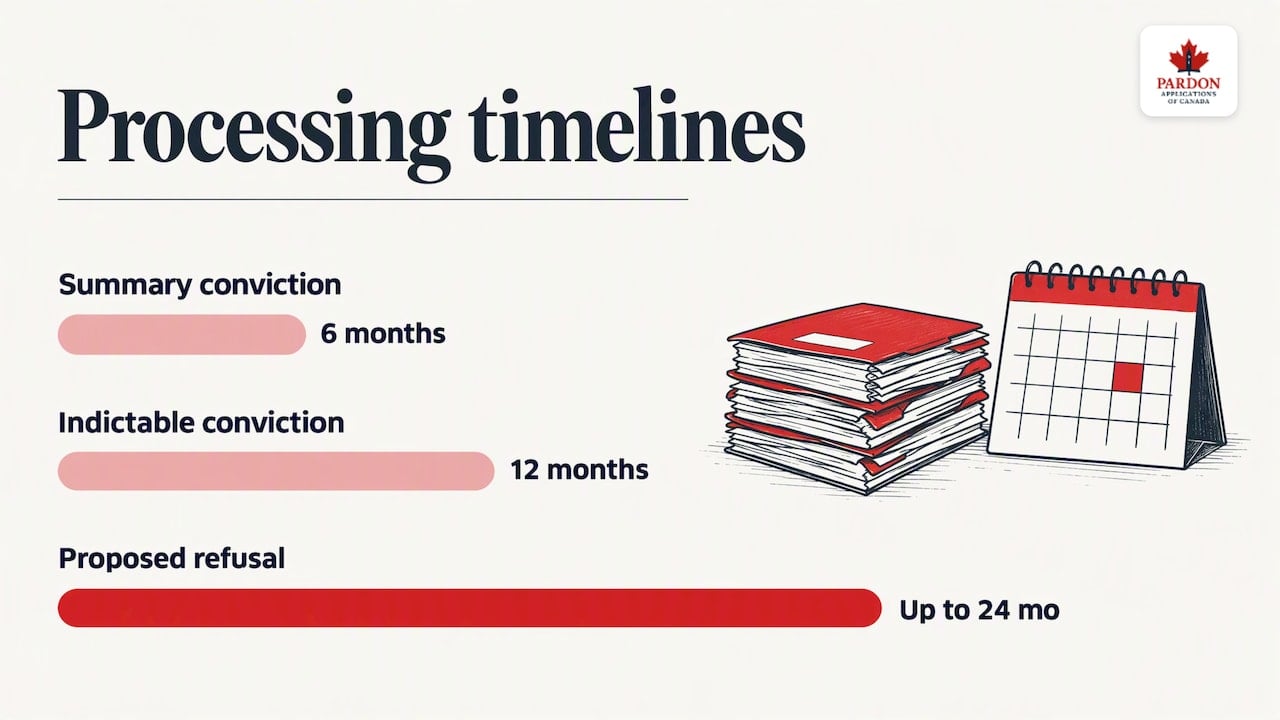
Once your application is accepted as eligible and complete, the Parole Board of Canada aims to process summary conviction applications within 6 months and indictable conviction applications within 12 months.
For a typical, complete application, expect a 6-month wait for summary offences and up to 12 months for indictable offences, measured from the point the Board accepts your file as eligible and complete, not from the date you mail it. That distinction trips up a lot of applicants who count the clock from their submission date instead of acceptance.
Those timelines shift when the Board identifies grounds to propose a refusal. If a case officer flags concerns, perhaps a conviction that falls under a Schedule 1 exception without adequate supporting evidence, or inconsistencies in your record, the Board must notify you and give you an opportunity to respond before a final decision is made. This representation process adds real time to a file. Applications where the Board proposes to refuse a suspension can take up to 24 months to resolve.
If you are tracking your own timeline, resist the urge to call the Board the moment your file passes the six or twelve month mark on your calendar. Those figures are service standards, not guarantees, and they only start counting once your file is confirmed as complete. A reasonable approach is to wait until you have clearly exceeded the applicable standard before reaching out, and to use that call to confirm your file is still active rather than to ask for an update you are not yet due. Our team recommends reviewing realistic timeline expectations from the outset.
Definitive documents checklist you must collect before you start
Most delays in this process come down to paperwork, not eligibility. Before you fill out a single form, gather the following:
- RCMP-verified criminal record, obtained through electronic fingerprint submission rather than a name-based search, since the Board requires the fingerprint-verified version.
- Proof of Conviction, also called a Court Information Form, for every conviction listed on your record, showing the date, the court, the sentence imposed, and proof that any fine or victim surcharge was paid in full.
- Local police records checks from your current city of residence and from every location you have lived in, each valid for 12 months from the date it was issued.
- Government-issued photo identification, since most police services require this to process a records check request.
- A Schedule 1 Exception Form and a Measurable Benefit and Sustained Rehabilitation Form, if any of your convictions fall under that category.
- The completed Record Suspension Application Form itself, along with the Processing Fee Form.
Pro Tip: Request your court Proof of Conviction documents as soon as you start the process. Courts can take time to locate older files, and this step can cause delays in the application.
A detail that catches applicants off guard: originals matter. Where the Board requires an original document, a photocopy will see your application returned, which restarts your wait for processing. At the same time, forms you sign yourself are valid for 12 months from the date of signature, so if you sign your application early and spend an extended time waiting on court records, you may need to re-sign before you submit. Build your document collection timeline backward from the day you expect to submit, not forward from the day you start.
Step-by-step application: completing forms, signing, and submitting
Once your documents are in hand, the actual submission follows a defined sequence.
- Confirm your eligibility by calculating your waiting period from the date you completed every part of your sentence, including fines and surcharges.
- Order your RCMP criminal record through an accredited fingerprinting service, since the Board requires the electronic fingerprint-based version rather than a name-based check.
- Request Proof of Conviction and court information for every conviction appearing on your record, confirming dates, sentences, and payment of any fines or surcharges.
- Obtain local police records checks for your current city and any municipality where you have lived.
- Complete the Measurable Benefit and Sustained Rehabilitation Form if any conviction falls under a Schedule 1 exception.
- Fill out the Record Suspension Application Form in full, sign and date it, and keep in mind the signature is valid for 12 months.
- Attach the $50 federal processing fee payment along with every supporting original document the application requires.
- Submit your complete package either by mail to the Parole Board of Canada or through the PBC Service Portal.
Pro Tip: If you run out of space on any form, attach a separate page labelled with the section number it continues, and reference it clearly on the original form rather than leaving a section blank.
One scenario worth planning for: sometimes a conviction you know happened does not appear on your RCMP record, often because of how older records were digitized. When that happens, you cannot simply leave it off your application. You need to obtain a Proof of Conviction directly from the court where the matter was heard and include it with your submission, since the Board cross-references your declared convictions against your supporting documents, not just the RCMP printout.
Submitting through the PBC Service Portal requires a GCKey account, and it lets you start your application, save your progress, upload supporting documents, and track where your file sits in the queue. For applicants juggling documents from multiple courts and police services, that tracking visibility is often worth the setup time.
Fees and extra costs: budgeting for fingerprints, police checks and court copies
The federal application processing fee for a record suspension is $50.00 (CAD), paid directly to the Parole Board of Canada. That fee covers only the Board’s processing of your file, not the documents you need to assemble beforehand.
Expect several additional costs along the way. The RCMP charges a $25.00 fee for the federal criminal record check itself, and your fingerprinting provider will add its own service fee on top. Local police services charge their own fees for a local records check, and these vary considerably from one municipality to the next. Courts typically charge per-document fees for Proof of Conviction and Court Information Form copies, and if any of your records require courier delivery or translation, those costs add up as well.
Because these regional costs vary by provider, confirm pricing directly with your local police service and the relevant court clerk before you commit to a submission date. Budgeting a buffer above the $50 federal fee, rather than treating it as the full cost of the process, saves you from an unwelcome surprise partway through.
What a record suspension does and what it doesn’t
A record suspension does not erase your conviction. Your record is kept separate and apart from other criminal records in the National Repository of Criminal Records rather than destroyed, which means it generally will not surface in a standard background check, but it has not vanished from existence.
There are specific, legislated situations where a sequestered record can still be disclosed. Vulnerable sector checks, required for work or volunteer roles involving children or other vulnerable people, can reveal a suspended record if it relates to a relevant sexual offence. Certain other federal and law enforcement contexts also allow access under exceptions written into the Criminal Records Act.
A record suspension can also be revoked after it is granted. The Board can revoke it if you are convicted of a new indictable offence, if it discovers you made a false statement or withheld relevant information in your application, or if there is evidence you have not maintained good conduct since the suspension was ordered. Revocation restores your full record, which is one more reason an honest, complete application matters more than a fast one.
How to submit: using the PBC Service Portal and document validity rules
The PBC Service Portal gives applicants and their representatives a single place to start an application, save it partway through, upload every supporting document, and track its progress through each stage of review. Access requires a GCKey account, which takes only a few minutes to set up.
Fingerprinting runs through a separate channel. The RCMP requires electronic fingerprint submissions for the criminal record check tied to a record suspension application, rather than the older name-based search method, so confirm your fingerprinting provider submits electronically before you pay for the service.
Watch your document clocks closely. Local police records checks are valid for 12 months from issue, and any form you have signed is valid for 12 months from your signature. If your document collection takes a long time, due to court delays or a complex multi-jurisdiction file, you may need to request a fresh police check or re-sign a form before submission.
Common mistakes that delay or return applications
Returned applications almost always trace back to a short list of avoidable errors:
- Forms submitted unsigned, undated, or signed more than 12 months before submission.
- Local police records checks that expired while other documents were still being gathered.
- Missing Proof of Conviction for one or more listed convictions.
- No proof of payment attached for a fine or victim surcharge, leaving the Board unable to confirm your sentence is complete.
- Photocopies submitted where the Board requires original documents.
Pro Tip: Keep a single master checklist with the issue date of every document you collect, and set a calendar reminder well before each police check expires so you can renew it in time.
For applicants with multiple convictions across different courts or provinces, build a simple timeline showing when each sentence component was completed and when each fine or surcharge was paid in full. This single document often resolves confusion faster than any other piece of your file, since it gives the Board a clear picture of exactly when your waiting period began. If you want to see how specific refusal patterns tend to arise, reviewing real examples before you submit can help you catch the same issues in your own file.
Where applicants usually need help and how professional support helps
Nothing in this process legally requires a lawyer or a paid representative. You can gather your own documents, complete your own forms, and submit directly to the Board. In practice, many applicants find that coordinating fingerprints, court records, and police checks across multiple jurisdictions, often while juggling expiry dates that do not line up, is where things get complicated.
An experienced representative’s main value is catching problems before the Board does: confirming every signature is dated, every police check is still valid, every original document is actually an original, and every Schedule 1 form is complete before the package ever gets mailed. We built our service around eligibility assessment, full document compilation, and ongoing client support through exactly these friction points.
What matters most in this process
The conventional advice treats the record suspension process as a paperwork exercise: fill out the forms, pay the fee, wait. What that framing misses is that most delays trace back to timing, not forms, specifically, the gap between when applicants think their waiting period started and when it actually did.
Our strongest recommendation is to nail down your completion-of-sentence date before you spend a dollar on fingerprinting or police checks. Get written confirmation from the court of your last payment date on any fine or surcharge. That single document prevents more wasted months than any amount of careful form-filling later in the process. A record suspension changes what shows up when an employer or a border officer looks you up, but only once the waiting period math is actually right.
— PAC
How Pardon Applications of Canada can help with your record suspension application
We built our service around the parts of this process that cause the most delays: confirming eligibility, assembling original documents from multiple sources, and catching errors before the Board sees them. Our accredited officers assess your waiting period, review your Schedule 1 status if it applies, and compile your RCMP record, court documents, and police checks into one complete package.

Working with us means:
- A personalized eligibility consultation before you spend money on fingerprinting or court fees.
- Full document compilation and verification, so originals, signatures, and expiry dates are checked before submission.
- Dedicated support for Schedule 1 exception cases that require a Measurable Benefit and Sustained Rehabilitation form.
- A direct point of contact for updates throughout your file’s review.
If you are ready to start, visit our how to get a pardon in Canada page for a full breakdown of our process, or go straight to apply now to begin your intake.
This article is general information, not a substitute for advice from a qualified lawyer. Consult a qualified legal professional about your own circumstances before acting on anything here.
FAQ
What does a record suspension mean?
A record suspension is an order from the Parole Board of Canada that keeps an eligible conviction separate and apart from your other criminal records, so it generally will not appear in a standard background check. It does not erase the conviction; the record remains in the National Repository of Criminal Records and can still surface under specific legislated exceptions.
Can I travel to the United States if I had a conviction decades ago?
Entry decisions for the United States are made by U.S. border authorities, not by Canada, so a Canadian record suspension does not guarantee entry even for an old conviction. Many travellers in this situation look into a separate U.S. Entry Waiver, since a Canadian pardon alone does not resolve U.S. inadmissibility.
How much does a record suspension cost for a DUI conviction?
The federal application processing fee is $50.00 (CAD), the same fee that applies to any eligible offence type, including impaired driving. On top of that, expect to pay for RCMP fingerprinting, local police checks, and court document copies, which vary by region.
Can a criminal record be expunged in Canada?
Expungement, which permanently destroys a record, is only available in Canada for a narrow set of historically unjust convictions under a separate federal process, not through the standard record suspension program. For most convictions, a record suspension is the mechanism available, and it sequesters rather than destroys the record.
How long does the record suspension process take from start to finish?
Once accepted as eligible and complete, the Board aims to decide summary conviction applications within 6 months and indictable conviction applications within 12 months. Cases where the Board proposes a refusal can take up to 24 months, since they involve an additional representation process before a final decision.
Official guides and forms to download or consult
Start with the official PBC application guide and forms, the PBC Service Portal for submission, and RCMP guidance for fingerprint-based checks.