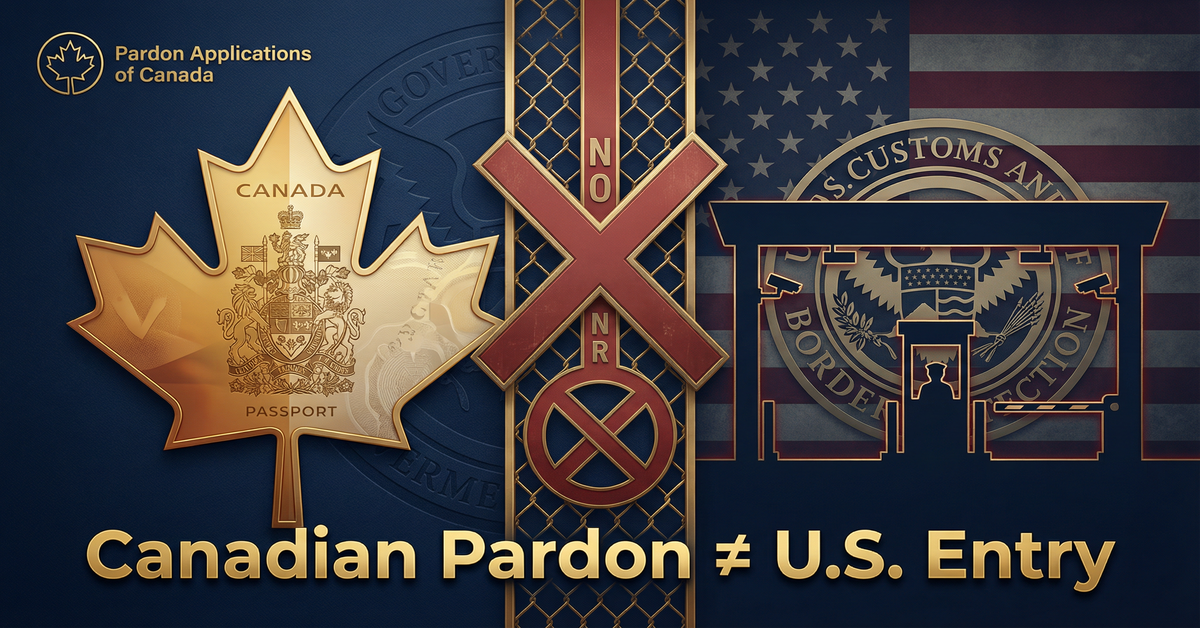

Many Canadians believe that obtaining a Canadian Pardon, now officially known as a Record Suspension, is the ultimate solution to all their past legal troubles. While it certainly opens doors for employment, volunteering, and peace of mind within Canada, there is one major limitation that catches many off guard: a Canadian Pardon will not get you into the United States.
The U.S. Does Not Recognize Canadian Pardons
The United States operates under its own immigration and border security laws, which do not recognize foreign pardons. When you approach a U.S. port of entry, U.S. Customs and Border Protection (CBP) officers evaluate your admissibility based on U.S. federal law. Under their regulations, a criminal conviction—especially for crimes involving moral turpitude or controlled substances—renders an individual inadmissible, regardless of whether Canada has granted a Record Suspension.
A Canadian Record Suspension seals your record at home — but at the U.S. border, it’s as if it never happened. American agents can still see your full criminal history.
Shared Criminal Databases Between Canada and the U.S.
One of the most critical factors to understand is the extensive information sharing between Canadian and American law enforcement agencies. Canada and the U.S. share access to criminal record databases, notably the Canadian Police Information Centre (CPIC) and the National Crime Information Center (NCIC). When your passport is scanned at the border, CBP officers can see your criminal history. While a Record Suspension seals your criminal record in Canada, removing it from the active CPIC database accessible to the general public and Canadian employers, it does not erase the record from U.S. databases if they have already downloaded or accessed it prior to your pardon. Furthermore, the Canada Border Services Agency (CBSA) can still share information with U.S. border agents under certain agreements.
The Risk of Being Turned Away at the Border
Attempting to cross the border with a sealed record, assuming the U.S. won’t know about it, is a significant risk. If a CBP officer discovers your past convictions—either through their own database records or through questioning—you will likely be denied entry. More severely, you could be detained, interrogated, and potentially barred from entering the U.S. for years due to misrepresentation or fraud if you fail to disclose your record when asked.
The Legal Solution: A U.S. Entry Waiver (Form I-192)
The only legal and reliable way to enter the United States with a criminal record is by obtaining a U.S. Entry Waiver. Officially known as Form I-192, Application for Advance Permission to Enter as a Nonimmigrant, this document grants you temporary permission to cross the border despite your inadmissibility. Applying for a U.S. Entry Waiver is a complex process that requires gathering extensive documentation, including court records, personal statements, and letters of reference. The application is reviewed by the Admissibility Review Office (ARO), which considers the nature of your past crimes, the time elapsed since your convictions, and your reasons for wanting to enter the U.S.
Why You Might Need Both
While a Record Suspension won’t help you cross the border, it remains a vital step for your life in Canada. Many individuals choose to pursue both a Record Suspension and a U.S. Entry Waiver simultaneously. Securing a Canadian Pardon demonstrates rehabilitation and good character, which can be viewed favorably by U.S. authorities when reviewing your I-192 application.
About PAC
Pardon Applications of Canada (PAC) is a BBB-accredited service helping Canadians navigate the Record Suspension and U.S. Entry Waiver process. Visit pardonapplications.ca to get started.