
If you were dealt with in youth court, you usually do not need to apply for a Pardon (the process the federal government now calls a record suspension). The Parole Board of Canada says anyone convicted only in youth court does not need to apply for a record suspension, because youth records are destroyed or archived once the time periods set by law run out. The catch is that those periods can be extended, and an adult conviction can pull a youth record back into view. This guide explains how the clock works, how to confirm your record is closed, and where an adult Pardon application or a U.S. Entry Waiver becomes the next step.
TL;DR
- Youth records are not cleared by a Pardon application. They are closed, sealed or destroyed automatically after an access period set by the Youth Criminal Justice Act (YCJA).
- Most periods run from two months to five years, counted from the end of your sentence or the outcome of your case.
- A new conviction as an adult while your youth record is still open can turn it into part of your adult record.
- If you have an adult record, with or without a youth record behind it, a Pardon (record suspension) may be the route. Our accredited officers can assess your eligibility.
- A youth record can still matter at the U.S. border. That is where a U.S. Entry Waiver (I-192) comes in.
Table of Contents
- What “sealing” a youth record really means
- How long a youth record stays open
- When the clock does not run out as expected
- How to confirm your youth record is closed
- What this means for work and volunteering
- Crossing the U.S. border with a youth record
- Where a Pardon fits in: adult records
- How we help with your next step
- A short checklist before you act
- FAQ
- Sources
What “sealing” a youth record really means
People search for “youth record sealing” or “youth record Pardon”, but Canadian law uses different words. Adults with a conviction ask the Parole Board of Canada (PBC) for a record suspension. Youth sentences sit under a separate system, the YCJA, which controls who can see a youth record and for how long.
The Canadian Bar Association describes the YCJA’s access rules as a comprehensive scheme that strictly controls access to youth records. As a result, Pardons and record suspensions under the Criminal Records Act generally do not apply to young people, with a few exceptions. Once the access period has ended, no one may use the record for any purpose that would identify you.
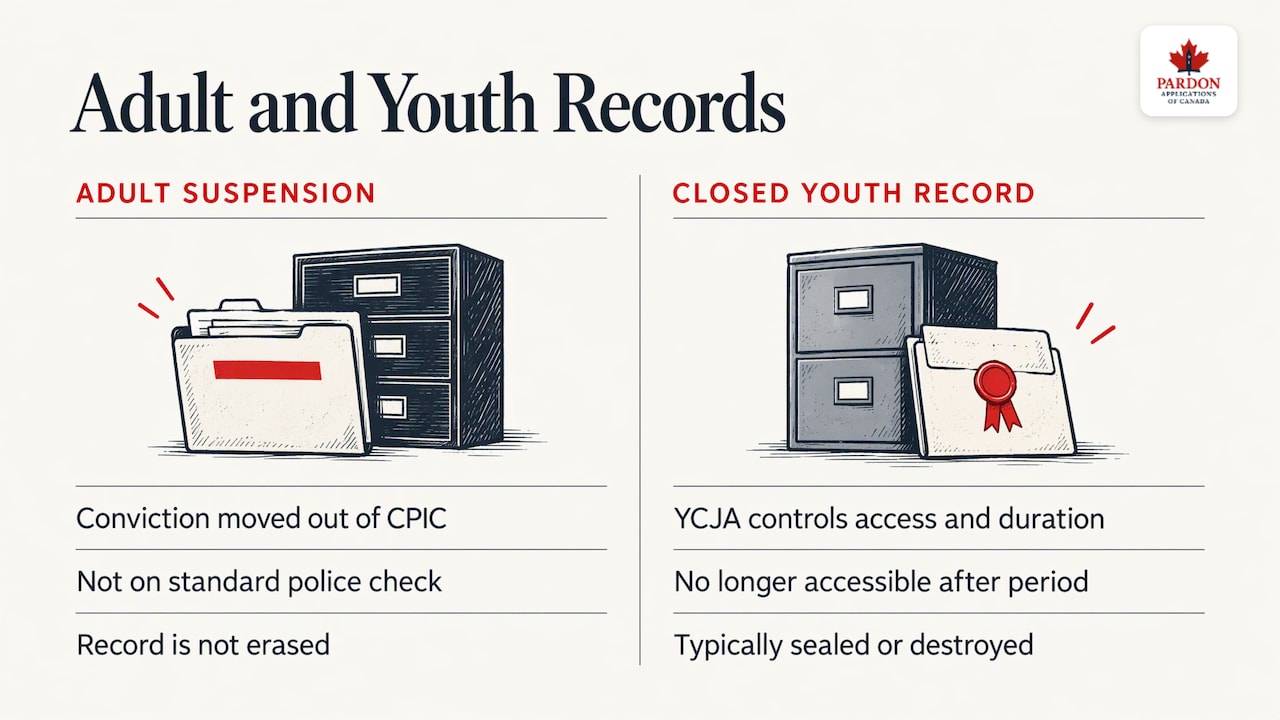
Compare that with an adult record suspension. A record suspension moves the conviction out of the CPIC database (the police database behind most record checks), so it does not show on a standard police record check, but it does not erase the record. A closed youth record is different. The Department of Justice says that once the period ends, the record is closed, can no longer be accessed and is typically sealed or destroyed.
How long a youth record stays open
The length of the access period depends on how your case ended. Under section 119(2) of the YCJA, the periods range from two months for some outcomes up to five years. Here is the pattern for the most common outcomes:
| How your case ended | How long the record stays accessible |
|---|---|
| Charge stayed, after a year with no further proceedings | One year |
| Absolute discharge | One year |
| Extrajudicial sanction (a measure outside court) | Two years |
| Conditional discharge | Three years |
| Summary conviction (the less serious category) | Three years after the sentence is completed |
| Indictable offence (the more serious category) | Five years after the sentence is completed |
The period starts when your sentence ends, not on the day you were charged. If you were on probation or served custody, the clock starts after that is finished.
The RCMP, which holds the national records, applies the same logic. It says it destroys the record three years after the sentence for a summary offence and seals it five years after the sentence for an indictable offence. It also notes that retention can be extended if you are found guilty of a new offence.
Who can see the record while it is open
During the access period, the list of people allowed to see a youth record is defined in the same section of the Act. It includes you and your lawyer, the Attorney General, peace officers, judges and courts, correctional directors and certain government employees. The Department of Justice adds that only government employers can obtain youth-record information from police. Other employers may ask you to complete a criminal record check, and you can refuse, though that may affect the job.
You keep your own right of access. Section 124 of the YCJA lets you and your counsel see your record at any time, even after the access period ends.

When the clock does not run out as expected
The automatic closing of a youth record has exceptions. Knowing them helps you avoid assuming your record is gone when it is not.
- An adult sentence was imposed. The Canadian Bar Association lists this as the first exception to youth-record closure, under YCJA s. 117.
- You were convicted again during the access period. The youth record stays open and can become part of your adult record. British Columbia’s government guidance says that if you are convicted as an adult while the youth record is still open, the youth record may be converted to an adult record.
- A court orders access. A court can allow access after the period expires if a stringent test is met.
- The offence was serious. For certain serious offences, section 120 of the YCJA extends the RCMP retention period, in some cases by five more years and in the most serious cases indefinitely.
The second exception is the one that most often affects our readers. Someone who got into trouble at 16 and again at 19 may find that both matters now sit together on an adult record. That adult record is exactly what a Pardon application is built for.
How to confirm your youth record is closed
Closure is meant to be automatic, and it often is for electronic files. But you do not have to take it on faith. Steps to Justice, a Canadian legal-education resource, suggests you check with the RCMP and your local police, preferably by requesting a criminal background check. Here is a practical routine:
- Work out your date. Find the date your sentence ended, then add the period from the table above. Court documents or your youth justice lawyer can confirm how the case ended.
- Request a record check. Ask your local police service for a criminal record check once the period has passed. Check the service’s own page for its fee and processing time, as these differ by police service.
- Read the result. A closed youth record should not appear. If it does, ask the police to erase or seal it.
- Escalate if needed. If police do not agree, a youth justice lawyer can help, according to the same guidance.
The Parole Board’s guidance and the YCJA both point to the same principle: a youth record that was properly closed is not a record you must disclose as a conviction. If you are unsure whether something still appears, ask the police before you answer a question on a job or volunteer application.
What this means for work and volunteering
Many people with an old youth matter feel the shadow of it long after the law says it is over. The practical picture is simpler than it feels.
- While the record is open: only government employers can get youth-record information from police. A private employer can only ask you to provide a check, which you may decline.
- After the record is closed: it should not show up in a police record check.
- If you also have an adult record: that record can appear on checks, which is often the real barrier to a job, a licence or volunteer work with vulnerable people. A Pardon (record suspension) can address that adult record once you are eligible. Our guide on who can apply for a Pardon sets out the basics.
For a closer look at how youth offences interact with criminal records generally, read our article on youth offences and criminal records.
Crossing the U.S. border with a youth record
Closed does not always mean invisible everywhere. The Government of Canada’s guidance says other countries generally do not have access to youth records, but Canada may disclose information under international cooperation agreements, a customs officer may learn of a record by asking questions at the border, and a country that obtains the information may keep it in its own files permanently.
The RCMP adds that Canada and the United States have an information-sharing agreement giving each country access to the other’s criminal record and public safety information. It recommends that anyone with an active record or a record suspension contact the specific port of entry about entry requirements.
If you have been told you are inadmissible to the United States, a U.S. Entry Waiver (Form I-192) is the document that allows lawful entry. We prepare these applications, and our overview of why you may need a U.S. waiver explains who is affected. You can also see what the process involves on our U.S. Entry Waiver page.
Where a Pardon fits in: adult records
A Pardon application is the right tool when you have an adult conviction under federal law. If you are in that position, here is what to expect.
- Eligibility comes first. A waiting period applies after you finish all sentence terms, including fines and probation. Our article on the timeline for a Pardon explains how the wait is counted.
- The paperwork is detailed. Court documents, police records and fingerprint-based checks all have to be complete and consistent. Missing or inaccurate information is a common cause of delay, which is why a complete, accurate file matters.
- Costs go beyond the PBC fee. The PBC’s filing fee is $50, but that is only one part of the process. There are other costs, including record checks, court documents and fingerprinting, so the $50 figure is not the cost of a full application. Our page on the cost of a Pardon explains what the process involves.
If an old youth record has been merged into your adult record, mention it when you speak with an officer so they can look at the whole picture with you.
How we help with your next step
Pardon Applications of Canada prepares Canadian Pardon (record suspension) applications and U.S. Entry Waivers. You start with a consultation with an accredited officer who assesses your eligibility, and we put together a complete application so there is less risk of delays. Our Pardon Only plan is $80 per month, and details are on our Pardon cost page. We cannot guarantee a result, because the decision belongs to the Parole Board of Canada, but a well-prepared file gives your application its best footing.
If your youth record has closed and nothing else is on file, you may not need us at all. If you have an adult conviction, an open record that has merged, or a U.S. border problem, start with our consultation and we will tell you where you stand.
A short checklist before you act
- Note how each youth matter ended and the date the sentence was completed.
- Add the access period and mark the date on a calendar.
- Avoid new convictions during that period, since they can extend or merge the record.
- Request a police record check after the date passes.
- If an adult conviction remains, check your Pardon eligibility.
- If you travel to the U.S. and have ever been questioned at the border, ask about a waiver before booking.
FAQ
Can a youth record be sealed on request?
In most cases you do not have to ask. The YCJA closes the record automatically when the access period ends. If it still shows on a record check afterwards, ask the police or RCMP to erase or seal it, and see a youth justice lawyer if they refuse.
Is a youth record Pardon the same as a record suspension?
No. A record suspension is for adult federal convictions and keeps the record separate without erasing it. Youth records follow the YCJA instead and are destroyed or archived when the access period ends, so a Pardon application is not part of that process.
How long until my youth record is closed?
It depends on the outcome. Examples include one year for an absolute discharge, three years for a conditional discharge or a summary conviction after the sentence is complete, and five years for an indictable offence after the sentence is complete. A new offence or a serious offence can extend the period.
Will a youth record show up on an employer’s background check?
Once the record is closed it should not appear. While it is still open, only government employers can obtain youth-record information from police. Other employers can ask you to complete a check, and you may decline.
Can a youth record stop me from entering the United States?
It can. The Government of Canada says any criminal record, including a youth record, may prevent entry to another country. If you have been found inadmissible, a U.S. Entry Waiver (I-192) may be needed.
Sources
- Parole Board of Canada: Record Suspension guide
- Canadian Bar Association: Collateral Consequences review (2023)
- Steps to Justice: How do I get a pardon or a record suspension?
- Department of Justice Canada: Youth Records
- Youth Criminal Justice Act, section 119
- Youth Criminal Justice Act, section 120
- Youth Criminal Justice Act, section 124
- RCMP: Managing criminal records
- Steps to Justice: Confirm your youth record has been sealed or erased
Recommended
- Timeline For Pardon Or Record Suspension In Canada
- What is a Canadian Pardon? The Complete 2026 Guide to Record Suspensions
- Expungement vs Pardon in Canada: What Actually Applies
- Pardon (Record Suspension) Waiting Period in Canada: 5 or 10 Years
This content brings together contributions from PAC, our content team, and AI tools, with PAC retaining editorial responsibility. It is shared for general information, not legal advice. Laws and procedures may change; seek qualified legal advice for your circumstances.