


A Pardon (the Parole Board of Canada now calls it a record suspension) keeps most convictions out of a vulnerable sector check. The exception is a sexual offence. A suspended sexual offence conviction is flagged, and it can be disclosed, under strict rules, when you apply for a position of trust or authority over children or vulnerable people. If your record contains no sexual offence, a Pardon is designed to take the conviction out of the search. If it does, you need to know exactly what happens next before you apply for that volunteer or work role.
This guide explains the difference between the checks, who can request one, what is disclosed, and how a Pardon fits into your plan. It also covers the costs of the whole process, which are larger than the Parole Board’s filing fee.
TL;DR
- A vulnerable sector check is a police information check plus a search for record suspensions (Pardons) for sexual offences.
- For offences that are not sexual offences, a record suspension removes the record from the CPIC database, so a standard search shows nothing.
- For a sexual offence, the suspension is flagged. Disclosure needs your written consent and a position of trust or authority, and it goes through the Minister of Public Safety.
- The Parole Board’s filing fee is $50, but there are many other costs in the process, and waiting periods of 5 or 10 years apply first.
- A Pardon never guarantees an outcome. Our accredited officers can assess your eligibility before you commit.
Table of Contents
- What a vulnerable sector check is
- What a Pardon changes on a vulnerable sector check
- How disclosure works when a sexual offence was suspended
- Who can request a vulnerable sector check
- Fees and timelines for the check itself
- Do you need a Pardon before a vulnerable sector check?
- What a Pardon really costs
- Why a Pardon application is worth doing properly
- How we help
- Frequently asked questions
- Sources
What a vulnerable sector check is
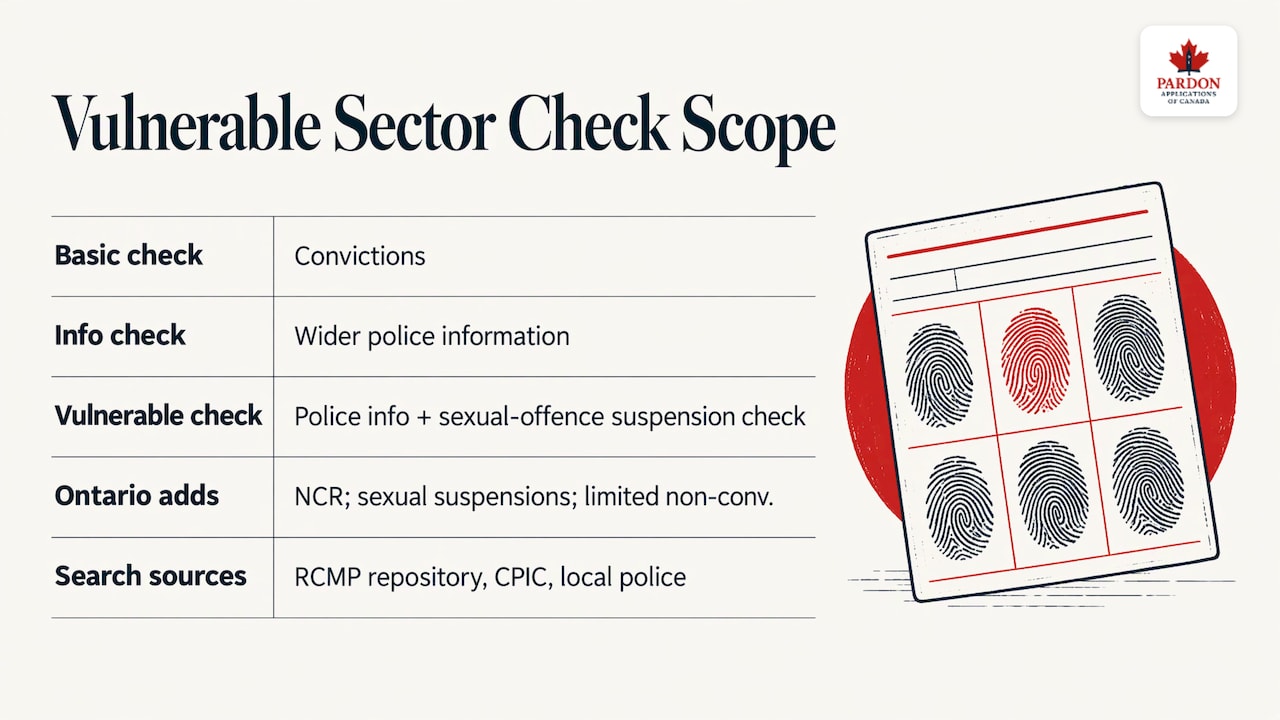
There are three common levels of police record check in Canada. A basic criminal record check looks at convictions. A police information check goes wider. A vulnerable sector check goes furthest.
The RCMP describes a vulnerable sector check as a police information check plus a check to see if a person has a record suspension for sexual offences. That feature was created in 2000 and is governed by section 6.3 of the Criminal Records Act.
Ontario’s guidance adds detail. A vulnerable sector check includes the same information as a criminal record and judicial matters check, plus findings of not criminally responsible on account of mental disorder, record suspensions for sexually based offences, and, in narrow circumstances, non-conviction information. It must be completed by the local police service, not a third-party provider.
Public Safety Canada’s directive says the search covers the RCMP national repository of criminal records, including suspended files for sexually based offences, CPIC databanks, and records held by police services where you have lived. Identity verification is required, which is why fingerprints are sometimes requested.
What a Pardon changes on a vulnerable sector check
A record suspension does not erase your record. It sets it aside. The Parole Board explains that the suspension removes the record from the CPIC database, so a CPIC search shows no criminal record or record suspension. The same page explains the exception: the file is flagged in CPIC for former sexual offenders, so a vulnerable sector check can identify that the person was convicted of a sexual offence for which a record suspension was received.
In plain terms:
| Your situation | What a Pardon does on a vulnerable sector check |
|---|---|
| Conviction for an offence that is not a sexual offence | The record is removed from CPIC, so a search is designed to show no conviction or suspension |
| Conviction for a sexual offence | The suspension is flagged, and the check can show it, under the consent rules below |
| Charge that did not lead to a conviction | Not affected by a Pardon. Release is limited to exceptional circumstances under the police service’s own test |
The Parole Board itself presents the record suspension as a way of opening doors to job, educational and volunteer opportunities, while flagging the sexual offence exception as the key limit to understand. Knowing which side of that line you are on is the first step.
Non-conviction information is a separate question
A Pardon deals with convictions. Police may still release some non-conviction information on a vulnerable sector check, but only when a strict test is met. The Ontario Information and Privacy Commissioner’s fact sheet lists the conditions: listed offences, an alleged victim who was a child or vulnerable person, and a person reasonably believed to be a risk. Ottawa Police describe the same approach, releasing non-conviction information only when it meets their Exceptional Disclosure Assessment. Practices differ between police services and provinces, so ask the service that will run your check how it applies.
How disclosure works when a sexual offence was suspended
Disclosure is not automatic and it is not casual. Section 6.3 of the Criminal Records Act sets the rules. According to the Act:
- Police can verify the notation only when the position is one of trust or authority towards a child or vulnerable person.
- You must have consented in writing to the check.
- Police send the conviction record to the Minister of Public Safety, who may disclose all or part of it back.
- Police disclose it to the requesting organization only if you have consented in writing to that disclosure.
The RCMP confirms that ministerial approval is needed before releasing record suspension information, and that for vulnerable sector checks the RCMP sends results to the processing police agency, not to the applicant.
So a suspended sexual offence conviction is not freely visible to anyone. But if you are applying to coach, teach, or work with seniors or children, the check is designed to find it. A Pardon in that situation still matters, for example for travel, housing, and jobs outside the vulnerable sector. Just do not plan around it disappearing from this one type of check.
Who can request a vulnerable sector check
You cannot order one for yourself out of curiosity, and an employer cannot request one for just any job.
The RCMP says the hiring organization must request the check, and you provide consent. You will need to supply a position description, the organization’s name, details about the children or vulnerable persons involved and, for volunteers, a letter confirming that the role is unpaid. Fingerprints may be required. The position must be one of trust or authority, and it is an offence to run the check if the position does not meet the Act’s requirements.
The Canadian Civil Liberties Association gives the same legal test: the request must come from a person or organization responsible for the well-being of a child or vulnerable person, for a specific paid or volunteer position, with the applicant’s written consent. Its recommended practice is that results go to the applicant first, so you can review them before the employer sees them. Not every service works this way, so ask before you consent.
If an employer asks for a vulnerable sector check for a role with no real contact with vulnerable people, ask them to confirm in writing why the position qualifies. That is your right as an applicant, and it protects you from a check being run that should not be.
Fees and timelines for the check itself
The check has its own costs, separate from a Pardon. The RCMP lists a federal processing fee of $25 per fingerprint-based check, waived for volunteer work in Canada, plus a local fee set by the police service or fingerprinting agency. Processing takes 3 business days or less when there is no match to a criminal record. If manual processing or a possible match is involved, it can take up to 120 business days, with results mailed to the address you provided.

That range matters. If a job or volunteer start date depends on the check, ask for it early and do not leave it to the last week.
Do you need a Pardon before a vulnerable sector check?
If you have a conviction and the role you want sits in the vulnerable sector, a Pardon is often the step that decides whether the check comes back clean. For non-sexual offences it is designed to make that happen. For sexual offences it will not remove the flag, but it can still change other parts of your life. That is why an eligibility assessment comes before everything else.
Check whether you even need to apply
Some records are removed automatically. Steps to Justice explains that you do not need to apply for a record suspension for an absolute or conditional discharge or a youth conviction. A conditional discharge is removed three years after the finding of guilt, and an absolute discharge after one year. Knowing which category you are in can save you months of effort.
Understand the waiting period
For offences on or after March 13, 2012, the Parole Board’s rule is 10 years for an offence prosecuted by indictment and 5 years for a summary conviction. The clock starts only after every sentence is complete: fines, surcharges, costs, restitution, imprisonment, parole and probation. If the method of trial cannot be confirmed, the longest period applies.
Unpaid fines are a common trap. CBC reported that even small unpaid fines of $15 or less can stop the waiting clock. Our guide to the record suspension waiting period walks through how to count it.
Gather your documents
A complete application depends on accurate court and police records. Our record suspension process checklist covers the eight documents to check, and our article on starting before you are eligible explains what you can prepare in the meantime.
What a Pardon really costs
The Parole Board’s filing fee is $50. CBC reported that the federal government cut it from $650 to $50 in 2022. That is a real improvement, and we explain it in our note on the reduced filing fee.
But $50 is only the Board’s filing fee, not the cost of the application. There are many other costs in the process: police record checks, fingerprinting, court documents from each jurisdiction where you were convicted, outstanding fines that must be paid first, and the time it takes to put it all together correctly. An incomplete file is returned or delayed, and that is where the time and money usually go.
Our cost breakdown sets out what we charge and how it compares with the full list of costs. Our Pardon Only plan is $80 per month.
Why a Pardon application is worth doing properly
When the vulnerable sector check is the reason you are applying, the details of your file matter more. You need to know the exact offences on your record, which sentences are complete and whether any file involves a sexual offence. A mistake in any of these can cost you months.
A Pardon can also be revoked or cease to have effect. The Parole Board lists the reasons: a new indictable offence (or in some cases a summary offence), a finding that you are no longer of good conduct, a false or misleading statement in your application, or a finding that you were ineligible when it was ordered. The record is then added back to CPIC. Accuracy at the start protects the result for years afterwards.
How we help
Our accredited Pardon and Waiver officers give you a personal consultation to assess your eligibility, then prepare a complete and accurate application, so delays and denials are less likely. We also keep you informed through dedicated support channels while your application moves forward. No one can promise a result, because the Parole Board makes the decision, but a complete file gives you the best footing.
If your goal is a role working with children or vulnerable people, tell us at the consultation. We will look at your record with that goal in mind. Our consultation guide shows what to ask and bring.
Start with a free consultation on our Canadian Pardon application service and find out where you stand before you spend anything on the Parole Board’s filing fee.
Frequently asked questions
Will a Pardon hide my record from a vulnerable sector check?
For offences that are not sexual offences, a record suspension removes the record from CPIC, so a search is designed to show no conviction. For a sexual offence, the suspension is flagged and a vulnerable sector check can identify it, subject to the consent rules in section 6.3 of the Criminal Records Act.
Is a vulnerable sector check different from a criminal record check?
Yes. It includes everything in a police information check plus a search for record suspensions for sexual offences. It is also restricted to people applying for positions of trust or authority over children or vulnerable persons, and the organization must request it.
How long does a vulnerable sector check take?
The RCMP says 3 business days or less when there is no match to a criminal record, and up to 120 business days if manual processing or a possible match is involved. Local police services add their own steps and fees, so start early.
Does the $50 fee cover my whole Pardon application?
No. The $50 is the Parole Board’s filing fee. Other costs include record checks, fingerprinting, court documents and any fines that must be paid first. Our cost page lays out the full picture.
Do I have to apply if I received a discharge?
Usually not. Steps to Justice states that absolute and conditional discharges and youth convictions do not need a record suspension application. They are removed after set periods: one year for an absolute discharge and three years for a conditional discharge.
Sources
- Vulnerable sector checks, RCMP
- Police record checks, Government of Ontario
- Ministerial directive concerning the release of criminal records, Public Safety Canada
- What is a record suspension?, Parole Board of Canada
- Applying for a record suspension, Parole Board of Canada
- Who is eligible for a record suspension?, Parole Board of Canada
- Fact sheet, Information and Privacy Commissioner of Ontario
- Police record checks, Ottawa Police Service
- Criminal Records Act, section 6.3
- How your personal information is used, RCMP
- Police record checks and rights-respecting hiring, Canadian Civil Liberties Association
- Processing times and fees, RCMP
- How do I get a Pardon or a record suspension?, Steps to Justice
- Stigma of criminal record ‘is massive,’ CBC News
Recommended
- Criminal Record Discrimination by Employers and How a Pardon Can Help
- A Record Suspension/Pardon: Who Can Apply
- Do I Need a Pardon or Record Suspension for My Young Offender Convictions?
- When Pardoned (Record Suspended) Documents Are Released: Who Is Accountable?
This content brings together contributions from PAC, our content team, and AI tools, with PAC retaining editorial responsibility. It is shared for general information, not legal advice. Laws and procedures may change; seek qualified legal advice for your circumstances.