

A denied Pardon (the Parole Board of Canada’s official term is record suspension) is rarely the end of the road. Most applications that fail never get a real hearing on the merits: they are sent back because a document, a payment or a court record is missing. A formal refusal can be answered with written representations, and you can apply again one year after the refusal date. The sections below explain which situation you are in and how to build the next application so it holds up.
If you are reading this with a knot in your stomach, that is a normal reaction. A record can feel like a shadow that follows you into every job interview and every border lineup. The goal here is to give you a clear picture of what happened and a concrete way forward.
TL;DR
- “Denied” can mean two different things: your application was rejected at screening (returned, often for missing documents or payment), or the Board formally refused your record suspension after review.
- In 2024-2025, about 21% of applications received were rejected at screening, and 77% of those were for missing documents or payments, so a complete file matters most.
- If the Board proposes to refuse, you get written notice and the right to make representations. After a refusal, you must wait one year before reapplying.
- The $50 Parole Board of Canada filing fee is only one cost: records, court documents, fingerprints and preparation add up.
- Nobody can promise an outcome, but a careful, complete application removes the avoidable reasons for refusal.
Table of Contents
- First, work out what “denied” means in your case
- Why applications are returned at screening
- Why the Board refuses an application it has fully reviewed
- Waiting periods: the most common hidden mistake
- If the Board proposes to refuse: your right to respond
- After a refusal: when you can apply again
- What a denial costs, and why $50 is not the whole bill
- Why a complete, well-prepared file changes the odds
- Your next step, depending on where you stand
- When your record still shows up on checks
- If you also need to travel to the United States
- How Pardon Applications of Canada can help
- FAQ
- Sources
First, work out what “denied” means in your case
People use the word for three very different outcomes, and your next step depends on which one you got.
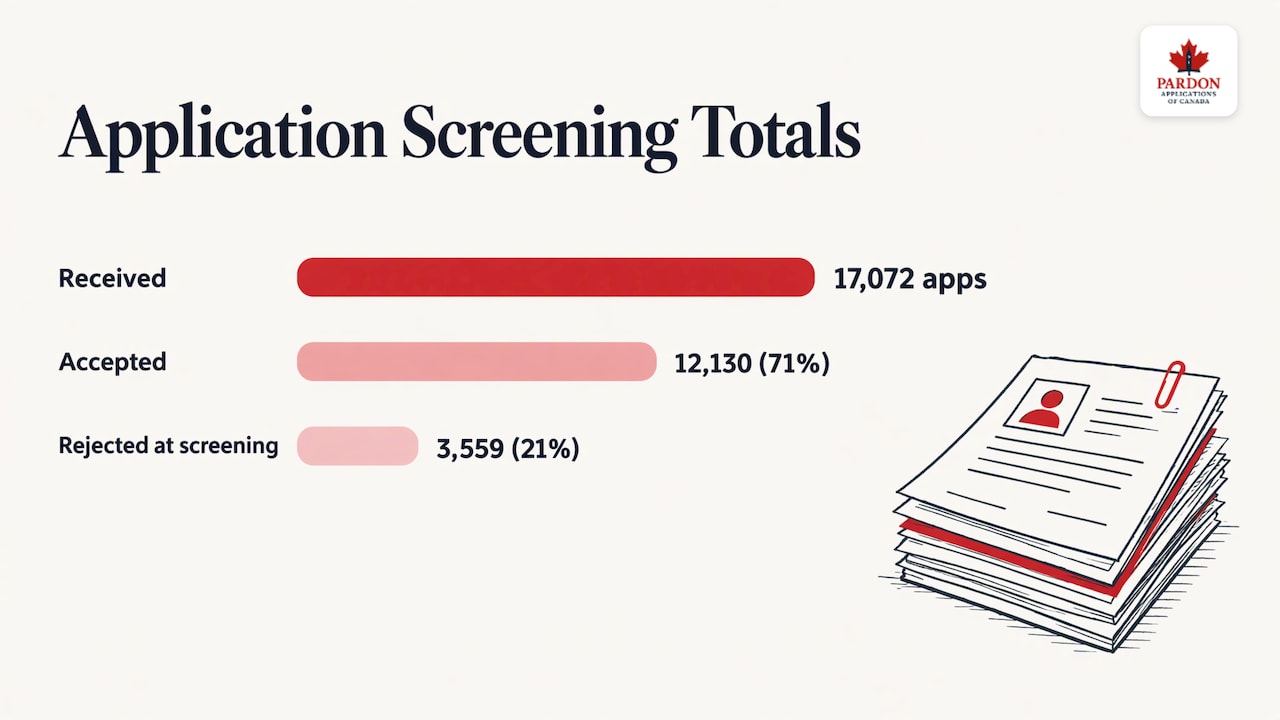
1. Your package was returned or rejected at screening. The Board checks every application for eligibility and completeness before it begins its review. In 2024-2025 the Board received 17,072 applications, accepted 12,130 (71%) as eligible and complete, and rejected 3,559 (21%) at screening. Of those screening rejections, 77% were for missing documents or payments, and 23% for ineligibility, lack of jurisdiction or a discontinued file. This is the most common kind of “denial” and the most fixable.
2. The Board sent you a notice that it proposes to refuse. This is not yet a final decision. You have the chance to respond.
3. The Board formally refused your record suspension. This is a final decision on that application, and a waiting period before you can try again.
Read the letter you received and match it to one of these. If it mentions missing items, fees or eligibility, you are in the first group. If it mentions a proposed refusal and invites you to respond, you are in the second.
Why applications are returned at screening
The screening stage is administrative, but it is strict. The Parole Board’s application instructions say a missing, incomplete or inaccurate fee can cause the application to be returned unprocessed. The fee is $50.00 CAD, paid by credit card using the fee form, or by certified cheque, money order or bank draft made out to the Receiver General for Canada. Personal cheques and cash are not accepted.
The usual causes of a returned file are:
- A payment problem: the wrong payment type, a missing fee form, or an amount that does not match.
- Missing court documents: a certified copy of the information or indictment, and proof of the sentence, for every conviction.
- Missing proof that sentences are complete: fines, surcharges, restitution, probation and any other part of the sentence must be finished before the waiting period starts.
- Applying too early: the waiting period had not yet run.
- Incomplete local police records or inaccurate details about an offence date or the way the case proceeded.
These are errors of paperwork and timing, not judgments about your character. That is good news, because they are within your control on the next attempt. Our own walkthrough of the record suspension process and the 8 documents to check lists what the file needs before it goes in.
Why the Board refuses an application it has fully reviewed
Once your file is accepted, the Board decides under the Criminal Records Act. For the stricter category of offences, the law is that the Board may order a record suspension if you meet the good-conduct and no-new-conviction conditions and, for offences under section 4(1)(a), you also show a measurable benefit, rehabilitation and that a suspension would not bring the administration of justice into disrepute. The burden of proving measurable benefit and rehabilitation sits with you.
In plain terms, the reviewer wants to see:
- Good conduct since your sentence ended, with no new convictions.
- Measurable benefit: a real, specific way your life would improve, such as a job that requires a clean check, a licence, volunteering or travel for work.
- Rehabilitation: evidence that you have moved on, such as steady work, education, family responsibilities and community involvement.
For context, of the applications decided under the current Act in 2024-2025, 2,333 record suspensions were ordered and 68 were refused. Of those refusals, 1 was under section 4(1)(a) and 67 under section 4(1)(b). The Board’s Departmental Results Report adds that of 305 record suspensions or Pardons refused or denied in 2024-25, only 2 needed a new review after a Federal Court order. These numbers describe the Board’s results in that year, not what will happen in your case, and no one can guarantee an outcome. They do show that careful files tend to succeed far more often than they fail.
Eligibility problems that cause outright ineligibility
Some people are not eligible at all, and it is better to know this early. Under section 4(2) of the Act, a person is ineligible if convicted of a Schedule 1 offence, or of more than three qualifying indictable offences that each carried a sentence of two years or more. A Schedule 1 applicant may still qualify if the Board is satisfied that:
- you were not in a position of trust or authority toward the victim, and the victim was not dependent on you;
- you did not use, threaten or attempt violence, intimidation or coercion; and
- you were less than five years older than the victim.
If your record includes a drug trafficking conviction, our guide to a Pardon after a drug trafficking conviction explains how that is treated.
Waiting periods: the most common hidden mistake
Many first applications fail because the applicant counted the waiting period from the wrong date. The Parole Board’s eligibility rules say the clock only starts once you have completed every part of your sentence: all fines, surcharges, costs, restitution and compensation orders, all imprisonment, conditional sentences, parole and statutory release, and any probation. Weapons or driving prohibitions do not have to expire first.
The length of the wait depends on the date of your first offence:
| First offence date | Indictable offence | Summary offence |
|---|---|---|
| Before June 29, 2010 | 5 years | 3 years |
| June 29, 2010 to March 12, 2012 | 10-, 5- or 3-year tiers | 10-, 5- or 3-year tiers |
| On or after March 13, 2012 | 10 years | 5 years |
Since March 19, 2020, the Board assesses eligibility under the rules in place when your first offence occurred, rather than applying the 2010 and 2012 changes retroactively. If the court cannot confirm whether your case proceeded as summary or indictable, the longer waiting period applies. That detail trips up many applicants with older records. If you are unsure about timing, see our page on starting the process before you are eligible.
If the Board proposes to refuse: your right to respond
The Criminal Records Act does not let the Board refuse you silently. When it proposes to refuse, it must give you written notice and let you make relevant representations, in writing or, with the Board’s authorization, orally. The Board must consider representations that arrive on time.
What strong representations usually contain:
- A direct answer to the concern in the notice. Read it closely and respond to the specific issue, not to everything.
- Evidence, not just statements. Letters from employers, proof of enrolment, volunteer confirmations, proof of a job offer or licence that depends on a suspended record.
- A clear measurable benefit. If the notice questions it, name the exact job, licence, housing or travel need and what the record blocks.
- Proof of rehabilitation and stable conduct since the sentence ended.
- Respect for the deadline. Late material may not be considered.
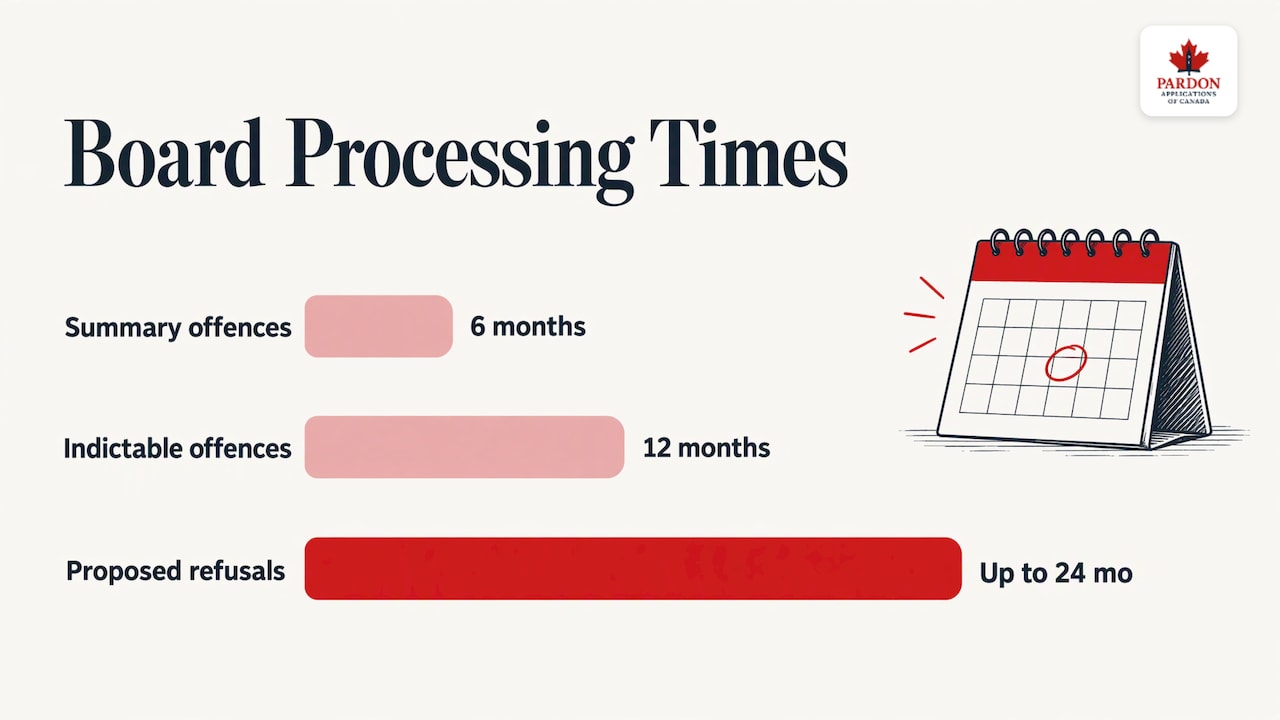
This stage is also where time passes. The Board’s service standards are 6 months from acceptance for summary offences and 12 months for indictable offences, and files where the Board proposes to refuse can take up to 24 months because of the written notice and representation period. Plan around that rather than waiting anxiously for a letter.
After a refusal: when you can apply again
After a refusal you may not reapply until one year has expired after the refusal date. Use that year as preparation time:
- Request the reasons or review the notice to understand what the Board focused on.
- Gather stronger evidence of your measurable benefit and rehabilitation.
- Confirm every sentence component is complete and documented.
- Order fresh court and police records so nothing is outdated.
- Keep a clean record. A new conviction can end the matter entirely.
Treat the second application as a different project from the first, because the first showed you where the file was thin. Our page on the timeline for a Pardon or record suspension helps you plan the stretch ahead.
What a denial costs, and why $50 is not the whole bill
The Parole Board’s filing fee is $50.00 CAD. It was introduced on January 1, 2022 and, according to the Board’s report, is not subject to CPI increases. Keep two points in mind:
- A returned or refused application means you usually pay that fee again when you reapply.
- The filing fee is only one line. There are many other costs in the process: local police record checks, fingerprinting, certified court documents, courier or mail costs, and the time spent chasing records from several courts and agencies. Those costs repeat when a file has to be rebuilt.
That is why getting the file right the first time matters financially as well as emotionally. Our page on saving money during the Pardon application process breaks down where the costs fall.
Why a complete, well-prepared file changes the odds
The numbers above point to one conclusion. Of the applications rejected at screening, most failed on missing documents or payments. These are not mysteries of the law; they are checklists. A Pardon application is a long list of items from different courts, police services and agencies, each with its own format and timeline, and a single gap can send the whole package back and cost you months.
At Pardon Applications of Canada, you work with accredited Pardon and Waiver officers through a personalized consultation that starts with your eligibility. The aim is a complete and accurate application, which is designed to reduce the chances of delays or denials. We also keep dedicated support channels open so you know where your file stands. We cannot guarantee a result, because the decision belongs to the Parole Board, but we can help make sure that nothing avoidable stands in your way.
If you want the full picture of how a file is assembled, read how the PAC record suspension process works, step by step.
Your next step, depending on where you stand
Returned at screening. Identify the missing item from the letter, gather it, and resubmit with the correct payment. Check that your waiting period has actually finished.
Notice of proposed refusal. Start your written representations now. Collect evidence of measurable benefit and rehabilitation, and respond to the specific concern raised.
Formal refusal. Note the date, count one year forward, and use the time to rebuild the file. Do not apply earlier, because the Act does not allow it.
Ineligible under the Act. Learn exactly which provision applies. Cannabis possession cases are a special route: under Bill C-93, a person convicted only of simple possession of cannabis for offences before October 17, 2018 may apply without the usual waiting period or fee.
When your record still shows up on checks
A record suspension sets your record aside; it does not erase it, and it does not guarantee entry or a visa in another country. It can also be revoked if you are convicted of a new offence, found to be no longer of good conduct, found to have made false or misleading statements, or found to have been ineligible when it was ordered. These points come from the Board’s own guidance on record suspensions. Sexual offences also continue to be flagged in vulnerable sector checks.
Separately, background reports can contain mistakes of their own. A survey on background checks and credit reports looks at how errors in consumer reports affect people, which is worth reading if an employer or landlord report seems wrong.
If you also need to travel to the United States
A Canadian record suspension and a U.S. Entry Waiver (Form I-192) are separate things. A Pardon does not by itself guarantee entry to the United States, and many people need both. We explain how they fit together in Pardon or Waiver: many people need both. If a waiver has been refused, our page on what an I-192 denial means and your next steps covers the options, and we also prepare I-192 renewals.
How Pardon Applications of Canada can help
If your application was returned or refused and you want to approach the next one with a prepared file, our team can assess your eligibility, assemble the documents and support you through each stage. Our Pardon Only plan is $80 per month, and the details are on our Pardon costs page.

You can also see everything we do on our services page, or start from our home page and speak with an accredited officer about your situation.
FAQ
Can I appeal a denied Pardon in Canada?
If the Board proposes to refuse, you have the right to make representations before the decision, in writing or orally with the Board’s authorization. After a formal refusal, the route is a new application once one year has passed. Questions about a court review of the Board’s decision should go to a lawyer.
Do I get my $50 fee back if I am denied?
The fee is not refunded when the Board refuses an application. Your next application also requires a new fee. Remember that $50 is only the Parole Board’s filing fee, and many other costs come with gathering records and preparing the file.
How long must I wait before reapplying after a refusal?
You cannot reapply until one year has expired after the refusal date. Use that time to strengthen your evidence of rehabilitation and measurable benefit, and to confirm that every document is current and complete.
Does a co-accused’s refusal affect my application?
No. The Board looks at each applicant’s own record, conduct and circumstances, so another person’s outcome does not decide yours.
Can I still travel to the U.S. if my Pardon was denied?
A Canadian Pardon does not itself guarantee entry to the United States. People with a record who are found inadmissible may need a U.S. Entry Waiver (I-192), which is a separate application with its own process.
Sources
- Criminal Records Act, full text
- Criminal Records Act, full text with representations and reapplication provisions
- Criminal Records Act, section 4
- Record Suspension Program 2024-2025 Report to Parliament
- 2024-25 Departmental Results Report, Parole Board of Canada
- Applying for a record suspension, Canada.ca
- Who is eligible for a record suspension, Canada.ca
- Determining your eligibility for a record suspension, Canada.ca
- Record suspension service standards, Canada.ca
- Bill C-93, Royal Assent text, Parliament of Canada
- Applying for a Record Suspension, Parole Board of Canada publication
Recommended
- How to Get a Pardon in Canada
- The Legal Process Behind a Pardon Application in Canada
- How to Get a Canadian Pardon After You Have Been Deported
- Can Pardons Be Revoked in Canada?
This content brings together contributions from PAC, our content team, and AI tools, with PAC retaining editorial responsibility. It is shared for general information, not legal advice. Laws and procedures may change; seek qualified legal advice for your circumstances.