

If your conviction was for a hybrid offence, your Pardon (record suspension) waiting period is 5 years if the Crown prosecuted it summarily and 10 years if it prosecuted by indictment. The clock starts only when every part of your sentence is finished, including probation and fines. The hard part is usually proving which route the Crown took, because when the court cannot confirm it, the longer period applies. Our accredited Pardon officers at Pardon Applications of Canada (PAC) can assess your file and tell you where you stand.
TL;DR
- A hybrid offence is one the Crown can prosecute either summarily or by indictment. That choice (the Crown election) sets your Pardon waiting period: 5 years or 10 years after your sentence ends.
- The wait begins when your sentence expires, not on the day of the offence or the day you were sentenced. Jail, probation and fine payment all count.
- If your records cannot show how the Crown proceeded, the Parole Board of Canada (PBC) applies the longer period.
- The waiting period is not the same as the time limit for laying a charge. They are two separate rules.
- The PBC’s filing fee is $50, but a complete application involves many other costs, such as record gathering, fingerprints and court documents.
Table of Contents
- What a hybrid offence is, and why it matters for your Pardon
- The two waiting periods
- When the clock actually starts
- Proving how the Crown proceeded
- A waiting period is not a time limit for charging
- What a Pardon does and does not change
- Travelling to the United States with a hybrid conviction
- What a Pardon really costs
- Starting before you are eligible
- Get a clear answer on your own date
- FAQ
- Sources
What a hybrid offence is, and why it matters for your Pardon
Canadian criminal law sorts offences into summary (less serious) and indictable (more serious). A hybrid offence sits between the two. According to the Department of Justice, the prosecutor may choose to proceed either summarily or by indictment, based on things like how serious the conduct was and the harm caused.
That decision is called the Crown election. British Columbia’s justice ministry explains that the election determines the maximum penalty: summary offences usually carry up to six months in jail or a $5,000 fine, while indictable offences can carry much more.
Most people never think about it at the time. Many common charges, such as theft, mischief and assault, are hybrid, and the John Howard Society of Manitoba notes that the vast majority of charges in Canada fall into this group. Years later, that early decision is the number that decides how long you wait.
The two waiting periods
The Criminal Records Act sets the rule. Under section 4(1), you cannot apply until:
- 5 years have passed after your sentence expired, for an offence punishable on summary conviction; or
- 10 years have passed after your sentence expired, for an offence prosecuted by indictment.
The Parole Board’s eligibility page gives the same 5 and 10 years for offences committed on or after March 13, 2012. Earlier offences fall under older tables, and the page lists separate periods for offences before June 29, 2010 and for those between June 29, 2010 and March 12, 2012. The date of your first offence, not the date of sentencing, decides which table applies.
| Crown election | Typical result | Waiting period (offence on or after March 13, 2012) |
|---|---|---|
| Summary | Lighter maximum penalty, provincial court | 5 years after sentence ends |
| Indictable | Higher maximum penalty, more serious procedure | 10 years after sentence ends |
| Cannot be confirmed from records | Unknown | The longest applicable period |
If you have several convictions, the rules on multiple offences and on certain listed offences also apply. Section 4 of the Act makes some people ineligible, such as those with more than three indictable offences each carrying a sentence of two years or more. A person convicted of a Schedule 1 offence (a list of sexual offences in the Act) is ineligible, unless the Board is satisfied that the person was not in a position of trust or authority towards the victim, did not use or threaten violence, intimidation or coercion, and was less than five years older than the victim. These are fact-heavy questions, and a personalized eligibility review is the sensible way to settle them.
When the clock actually starts
People often count from the wrong day. The wait runs from the expiry of your entire sentence. Section 4 of the Criminal Records Act counts any imprisonment, probation and payment of a fine. A few examples:
- You received a $1,000 fine in March 2019 but paid the last instalment in June 2021. The clock starts in June 2021.
- You served 30 days in custody, then were put on 12 months of probation. The clock starts when probation ends.
- You were fined, but a restitution order or a fine remains unpaid. The sentence has not expired, so the wait has not begun.
This is why a conviction from, say, 2014 may not be eligible when you expect. For a closer look at how a late start plays out, see our guide on why the 5 or 10 year clock starts late in Ontario, and our page on the record suspension waiting period.
A worked example
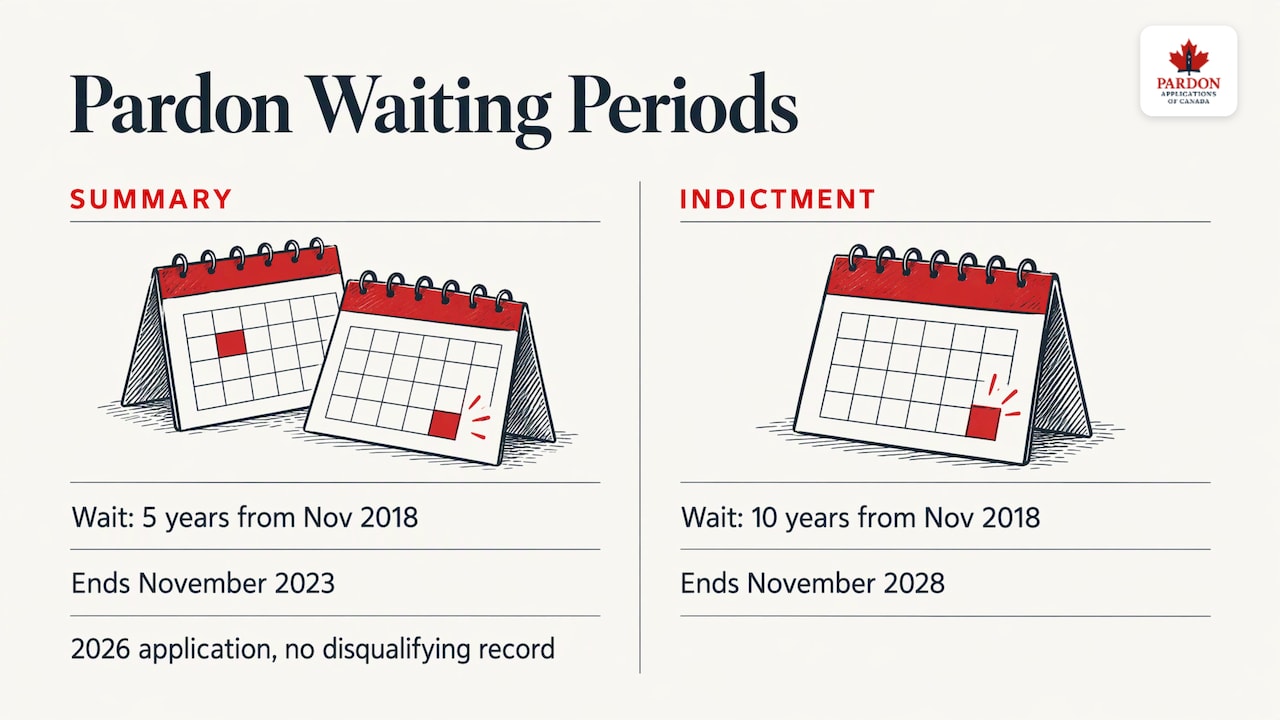
Imagine a theft charge from 2017. The Crown proceeded summarily, and you received a fine and 12 months of probation that ended in November 2018. Your 5 years ran to November 2023, so you could apply in 2026 as long as you hold no other disqualifying record. Now imagine the same offence prosecuted by indictment. The wait would be 10 years, which ends in November 2028. Same act, same sentence, five years apart. That is the real weight of the Crown election.
Proving how the Crown proceeded
The PBC’s rule is that if the court cannot confirm the method of trial, the longest applicable period applies. So a missing or unclear court record can quietly turn 5 years into 10.
The documents that usually settle it are the information or charging document, the court record of the conviction and the sentence, and proof of completion of every part of the sentence. Court records can be old, archived or hard to find, and each province keeps them differently. This is a stage where a complete, accurate file matters. Our officers help you work out which documents prove the election and your sentence completion, so the application reaches the Board without avoidable gaps. Our record suspension process guide lists eight documents worth checking before you file.
A waiting period is not a time limit for charging
Searching this topic often turns up another rule that sounds similar: the limitation period. Section 786(2) of the Criminal Code says proceedings for summary offences must generally start within 12 months. Dhindsa Law explains that this applies to hybrid offences only where the Crown elects to proceed summarily, and that indictable offences generally have no limitation period. The BC Legal Services Society manual says the same, with the exception of treason.
That rule governs whether you can be charged. It has nothing to do with the Pardon waiting period, which only starts after you have been convicted and finished your sentence. If you are asking when you can apply, the 5 or 10 year rule is the one that matters.
What a Pardon does and does not change
Once a record suspension is granted, your convictions are removed from the CPIC database (the police database used for most record checks) and cannot be disclosed without ministerial permission. For many people that means fewer barriers to jobs, volunteering and housing, the end of the shadow of a past conviction.
Some limits matter for safe planning:
- A suspension has no effect on driving or weapons prohibition orders.
- It can cease to have effect if you are later convicted of an indictable or hybrid offence, according to the same manual.
- Federal law binds only federal departments, so provincial and municipal bodies handle their own records, though many restrict access once notified.
No one can promise the Board’s decision. What a careful, complete application can do is give the Board everything it needs to consider your case.
Travelling to the United States with a hybrid conviction
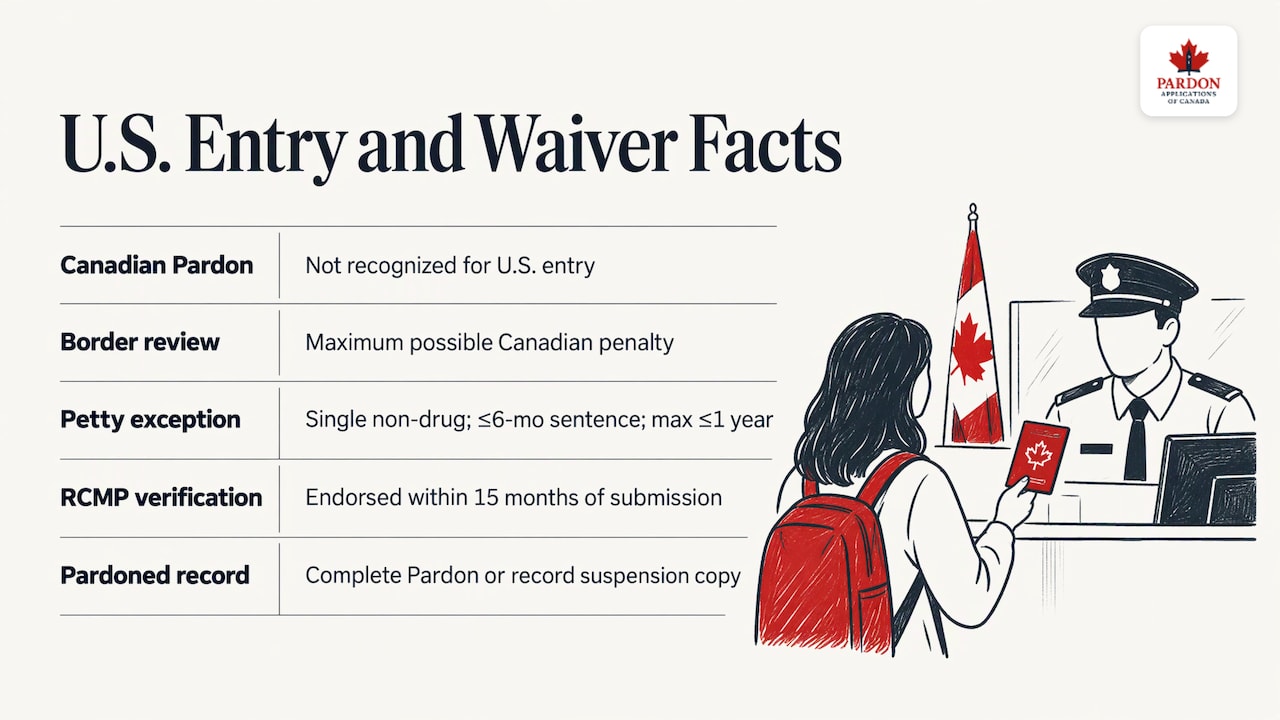
If you want to cross the U.S. border, a Canadian Pardon does not settle the question. Courthouse Libraries BC states that a Canadian Pardon is not recognized for U.S. entry purposes and that a past record must be declared.
The Crown election matters less here than people expect. LegalClarity notes that U.S. officials look at the maximum possible penalty under Canadian law rather than the sentence you received, so a summary conviction with a small fine can still cause trouble. Whether an offence involves moral turpitude depends on the nature of the offence, not the Crown’s election.
The U.S. petty offence exception can apply in narrow cases. According to a Toronto criminal lawyer’s explanation, it needs a single conviction, not drug-related, with a sentence of no more than six months and an offence whose maximum was not over one year. Whether you qualify is a question for U.S. authorities and a qualified lawyer.
When a waiver is needed, you apply with Form I-192. The U.S. CBP e-SAFE portal says Canadians must submit an RCMP record verification endorsed within 15 months of submission, and for a pardoned record, a complete copy of the Pardon or record suspension. PAC prepares U.S. Entry Waiver (I-192) applications and I-192 renewals. See our guides on why you might need a U.S. waiver and I-192 processing times.
What a Pardon really costs
The PBC’s application processing fee is $50. That is the Board’s filing fee only, not the cost of the whole application. Around it sit many other costs: fingerprinting, police record checks, court documents, local police and RCMP records, postage and your time chasing records from several offices. A hybrid conviction adds more work, because the Crown election and sentence completion must be documented.
PAC’s Pardon Only plan is $80 per month, and you can see how our fees work on the costs page. For the Board’s fee history, read our note on the filing fee increase.
Starting before you are eligible
You cannot file with the Board until the waiting period ends, but you do not have to wait to get ready. Knowing your exact date, collecting records and clearing up unpaid fines can save months. Our guide explains what you can do before you are eligible, and the timeline for a Pardon shows what to expect after filing.
Offences with special rules, such as DUI or drug trafficking, have their own detail worth reading.
Get a clear answer on your own date
A hybrid offence turns a simple question into a document question: how did the Crown proceed, and when did your sentence truly end? At PAC, you work with accredited Pardon and waiver officers who review your eligibility and prepare a complete, accurate application, with dedicated support channels to keep you informed. Our approach is built to reduce delays and avoidable denials, though we cannot promise any outcome.

Start with a free consultation and a clear picture of your eligibility date at Pardon Applications of Canada, or see the Pardon Only plan.
FAQ
Is the waiting period 5 or 10 years for a hybrid offence?
It depends on how the Crown proceeded. Five years applies to a summary prosecution and 10 years to an indictable one, counted from the end of your sentence. If your records cannot confirm the route, the PBC applies the longer period.
Does the waiting period start on the day of the offence or the conviction?
No. It starts when your whole sentence expires, including jail, probation and payment of fines. For offences before March 13, 2012, the date of the first offence decides which table applies.
Is the limitation period for charging the same as the Pardon waiting period?
No. The 12 month limit in section 786(2) of the Criminal Code concerns when summary proceedings can begin. The Pardon wait is a later, separate rule that runs after sentence completion.
Does a Canadian Pardon let me enter the United States?
Not on its own. A Canadian Pardon is not recognized for U.S. entry, and you may need a U.S. Entry Waiver (I-192). Contact U.S. authorities or a qualified lawyer on your specific situation, and PAC can prepare the waiver application.
Sources
- Criminal Records Act, section 4
- Who is eligible for a record suspension? Parole Board of Canada
- Applying for a record suspension, Parole Board of Canada
- Criminal offences, Department of Justice Canada
- Record Suspensions in Manitoba, John Howard Society of Manitoba
- Summary, Indictable and Hybrid Offences in Canada, Dhindsa Law
- Chapter One: Criminal Law, LSLAP manual 2025
- 2021 Criminal Law & Procedure, Community Legal Education Association
- Record Suspensions (Pardons), Courthouse Libraries BC
- e-SAFE, U.S. Customs and Border Protection
- A Criminal Record May Mean Travel Restrictions, Anthony De Marco
- Hybrid Offence in Canada: Crown Election and Consequences, LegalClarity
Recommended
- Pardon (Record Suspension) Waiting Period in Canada: 5 or 10 Years
- Applying for a Canadian Pardon? 3 Recent Changes You Should Know
- The Legal Process Behind a Pardon Application in Canada
- Timeline For Pardon Or Record Suspension In Canada
This content brings together contributions from PAC, our content team, and AI tools, with PAC retaining editorial responsibility. It is shared for general information, not legal advice. Laws and procedures may change; seek qualified legal advice for your circumstances.