

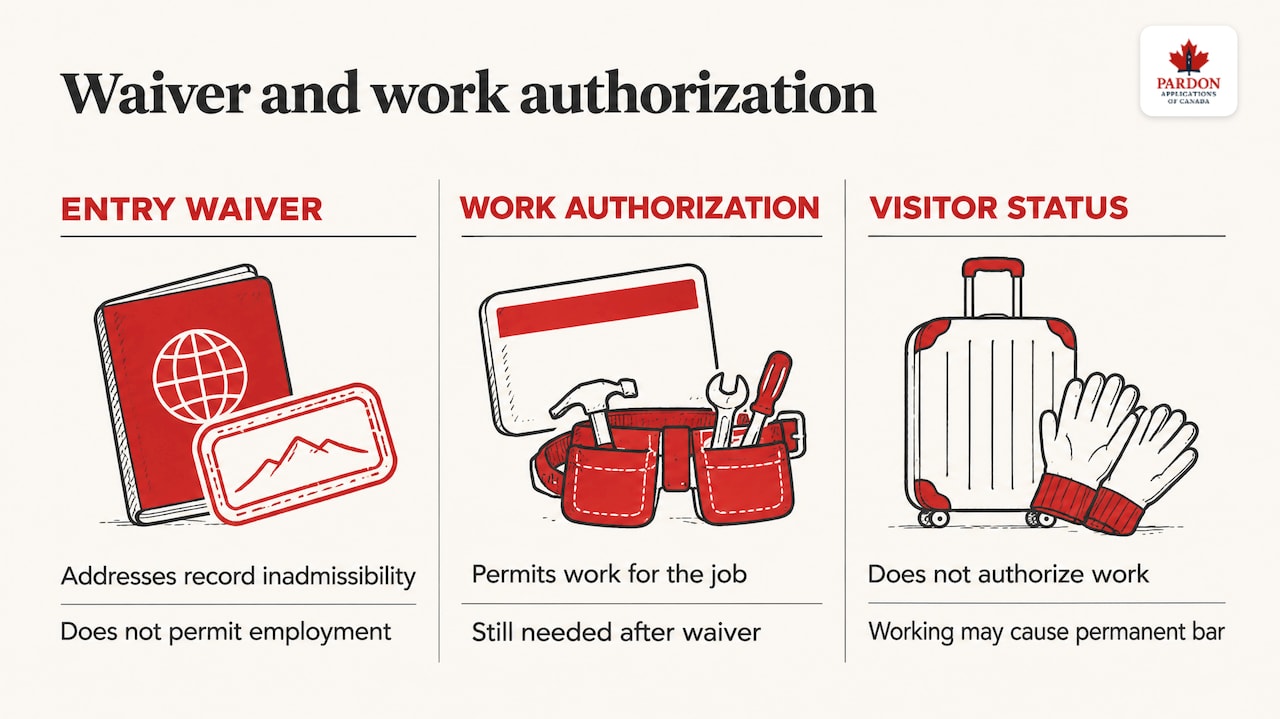
A U.S. Entry Waiver (Form I-192) does not give you permission to work in the United States. What it does is remove the inadmissibility that a criminal record creates, so that a U.S. work authorization you qualify for can actually be used at the border. If you have a record and a job or contract south of the border, you usually need both pieces, and the waiver is the slower one. At Pardon Applications of Canada, we prepare the I-192 with our accredited officers, so the application is complete before it goes to U.S. Customs and Border Protection (CBP).
TL;DR
- A U.S. Entry Waiver lets CBP admit you despite a record. It is not a work permit, and you still need the right U.S. work authorization.
- A Canadian Pardon (record suspension) is not recognized under U.S. law for entry purposes, so a Pardon alone will not clear the border.
- Canadian citizens file the I-192 directly with CBP through the e-SAFE portal, and CBP states that applications are averaging 9 to 12 months.
- Do not plan to work in the U.S. without telling the border officer. Doing so can lead to a permanent bar.
- Start early: the waiver takes months, so it belongs at the beginning of your job plan, not at the end.
Table of Contents
- Why a waiver and a work permit are two different things
- Does your record make you inadmissible?
- How Canadians apply for the waiver
- Working in the U.S. as a Canadian: the other half
- What happens to your Canadian Pardon plans
- How we help with your waiver
- Questions we hear
- Sources
Why a waiver and a work permit are two different things
Most Canadians never think about U.S. paperwork. As a Canadian citizen, you generally do not need a visa to visit the U.S. The U.S. Department of State lists only a few visa categories (such as E-1, E-2, E-3D, K, S, A, G and NATO) where Canadians do need one.
That ease disappears when a record enters the picture. A conviction can make you “inadmissible”, which is the legal term for a person a border officer is not allowed to let in. A waiver is the U.S. government’s way of saying: we know about your record, and we will let you in for a temporary purpose anyway.
Work is a different question. Visiting the U.S. and working there are treated differently, and the U.S. Embassy in Canada warns that a person who intends to work in the U.S. and does not tell the CBP officer in advance may be permanently barred. So think of it as two keys for one door:
- The work authorization (for example, the status your employer or your profession qualifies you for) says what you may do in the U.S.
- The waiver says that you, personally, may be admitted despite your record.
Having one without the other leaves you stuck. A job offer does not override an inadmissibility finding, and a waiver does not turn a visit into employment.
Does your record make you inadmissible?
This is the question most people want answered first, and it is the one worth answering before you accept any job that involves crossing the border.
CBP officers can see Canadian criminal record information. The Government of Canada’s travel advice for the United States states plainly that a Canadian Pardon is not recognized under U.S. law for entry. That surprises many people, because a record suspension in Canada sets the record apart from the general database. It does not change how a U.S. officer assesses the underlying conviction. We explain the reasoning in more detail in why a Canadian Pardon won’t get you into the United States.
Some points to keep in mind:
- Age of the conviction does not erase it. A minor or decades-old offence can still be found at a land crossing or an airport preclearance area.
- Impaired driving is the common case. Many Canadians with a single DUI are surprised to find themselves inadmissible. Our page on travelling to the U.S. with a DUI covers it.
- Outstanding charges matter too, not only convictions.
- Whether you are actually inadmissible depends on the offence, the statute and the sentence. A short consultation to assess this is better than guessing at the border.
If you are unsure, our consultation includes an eligibility assessment by an accredited officer, so you know where you stand before you commit to a job that depends on crossing.
How Canadians apply for the waiver
Canadian citizens do not go through a U.S. consulate for this. According to CBP’s e-SAFE portal, Canadians file the I-192 with CBP online. The form’s official instructions describe it as the application for advance permission for a person who is inadmissible to enter temporarily as a nonimmigrant. A separate rule applies if you need a visa: in that case the same instructions send you to the U.S. Embassy or Consulate instead of filing an I-192.
Here is the routine, and where it tends to go wrong.
Step 1: Confirm what you are applying for
Write down exactly why you will enter the U.S.: the employer, the type of work, how often, for how long. The waiver is granted for a temporary purpose, and what you say must match what you later tell the officer at the border.
Where it goes wrong: Describing the purpose vaguely, or as “visiting” when the real plan is employment. Our officers help you set out the purpose accurately so the application and your border conversations tell the same story.
Step 2: Collect every conviction record
The form’s instructions require a signed statement listing each crime, the statute, the dates, the court and the sentence. You must also supply official records of every conviction, in English or with a certified translation.
Where it goes wrong: Court documents from different provinces, old files that are hard to track down, and gaps in the list. A missing conviction is the kind of error that causes delays or a refusal. Completing this documentation is part of what we do for clients.
Step 3: Get the RCMP criminal record verification
The e-SAFE portal states that Canadians must submit an RCMP criminal record verification that was endorsed within 15 months of the day you submit, along with a complete copy of any Pardon or record suspension. The instructions say this record is obtained through fingerprints.
Where it goes wrong: Timing. If the RCMP document is older than 15 months by the time you file, it will not do. A check obtained too early, in a long application, can expire before you press submit.
Step 4: Complete the I-192 and submit
The form must be filled accurately and consistently with your supporting documents. The fee is set by the U.S. government and changes from time to time, so check the current fee on the official Form I-192 instructions before you file.
Where it goes wrong: Inconsistencies between the form, the statement and the court records. Our process covers a full review of the package before it is submitted. You can see our step-by-step U.S. Entry Waiver process for how it works in practice.
Step 5: Wait for CBP’s decision
CBP’s portal states that applications are being processed in an average of 9 to 12 months. We lay out how much of that is preparation and how much is waiting on our page about I-192 processing time for Canadians. CBP’s Admissibility Review Office makes the decision.
Where it goes wrong: Starting too late. A job start date in three months and a waiver that takes most of a year do not fit together. If your timeline is tight, we offer priority processing for $95 to $150 as a one-off, described on our U.S. waiver costs page.
Step 6: Keep the approval and plan the renewal
A waiver is temporary. Approved waivers carry an expiry date, and you need to renew before it passes if you still need to cross for work. We handle this through our I-192 Renewal service.
Working in the U.S. as a Canadian: the other half
The work authorization depends on your job, your employer and your profession. As a general rule, Canadians are visa-exempt for ordinary visits but not for working, and the Department of State lists the categories that require a visa. Your employer or a U.S. immigration process will define which route applies to you.
What matters for you is the sequencing:
- Understand your inadmissibility situation first.
- Start the waiver as soon as you know the job is real.
- Complete the work authorization steps in parallel.
- Declare your purpose honestly to the border officer when you cross.
The waiver gives you the ability to be admitted. Telling the officer the truth about your work protects it.
What happens to your Canadian Pardon plans
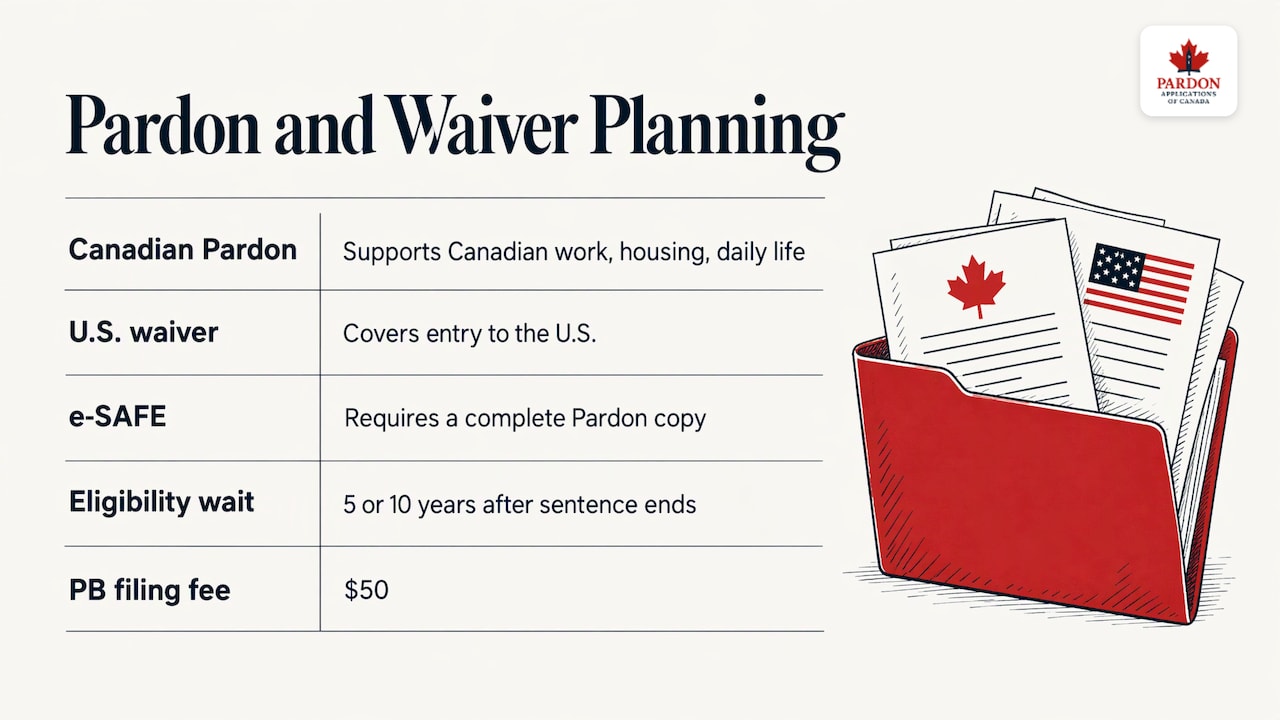
Many people ask whether they should get the Canadian Pardon first or the waiver first. The two do different jobs. A Pardon (record suspension) from the Parole Board of Canada helps with Canadian employment, housing and daily life, and the waiver covers entry to the U.S. Many people need both, which is the subject of our guide on whether you need a Pardon or a waiver.
The e-SAFE portal asks for a complete copy of any Pardon or record suspension you hold when you apply, so the two processes also connect on paper.
If you are not yet eligible for a Pardon, the waiting period is five or ten years depending on the offence, after your sentence is complete. We also explain whether you can start the application before you are eligible.
A note on cost, so there are no surprises: the Parole Board of Canada’s filing fee is $50, but that is only one piece. Fingerprints, court and police record searches, and the preparation of the documents add costs. Our Pardon cost page sets out how our Pardon Only plan works, at $80 per month.
How we help with your waiver
The waiver is where people with a work opportunity feel the pressure most: the process is long, and the paperwork is unforgiving. Our service is built around that. You speak with an accredited Pardon and Waiver officer who assesses your eligibility, prepares complete and accurate documentation, and keeps you informed through dedicated support channels. We have been doing this for over 55 years, and our approach is designed to reduce delays and denials, although no one can promise how CBP will decide any individual case.

If you have a job, a contract or a career move that depends on crossing the border, start with a consultation about your U.S. Entry Waiver. If your waiver is approaching its expiry, the renewal service picks up where your first approval ends.
Questions we hear
Can a Canadian work in the U.S. with just an entry waiver?
No. The waiver addresses inadmissibility because of your record. You still need the proper U.S. work authorization for the job you will do. Entering as a visitor and then working is the situation the U.S. Embassy warns can lead to a permanent bar.
Does my Canadian Pardon let me work in the U.S.?
No. The Government of Canada’s travel advice states that a Canadian Pardon is not recognized under U.S. law for entry. If your record makes you inadmissible, you need a U.S. Entry Waiver to be admitted, along with the right work authorization.
How long does a waiver take?
CBP’s e-SAFE portal states an average processing time of 9 to 12 months. Preparation on your side comes before that, because your records and RCMP verification have to be collected first. Plan your job timeline around the full period, not just the form.
What if my waiver is denied?
A refusal is not necessarily the end of the road. The reason for the decision shapes what comes next, and our page on what an I-192 denial means explains the options.
Sources
- Government of Canada: United States travel advice
- U.S. Embassy in Canada: Canadians requiring visas
- U.S. Department of State: Citizens of Canada and Bermuda
- CBP e-SAFE portal
- USCIS: Form I-192 instructions
Recommended
- Why a Canadian Pardon (Record Suspension) Won’t Get You Into the United States
- Why a US Waiver Is Needed for Some Travelers to Enter the United States
- CIMT and U.S. Entry: What Canadians Need to Know
- Shoplifting and U.S. Entry: What Canadians Need to Know
This content brings together contributions from PAC, our content team, and AI tools, with PAC retaining editorial responsibility. It is shared for general information, not legal advice. Laws and procedures may change; seek qualified legal advice for your circumstances.