
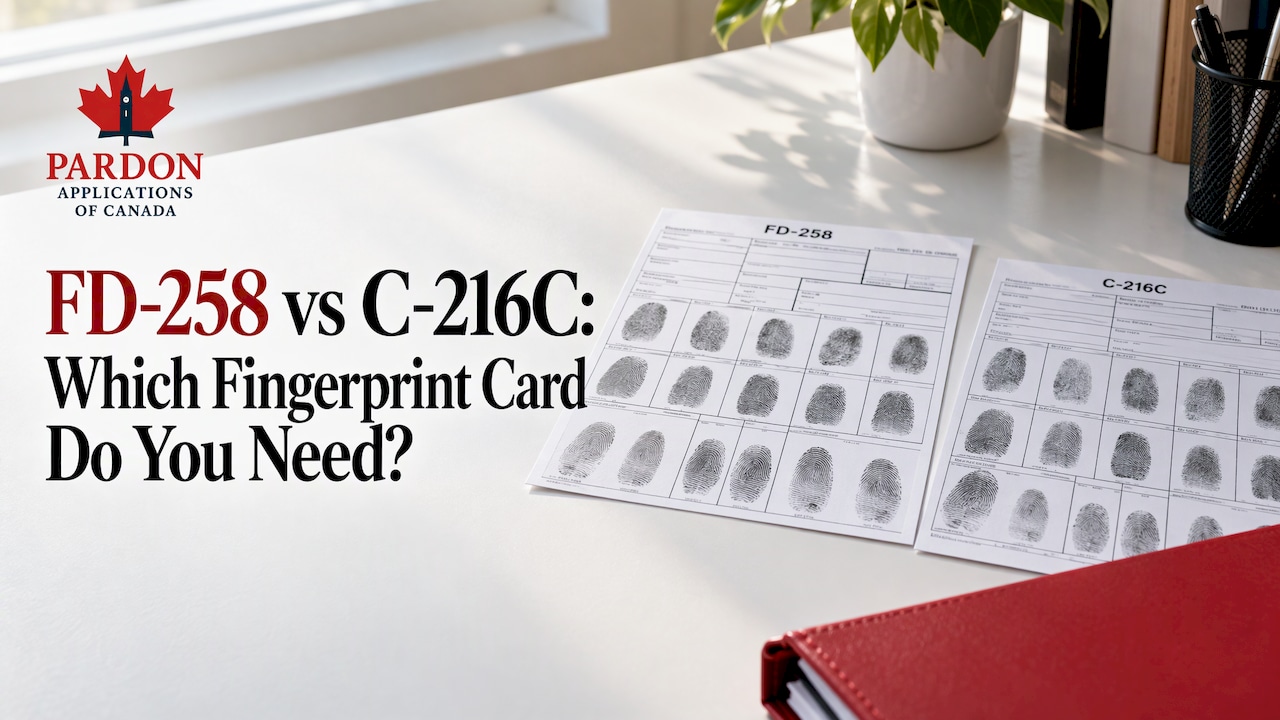
The FD-258 is the FBI’s applicant fingerprint card, and the C-216C is the RCMP’s. They look almost the same, but they are not interchangeable. The FD-258 serves U.S. purposes. The C-216C serves Canadian police checks and some foreign police certificates. If you are working on a Pardon (record suspension) or a U.S. Entry Waiver (I-192), picking the wrong card is a common way to lose weeks. Our accredited Pardon and Waiver officers at Pardon Applications of Canada help clients assess their eligibility and prepare complete, accurate applications, so the right paperwork is in place before anything is sent.
TL;DR
- FD-258: an FBI card used for U.S. purposes, such as federally required checks, certain state and local licensing, and law-enforcement applicants.
- C-216C: the RCMP’s card, used for Canadian criminal record checks and for police certificates that foreign authorities ask for on paper.
- Inside Canada: most civil fingerprint checks are now submitted electronically to the RCMP, so you may never handle a paper card. Ink cards matter mainly when a foreign body demands one.
- For a Pardon: the application needs a fingerprint-based RCMP check, and the Parole Board of Canada’s $50 filing fee is only one of several costs.
- Before you pay: confirm the exact form with whoever is asking for it. A wrong or incomplete card can be rejected or returned.
Table of Contents
- What each card is
- FD-258 vs C-216C at a glance
- Which card fits your situation
- Where to get your fingerprints taken in Canada
- Costs and timing
- Mistakes that get a card rejected
- How we can help you move forward
- FAQ
- Sources
What each card is
A fingerprint card is a standard-size form on which your ten fingerprints are rolled in ink, along with your identifying details. Agencies use these cards to search their databases for any record linked to your prints. Fingerprints are preferred over a name search because names can be shared, changed or misspelled, while your prints identify only you.
The FD-258
The FD-258 is the FBI’s applicant card. Its stated uses include law-enforcement applicants, authorized state and local employment, licensing and permits, U.S. government agencies and entities required by federal law, and federally chartered or insured banks. The current revision is dated 10/31/2023.
The form must be typed or printed legibly in blue or black ink. The required fields include the ORI (the agency identifier), date and place of birth, name, sex, date fingerprinted, the reason you are being fingerprinted, and properly completed impression boxes. Prints must be rolled nail to nail and in the correct sequence.
The C-216C
The C-216C is the RCMP’s fingerprint form. Canadian police services and accredited companies use it for ink-and-roll prints when a certified criminal record check is needed on paper, which in practice usually means a foreign authority asked for it. The physical layout looks very close to the FD-258, which is exactly why people mix them up. The agency reading the card is what differs, and that agency decides whether it will accept the form.
FD-258 vs C-216C at a glance
| FD-258 | C-216C | |
|---|---|---|
| Issued by | FBI (United States) | RCMP (Canada) |
| Typical purpose | U.S. employment, licensing and federally required checks | Canadian criminal record checks, police certificates for countries that accept it |
| Where the result goes | U.S. agencies | RCMP’s national repository, through an accredited channel |
| Format | Ink and roll, hard copy | Ink and roll, or electronic capture inside Canada |
| Use it for a Canadian Pardon file? | No, the Pardon file relies on an RCMP check | Not as a paper card in most cases; the RCMP check is submitted electronically |
The safest rule: the body asking for the check names the form. If a U.S. agency asks for fingerprints, you need its format. If a Canadian body asks, you need the RCMP route.
Which card fits your situation
You are applying for a Pardon (record suspension)
A Pardon file needs a fingerprint-based check. A Manitoba record suspension guide from the John Howard Society explains that you need two record checks: a fingerprinted CPIC/RCMP check, plus local police checks from every jurisdiction where you lived in the past five years. The Parole Board of Canada requires the fingerprints to be taken by a police service or an accredited company that submits them electronically, with the submission marked for a record suspension, as SafeHire’s 2026 overview also notes.
That means the FD-258 has no role in the Canadian side of a Pardon. The card you hear about in a Pardon context is really an electronic RCMP submission, not a paper form you mail yourself.
What people overlook is cost. The Parole Board of Canada’s filing fee is $50, but that is only one line. The same process also involves the RCMP fingerprint check, local police record checks, court and other document requests, and the time needed to collect them. The total for a complete Pardon application is much higher than $50, and that is why many applicants choose a guided service. Our Pardon Only plan is $80 per month.
Our article on what accredited fingerprinting involves in 2026 walks through the electronic process in more detail.
You need a U.S. Entry Waiver (I-192)
A Canadian Pardon does not solve U.S. inadmissibility. Global Affairs Canada’s position, as summarized by SafeHire, is that a Canadian pardon is not recognized under U.S. law, and an inadmissible person must apply to U.S. Customs and Border Protection for a temporary waiver. The same Manitoba guide above says a record suspension does not guarantee U.S. entry and that an I-192 may still be needed for serious offences.
Because the waiver goes to a U.S. agency, the FBI-format card is the one tied to U.S. purposes. Which exact form and which fingerprint route your file calls for depends on your case, so confirm it with your waiver officer before you get prints taken. Using a wrong or incomplete card is the sort of avoidable error that adds delay. For the full sequence, see our step-by-step U.S. Entry Waiver process and our guide on why you may need a U.S. waiver.
You need a police certificate for immigration or work abroad
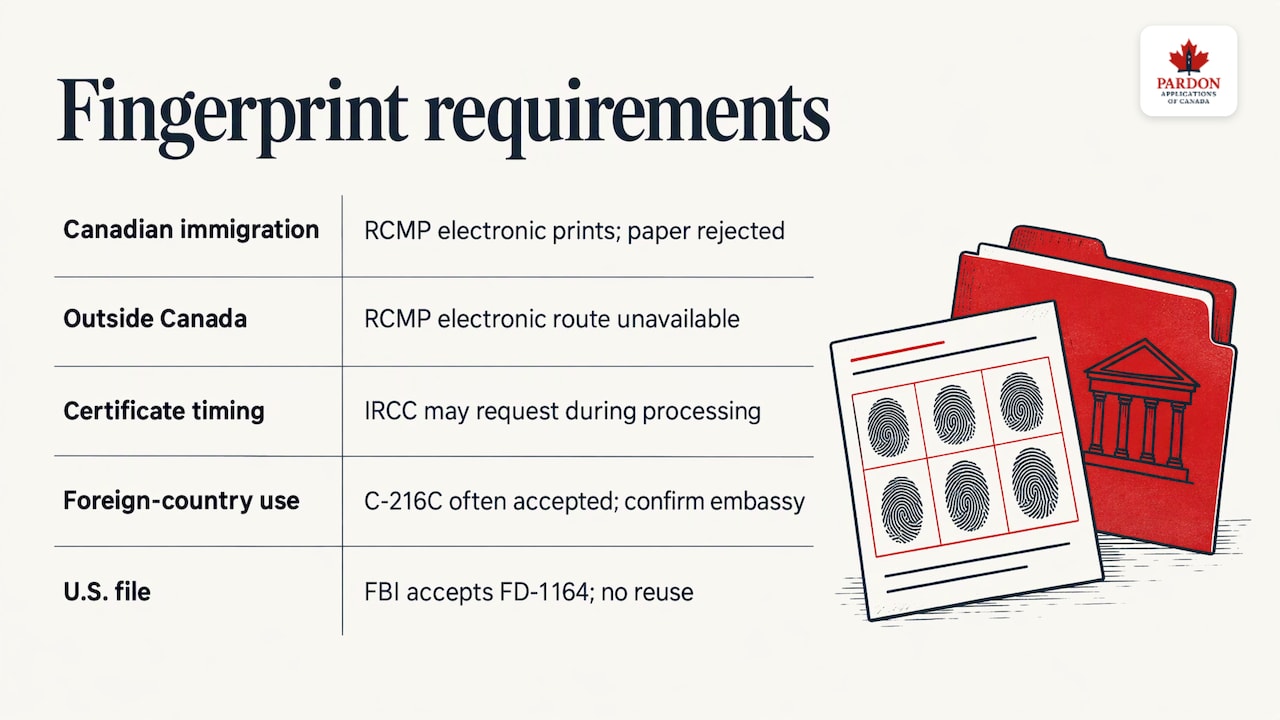
This is where the two cards usually meet. Immigration authorities may ask for a police certificate from each country where you lived. For Canadian immigration, IRCC’s guidance says fingerprints must be submitted electronically to the RCMP’s national system, electronic submissions are not available from outside Canada, and paper submissions will not be processed. Also, a police certificate is not required up front for permanent residence; IRCC tells applicants if one is needed during processing.
For foreign countries asking for your Canadian record, a paper C-216C is often what they accept, but not all do. Check with the embassy or authority involved before you pay for fingerprints. The Edmonton Police Service offers both the RCMP C-216 and FBI FD-258 ink forms and recommends confirming with the destination country’s embassy which one is required.
For the U.S. side of a Canadian immigration file, a FBI Identity History Summary is the usual document. The FBI states that it accepts its FD-1164 cards on standard white paper for a personal identity-history check, and that a card used for a previous check cannot be reused. That means a third card name, the FD-1164, can enter the picture, which is another reason to ask which form is required before you start.
Where to get your fingerprints taken in Canada
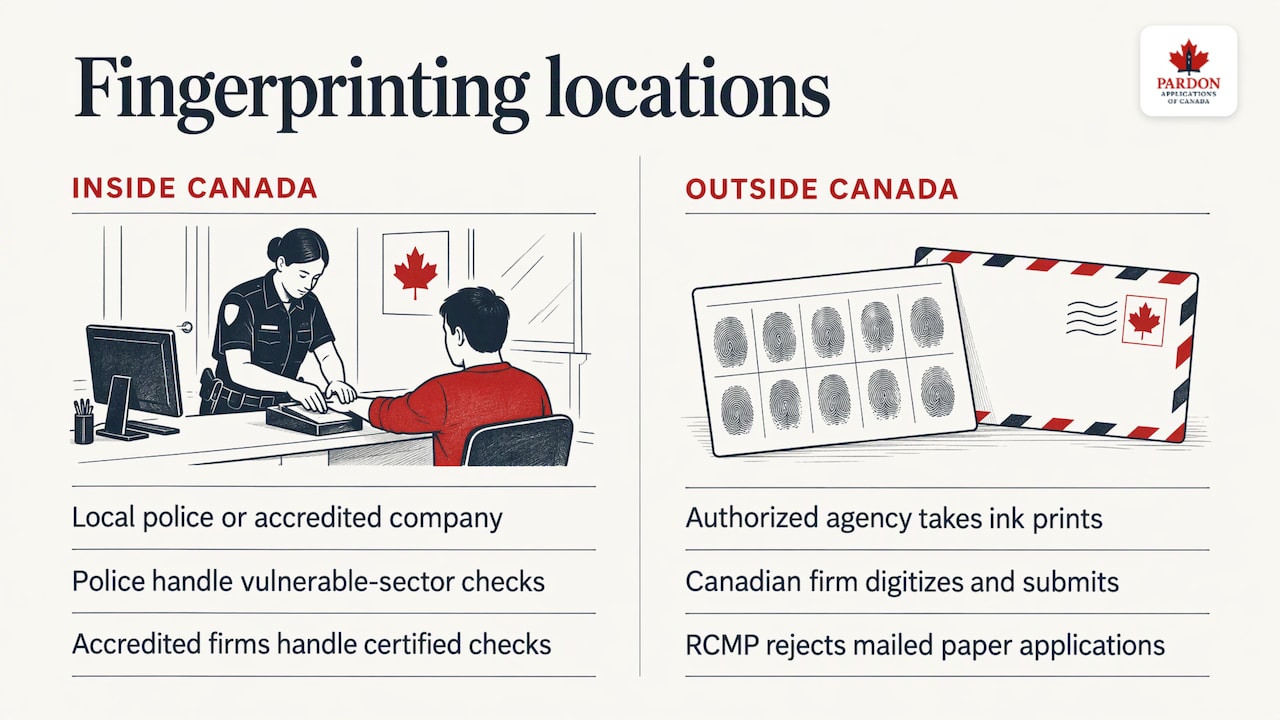
The RCMP’s guidance on where to go says that inside Canada you can be fingerprinted at your local police service or at an RCMP-accredited private fingerprinting company. Vulnerable sector checks go through police, while certified criminal record checks can go through accredited companies. The RCMP also keeps a monthly-updated list of accredited private fingerprinting companies and says there are none outside Canada.
If you are outside Canada, paper ink prints must be taken by an authorized agency, then sent to an accredited Canadian company to be digitized and submitted electronically. Paper applications mailed directly to the RCMP will not be accepted. Our guide on getting a police record check from outside Canada covers this path.
What to bring
Bring two pieces of valid identification. Edmonton Police’s FAQ, for example, asks for one government-issued photo ID, such as a driver’s licence, passport, PR card or Status card, plus a second ID showing your full name. Expired ID is not accepted. Other providers have their own rules, so confirm before you go.
Costs and timing
Fees vary by route, so treat these as the published figures for their periods, not what you will necessarily pay.
- RCMP civil criminal record check: the RCMP’s Fees Report lists $25 for the fiscal years 2025-26, 2026-27 and 2027-28. Its service standard is three business days or less when there is no match, and up to 120 business days if manual processing is involved or there is a possible match.
- Collection fees: the person or company taking the prints sets its own charge on top of the RCMP fee. The RCMP fee is not the whole price of getting fingerprinted.
- FBI Identity History Summary: the FBI’s fee was listed at $18 USD as of October 2026 in this cost guide. The FBI’s own pages are the place to confirm the current amount, since fees can change.
If timing matters, IRCC notes high RCMP demand and says it automatically extends the deadline for the criminal record check by 30 days if you are delayed. For a Pardon, delays in one document can hold up the whole file, which is why we prepare the full set of documents together.
Mistakes that get a card rejected
Most rejections are about the card, not the person. Watch for these:
- Wrong form for the agency. The FBI and the RCMP use cards that look alike but are processed by different bodies. Confirm the form with whoever requested it.
- Blank required fields. FBI guidelines state that a civil FD-258 with required fields left blank, such as name, ORI, date of birth, sex, impressions or reason fingerprinted, is rejected without further processing unless a quoted FBI UCN number is provided.
- Poor-quality prints. Smudged or partial rolls can be returned. Prints should be rolled nail to nail in the correct sequence.
- Old forms. Check the current version of the card on the official FBI or RCMP page. The FD-258 revision cited above is dated 10/31/2023.
- Stale results. For Canadian immigration, police certificates generally must be issued within six months of the application date, as one 2026 immigration guide states. Ask the requesting body how recent your check must be.
- A recent U.S.-side change. Since April 24, 2025, the Sex field must be populated with Male or Female on electronic and hardcopy fingerprint submissions to U.S. vetting channels, according to the U.S. Defense Counterintelligence and Security Agency.
For a broader look at what different checks reveal, see background check types in Canada.
How we can help you move forward
For many people, the fingerprint card is the smallest piece of a much larger project. A Pardon can lift the shadow of a past conviction from your job search, and a U.S. Entry Waiver can reopen travel, but each file has to be complete and accurate before it is submitted. Our accredited Pardon and Waiver officers offer personalized consultations to assess your eligibility, and we provide dedicated support so you stay informed as your file moves forward. We cannot promise any particular outcome, since decisions rest with the Parole Board of Canada and U.S. authorities, but a complete application gives you the strongest footing.
Our Pardon Only plan is $80 per month. If you need a U.S. waiver, our Priority processing option is a one-off $95 to $150. If you already hold a waiver, we also handle an I-192 renewal. You can start with a free consultation on our main page.
FAQ
Can I use a C-216C card for the FBI?
Not as a rule. The FBI accepts its own FD-258 or FD-1164 cards, depending on the purpose, and a card from another agency can be returned. Confirm the form with the agency before you have prints taken.
Do I need ink fingerprints for a Canadian Pardon?
A Pardon file needs a fingerprint-based RCMP check, and the Parole Board of Canada requires that fingerprints be submitted electronically by a police service or an accredited company. Ink cards are mainly for foreign authorities that still require them.
How long are my fingerprints valid?
The certificate itself has no printed expiry, but the organization asking for it usually wants a recent one. For Canadian immigration, police certificates generally must be issued within six months of your application. Ask the requesting body for its window.
Does a Pardon replace a U.S. Entry Waiver?
No. A Canadian Pardon is not recognized under U.S. law, so someone who is inadmissible must apply to U.S. Customs and Border Protection for a temporary waiver. Our officers can assess which applies to you.
Is the $50 fee the full cost of a Pardon application?
No. The Parole Board of Canada’s filing fee is $50, but the process also involves the RCMP check, local police checks, court and other documents, and preparation. Those costs come on top of the filing fee.
Sources
- FBI Fingerprint Card FD-258
- FBI Identity History Summary Checks FAQs
- FBI Guidelines for Preparation of Fingerprint Cards
- RCMP: Where to go
- RCMP: Private fingerprinting companies accredited by the RCMP
- RCMP Fees Report, fiscal year 2025-26
- IRCC: Criminal record check for an immigration or citizenship application
- Edmonton Police Service: Fingerprinting FAQ
- John Howard Society of Manitoba: Record Suspensions in Manitoba
- SafeHire: Pardon (Record Suspension) in Canada
- DCSA: Fingerprints
- FBI background check cost in 2026
- Police Certificate for Canadian Immigration: Complete 2026 guide
Recommended
- Which is Faster: Criminal Record Checks by Fingerprinting or Name and Birthdate?
- RCMP Accredited Fingerprinting in 2026: The Complete Guide
- Fingerprints 101 – Process Updates, Policy Changes and What This Means for You
- Fingerprinting for Criminal Record & Vulnerable Sector Checks Is Not What You Think
This content brings together contributions from PAC, our content team, and AI tools, with PAC retaining editorial responsibility. It is shared for general information, not legal advice. Laws and procedures may change; seek qualified legal advice for your circumstances.