


If your charges were dismissed, withdrawn, stayed or ended in an acquittal, you generally have no conviction, and most US criminal grounds of inadmissibility require one. That is the good news. The catch is that a US border officer can still ask about the arrest, and you carry the burden of showing how the case ended. Our team at Pardon Applications of Canada (PAC) helps Canadians prepare U.S. Entry Waivers (I-192) when a record does block the border, and the first step is knowing which side of that line you are on.
TL;DR
- A dismissed charge generally is not a conviction, and most criminal grounds of inadmissibility under US law require a conviction.
- You must still answer questions about arrests truthfully, and the best proof of the outcome is a court disposition, not a police report.
- A Canadian Pardon (record suspension) is not recognized under US law for entering the United States, so it does not change any of this.
- Some situations, such as controlled-substance charges, may need a closer look even without a conviction.
- If you are found inadmissible, the route is a U.S. Entry Waiver (Form I-192), filed in advance of travel.
Table of Contents
- Why a dismissed charge can still come up at the border
- Dismissed, withdrawn, stayed, discharged: how each outcome travels
- Carry the right paperwork
- Answer truthfully, every time
- Will a Pardon fix it? No, and here is why
- When a U.S. Entry Waiver comes into play
- Where PAC fits in
- A practical plan before your next trip
- FAQ
- Sources
Why a dismissed charge can still come up at the border
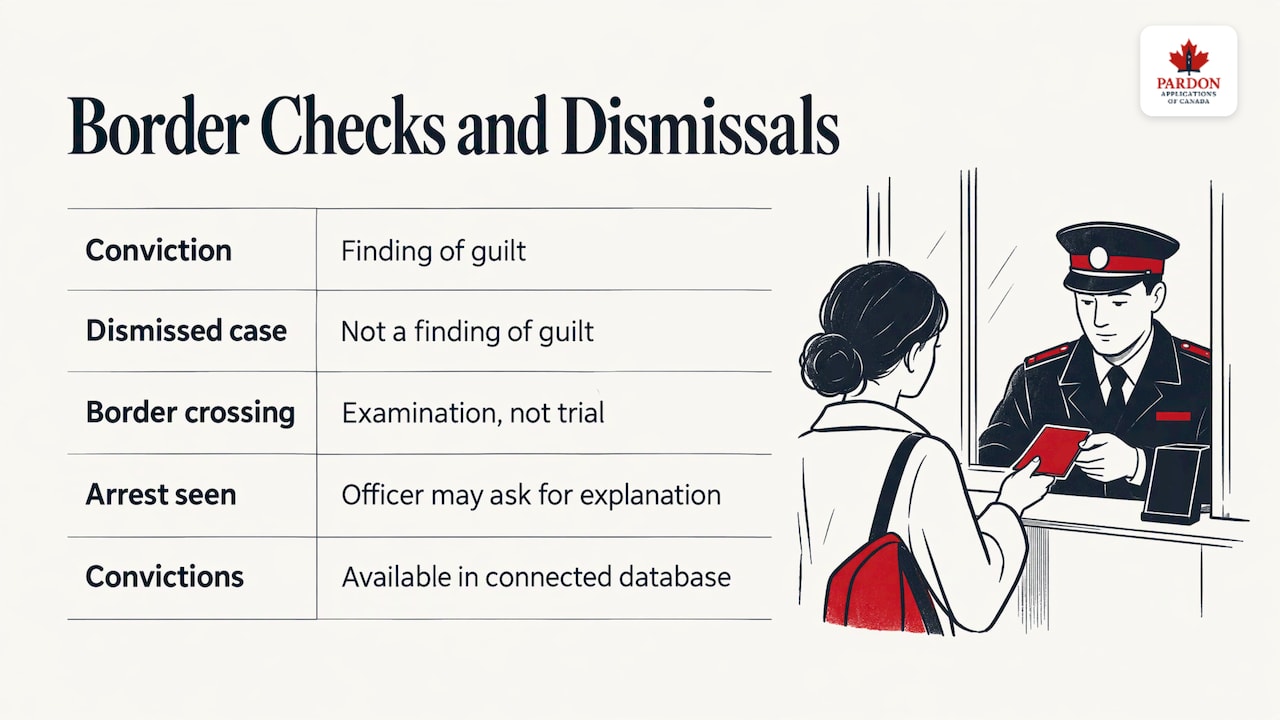
A conviction is a finding of guilt. A dismissal, withdrawal, stay of proceedings or acquittal is not. For travel, that is usually the best outcome a Canadian case can have. The Immigrant Defense Project, a US legal-advocacy group, explains that in general a dismissed case will not trigger grounds of removability or inadmissibility, because those grounds mostly depend on a conviction.
So why do people with dismissed charges get stopped? Because a border crossing is an examination, not a trial. US Customs and Border Protection (CBP) told CBC News that all international travellers are subject to examination and that people entering bear the burden of proof to show they are clearly eligible. If an officer sees an arrest, you may be asked to explain it. An officer who cannot see how it ended has little reason to wave you through.
Global Affairs Canada notes that US ports of entry are computerized and connected to a central database where convictions in both Canada and the US are readily available. Most US ports of entry also use facial recognition, and digital fingerprints are required for some travellers. Your identity is checked more thoroughly than it was a decade ago, which is a reason to be organized rather than a reason to panic.
Dismissed, withdrawn, stayed, discharged: how each outcome travels
Canadian courts end cases in different ways, and the label on yours matters when you explain it.
| Outcome in Canada | Conviction? | What to know for US travel |
|---|---|---|
| Charge dismissed or withdrawn | No | Generally the strongest result; carry the paperwork showing it |
| Stay of proceedings | No | Prosecution halted; you still need the court record to show it |
| Acquittal | No | No finding of guilt; document each charge separately if some went to trial and others did not |
| Peace bond | No guilty plea | Generally far better for travel than a guilty plea |
| Conditional discharge | Not a conviction in the Canadian sense | Treat it with care and keep the full court record |
The conditional discharge is where readers often get confused. It shows nothing on a standard Canadian criminal record check, yet a Winnipeg defence lawyer told CBC News that he had seen two clients with conditional discharges turned back, and he wondered whether a pattern was forming. A representative of the Criminal Defence Lawyers Association of Manitoba said such outcomes should not affect admissibility, since they are not convictions, while suggesting that US officials’ areas of concern may be widening. Our page on conditional discharge and US entry goes through that case in more detail.
The point is not that these outcomes are a problem. It is that the officer decides on what is in front of them, so what you can show matters as much as the result itself.
Carry the right paperwork
The Immigrant Defense Project says the best evidence that a case was dismissed is a court disposition, or a letter showing the prosecutor declined to prosecute. Police reports are not a substitute: they describe allegations and do not state the final outcome.
The cost of arriving without documents is real. In the CBC account, a Manitoba man with no criminal record was held for four hours, fingerprinted and denied entry at the Pembina-Emerson crossing because he could not produce court documents showing that theft charges had been stayed. The charges were nearly a decade old. He now keeps copies in more than one vehicle.
A practical folder looks like this:
- A certified court record for every charge, showing the final disposition (dismissed, withdrawn, stayed, acquitted, discharged). If several charges came from one arrest and some ended differently, you need the outcome of each.
- Proof that any conditions were completed, such as probation or a peace bond term, if one applied.
- A short written timeline of the arrest, the court dates and the outcome, so you can answer questions plainly and consistently.
- Your reason for travelling, such as a hotel booking or an event invitation.
Keep a copy where you can reach it on the road, not only at home. If you cannot find your court record, ask the court registry in the province where the case was heard; this is routine for them.
Answer truthfully, every time
The same guidance says you must disclose all arrests when asked, even if the case was ultimately dismissed. Answer calmly, stick to facts and hand over your documents if the officer asks. A truthful answer backed by paper is far stronger than a vague one.
The same source flags that dismissed cases involving controlled substances, a history of such charges, or alleged violations of a protection order may need additional review, because some US grounds can apply without a conviction. If your dismissed charge falls in one of those categories, get an assessment before you travel, not at the booth.
Will a Pardon fix it? No, and here is why
Many Canadians assume a Pardon (record suspension) clears the way south. Global Affairs Canada states that a Pardon issued by Canadian authorities is not recognized under US law for the purpose of entering the United States. If a US inadmissibility ground applies, the remedy is a US one. Our page on why a Canadian Pardon will not get you into the United States explains it step by step.
A Pardon still matters for what it does in Canada: employment screening, housing, volunteering and peace of mind. If you also have a conviction on file, you may need both a Pardon and a waiver, and our guide on whether you need a Pardon or a waiver helps you sort out which is which.
One cost note, because people ask. The Parole Board of Canada’s filing fee for a Pardon application is $50, but that is only one part of the process: documents, record checks and preparation all add up. Our Pardon Only plan is $80 per month.
When a U.S. Entry Waiver comes into play
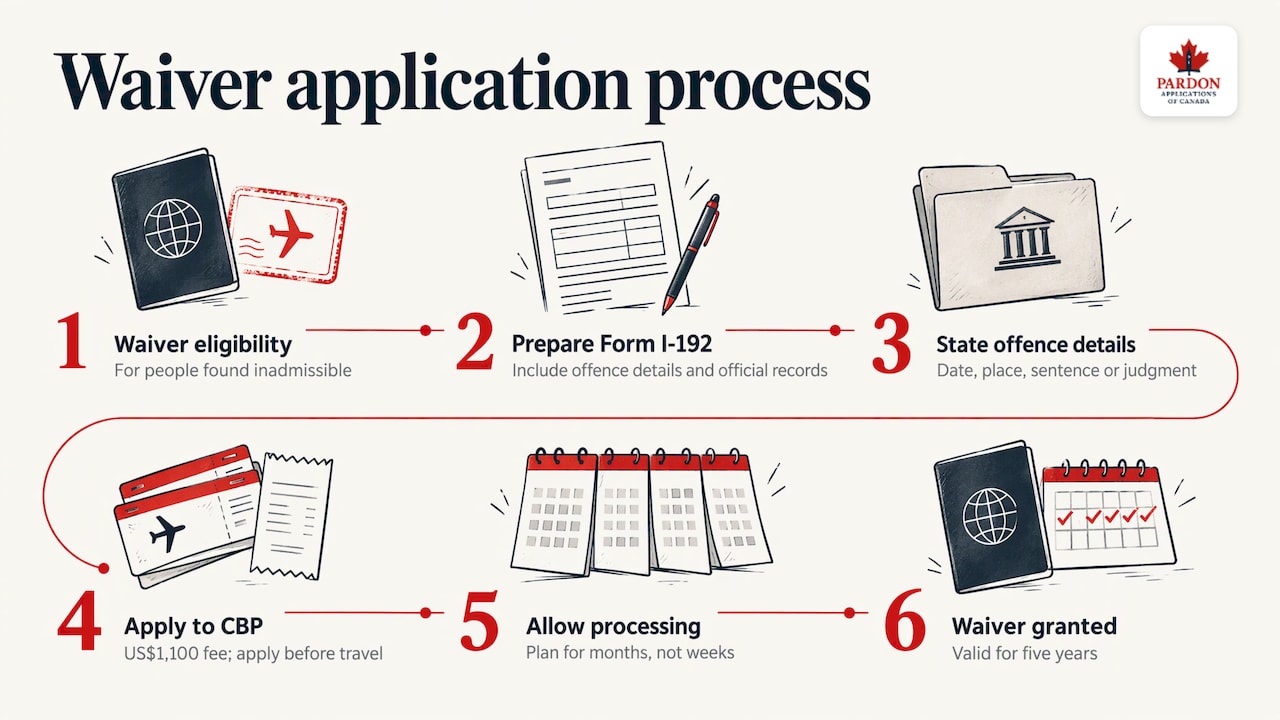
A waiver is not for dismissed charges as such. It is for people who are found inadmissible, which can happen through a conviction, an admission of certain conduct, or a ground that applies without a conviction. Our page on why you might need a US waiver covers the common triggers.
Global Affairs Canada advises that if you are ineligible to enter the US, you may apply directly to CBP for a temporary waiver of inadmissibility. Applicants file Form I-192, which asks for details of each offence and supporting official records. US regulations require the application to state the offence, the date and place, and the sentence or judgment, supplemented by the official record.
The government filing fee has been reported at US$1,100, a waiver must be applied for in advance of travel, and once granted it is valid for five years in that reporting. Processing times vary, so build in months, not weeks. Our I-192 processing time guide sets out what to expect, and the step-by-step waiver process shows how an application moves from preparation to filing.
Most officers weigh three questions, which come from long-standing US case law: how risky you are to the public, how serious the earlier matter was, and why you are travelling. A complete application speaks to all three with documents, not just a letter.
Where PAC fits in
A waiver application is only as strong as its paperwork, and incomplete files are a common reason for delay. At PAC, you get a personalized consultation with accredited Pardon and waiver officers who assess your eligibility, then prepare and submit a complete, accurate application. We also keep you informed through dedicated support channels. We cannot promise an outcome, because the decision rests with US authorities, but careful preparation is what we control.
If you are renewing an existing waiver, our I-192 renewal service is built for that. If your timing is tight, priority processing is available as a one-off add-on at $95 to $150, as described on our waiver costs page.

To see how we handle your situation, start with our U.S. Entry Waiver services or book a free consultation through our main site.
A practical plan before your next trip
- Gather certified court dispositions for every charge, well before you travel.
- Write your timeline and rehearse a short, factual answer.
- Check whether any charge involved controlled substances or a protection order, since those may need extra review.
- Keep copies of your documents with you in the vehicle or carry-on.
- If you have a conviction, or an officer has ever turned you back, treat a waiver as the next step and begin early.
FAQ
Can I enter the US if my charges were dismissed?
Generally yes, because most criminal grounds of inadmissibility need a conviction. You may still be asked about the arrest, so carry the court record showing how each charge ended.
Does a stay of proceedings or conditional discharge count as a conviction?
Not in the usual sense, and neither shows on a standard Canadian record check. Even so, Canadians with these outcomes have been questioned at the border, so keep the full court documents with you.
Will a Canadian Pardon stop the US from seeing my record?
No. A Pardon is not recognized under US law for entering the US, and information CBP has already recorded can remain in US systems. You must still answer questions about arrests honestly.
Do I need a waiver if I only had charges dismissed?
Usually not, unless a ground of inadmissibility applies without a conviction, as can happen with some drug-related matters. If an officer has turned you back or you are unsure, our team can assess your situation and prepare an I-192 if one is needed.
Sources
- Immigrant Defense Project: My client’s criminal case was dismissed
- CBC News: ‘Just bring your documents,’ warns Manitoba man stopped at the border
- Global Affairs Canada: United States travel advice
- Global Affairs Canada: United States travel advice, facial recognition and fingerprints
- US Code of Federal Regulations, 8 CFR Part 212 (2025)
- The Travel: CBP and the I-192 waiver for a Canadian with an old conviction
Recommended
- Conditional Discharge and US Entry: What Canadians Need to Know
- CIMT and U.S. Entry: What Canadians Need to Know
- Stayed Charges and Pardons in Canada: What Applies to You
- Why a Canadian Pardon (Record Suspension) Won’t Get You Into the United States
This content brings together contributions from PAC, our content team, and AI tools, with PAC retaining editorial responsibility. It is shared for general information, not legal advice. Laws and procedures may change; seek qualified legal advice for your circumstances.