
Whether you can apply for a Pardon (the Parole Board of Canada’s formal name is a record suspension) after a sexual offence conviction depends on one question: does your offence appear in Schedule 1 of the Criminal Records Act? If it involved a child and sits in Schedule 1, you are generally barred from applying, with one narrow exception. If it does not, you follow the same waiting periods and steps as most other applicants. Because this is the first thing the Parole Board checks, it is worth settling before you spend a dollar or a month on paperwork. At Pardon Applications of Canada, our accredited officers assess eligibility in a personalized consultation, so you know where you stand before you file.
TL;DR
- A person convicted of a Schedule 1 offence, which covers sexual offences involving children, is generally ineligible to apply for a Pardon.
- A narrow exception exists: you must show you held no position of trust or authority, used no violence, intimidation or coercion, and were less than five years older than the other person. The burden of proof is on you.
- For offences outside Schedule 1, the waiting period starts after every part of your sentence is finished: 10 years for an indictable offence and 5 years for a summary conviction when the first offence was on or after March 13, 2012.
- The Parole Board’s $50 filing fee is only one cost in a long list of documents, checks and fees.
- A Pardon does not guarantee entry to the United States. Some sexual offences may call for a separate U.S. Entry Waiver (Form I-192).
Table of Contents
- Why a sexual offence conviction is treated differently
- What Schedule 1 actually lists
- The Schedule 1 exception: who can still apply
- If your offence is not in Schedule 1: the waiting period
- What the Parole Board considers
- What you will need to file
- What a Pardon costs in real terms
- What a Pardon changes, and what it does not
- Travel to the United States after a sexual offence
- How we help you apply
- Key takeaways before you decide
- FAQ
- Sources
Why a sexual offence conviction is treated differently
Most criminal records can eventually be suspended once enough time has passed. Sexual offences involving children are the main category Parliament has set apart. The Criminal Records Act, the federal law that governs Pardons, says in section 4(2) that a person is ineligible to apply if they were convicted of an offence listed in Schedule 1.
Schedule 1 is a list of Criminal Code sections attached to the Act. It is not a general label for “sex crimes”. It lists specific offences, and for several of them what matters is that a child was involved. That detail decides many cases, so you need to read your own conviction against the list, not against a rumour you heard in a waiting room or online.
The same section also bars people convicted of more than three indictable offences (the more serious type of charge, usually prosecuted by the Crown in a higher court process), each with a prison sentence of two years or more. That rule applies to every kind of offence, not only sexual ones.
What Schedule 1 actually lists
The Schedule 1 list names sexual offences involving children, including these Criminal Code sections:
- 151 (sexual interference)
- 152 (invitation to sexual touching)
- 153 (sexual exploitation)
- 163.1 (child pornography)
- 172.1 (luring a child by telecommunication)
- 279.011 (trafficking of a person under 18)
- 286.1(2), 286.2(2) and 286.3(2) (certain sexual services and procuring offences involving a person under 18)
Attempts and conspiracies to commit these offences are covered too, as are equivalent offences under the National Defence Act, which matters for military convictions.
The Legislative Services Branch’s schedule page adds a second group: certain offences when they involved a child, such as sexual exploitation of a person with a disability (153.1), incest (155), voyeurism (162), indecent acts (173(1)), sexual assault (271), sexual assault with a weapon (272) and aggravated sexual assault (273), along with related offences from before 1988.
Two practical points follow:
- Your court record shows the section number you were convicted under. That number, not the news coverage or a charge sheet description, is what the Board compares to Schedule 1.
- A sexual offence that is not on the schedule, for example one that did not involve a child, is not caught by this bar. It is assessed under the ordinary rules described below.
If your paperwork is unclear on the section, or you are unsure whether your offence involved a child in the legal sense, do not guess. This is exactly the kind of question we sort out in a consultation before anything is filed.
The Schedule 1 exception: who can still apply
Section 4(3) of the Criminal Records Act gives a narrow way in. Someone convicted of a Schedule 1 offence may apply only if the Board is satisfied of all three of these things:
- No position of trust or authority. You were not in a position of trust or authority toward the victim, and the victim was not in a relationship of dependency with you.
- No violence, intimidation or coercion. You did not use, threaten or attempt to use any of these.
- Close in age. You were less than five years older than the victim.
These conditions are set out in section 4(3), and section 4(4) places the burden of proving them on you, the applicant. That means the Board will not go looking for evidence in your favour. Your application has to supply it.
If you rely on this exception, the Parole Board requires its Schedule 1 Exception Form with your application. If you have never been convicted of a Schedule 1 offence, you do not need the form.
A typical situation where the exception is considered is a conviction involving two young people close in age, with no authority relationship and no coercion. Whether that fits your history is a factual question. We do not promise outcomes, and nobody can: the Board makes the decision. What a complete, well-organized submission can do is put the facts the law asks for in front of the Board clearly, in the form it requires.
If your offence is not in Schedule 1: the waiting period
If you are not barred, the next question is timing. You cannot apply until you have waited out a period that starts only after you have completed everything in your sentence. The Parole Board’s eligibility page lists what must be finished:
- all fines, victim surcharges, costs, restitution and compensation orders
- all imprisonment or conditional sentences, including parole and statutory release
- any probation
Firearms or driving prohibitions do not need to have expired for the clock to start.
For a first offence committed on or after March 13, 2012, the waiting period is:
| Type of offence | Waiting period after sentence is complete |
|---|---|
| Summary conviction (the less serious track) | 5 years |
| Indictable offence (the more serious track) | 10 years |
The Criminal Records Act, section 4(1) states the same 5 and 10 year periods.
Three details trip people up.
The date of your first offence matters. The Board applies the version of section 4 in force on the date of your first offence, which is why you will see different periods in different guides. The Board’s policy manual explains that the current rules, the March 2012 rules and the June 2010 rules can each apply depending on that date.
Hybrid offences depend on how the Crown proceeded. Many offences can be prosecuted either as summary or as indictable. According to the John Howard Society of Manitoba, the Crown’s choice at trial sets your waiting period. Your court documents will say which route was taken.
Counting from the wrong date costs time. Applicants often count from sentencing, or from the day they were released, and file too early. For a closer look at when the clock really begins, see our guide to the record suspension waiting period. If you are close to the end of your waiting period, you may also want to read whether you can start the application process before being eligible.
What the Parole Board considers
Eligibility only gets you to the starting line. For many applications, the Board’s decision-making policy says members assess good conduct. For offences under the 2010 to 2012 scheme and for those under paragraph 4(1)(a), the Board also looks at measurable benefit to you, sustained rehabilitation, and whether granting the suspension would bring the administration of justice into disrepute.
In plain terms, the Board wants to see a person who has lived lawfully since the sentence ended, and a real reason the suspension matters: a job, volunteer work, housing, family life or travel. That is why the application includes a Measurable Benefit and Sustained Rehabilitation Form. A vague, rushed answer here is a common reason applications stall.
What you will need to file
The Parole Board’s process is document-heavy. A record suspension checklist from Steps to Justice outlines the core steps:
- Confirm you are eligible and the waiting period has passed.
- Obtain your RCMP certified criminal record using electronic fingerprints.
- Complete a Court Information Form for each courthouse that handled a conviction.
- Get local police records checks for every city where you lived for three months or more in the past five years. These expire after 12 months.
- Assemble the application package and mail it with the fee. The Board does not accept cash or personal cheques.
A Military Conduct Sheet, a copy of government ID, the Schedule 1 Exception Form where it applies and a signed consent form complete the package. Mistakes at this stage, such as an expired police check, a missing courthouse or an incomplete address history, delay files. Our officers prepare the full package so every document is present and consistent before it reaches Ottawa. You can see how we sequence this in The PAC Record Suspension Process, Step by Step, and in our list of 8 documents to check.
What a Pardon costs in real terms
The Parole Board’s filing fee is $50. That figure is the Board’s fee only. It is not the cost of a complete application. Around it sit the RCMP fingerprint-based record check, fingerprinting, court record fees and local police check fees, all set by the organizations that provide them, plus the time it takes to collect and verify each document.
Our Pardon Only plan is $80 per month. The details are on our page about the costs of a Canadian Pardon. If you want to understand the Board’s fee history, we also explain the filing fee increase.
What a Pardon changes, and what it does not
For most people, the reason to apply is the weight of a record that follows them into every interview and background screening, the invisible ceiling on what they can apply for. The John Howard Society of Manitoba notes that after a record suspension, a CPIC criminal record check for employment will not show the convictions. CPIC is the national police database. For more on how records affect work, read our article on criminal records and work authorizations.
A Pardon is not a guarantee of anything, though. It is a decision by the Parole Board, it is not the same as being found not guilty, and it does not by itself settle your status in another country.
Travel to the United States after a sexual offence
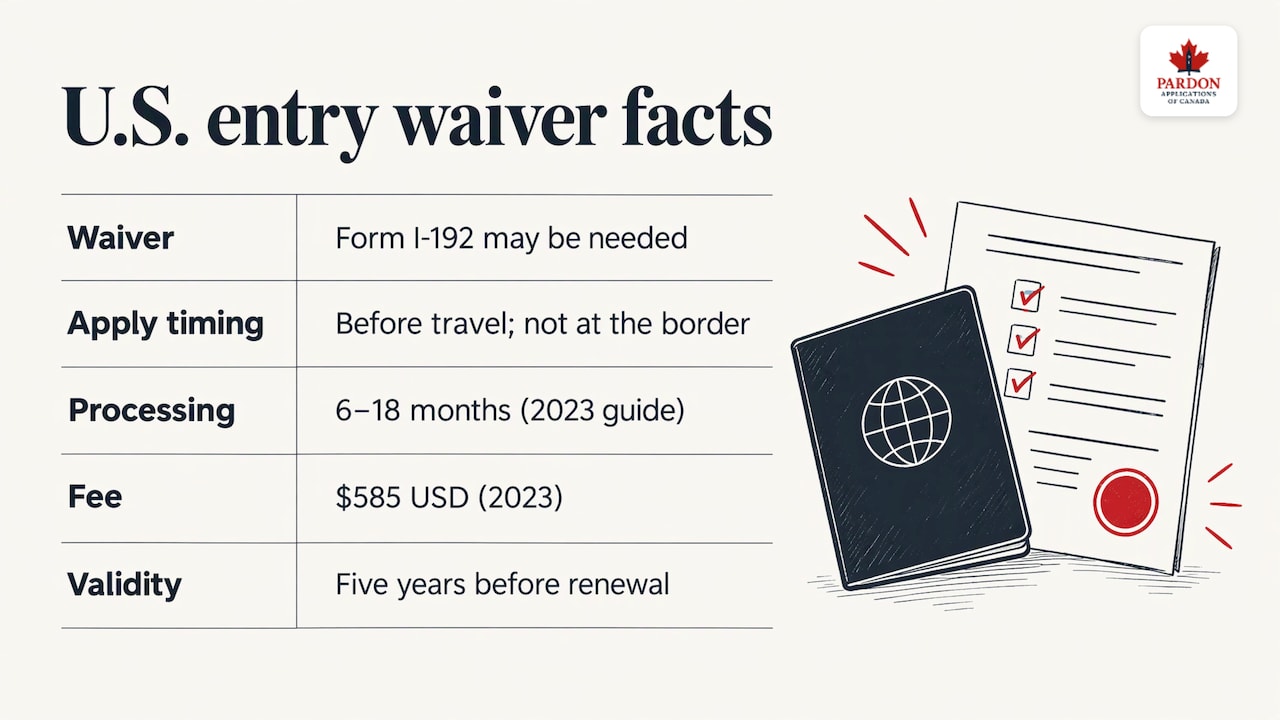
A Canadian Pardon does not guarantee entry to the U.S. The same John Howard Society guide says a U.S. Entry Waiver (Form I-192) may be needed and lists sexual assault among the offences that are likely to require one. U.S. border officers decide admissibility under their own law, whatever Canada has done with your record.
The waiver has to be applied for in advance. It cannot be requested at the border on the day you travel, and the approval is valid for five years before it must be renewed. The John Howard guide cited a government fee of $585 USD and a wait of 6 to 18 months when it was written in 2023, so check the official U.S. fee schedule before budgeting.
We prepare U.S. Entry Waiver applications and I-192 renewals as well as Canadian Pardons. If this is your situation, start with Why Do I Need a US Waiver? and our I-192 processing time guide, or see how the I-192 Renewal service works when your approval is coming up for expiry.
How we help you apply
Pardon Applications of Canada has been guiding people through Pardons and U.S. Entry Waivers for over 55 years. You begin with a personalized consultation with an accredited officer who assesses your eligibility, including the Schedule 1 question and your waiting period, and then prepares a complete and accurate application. Our aim is to reduce the chance of delays or denials, and we keep dedicated support channels open so you know where your file stands. We never promise a result, because the decision belongs to the Parole Board.
If you are ready to find out where you stand, talk to us about your Canadian Pardon.
Key takeaways before you decide
- Find the exact Criminal Code section on your conviction. That number tells you whether Schedule 1 applies.
- If Schedule 1 applies, the exception has three conditions and you carry the burden of proof.
- If it does not, count your waiting period from the end of every part of your sentence, using the rules for your first offence date.
- Budget for more than the $50 Board fee.
- If you travel to the U.S., plan the waiver separately and early.
FAQ
Can someone with a sex offence get a Pardon in Canada?
It depends on the offence. A conviction for a Schedule 1 offence, which covers sexual offences involving children, generally makes you ineligible. A narrow exception applies if you were not in a position of trust, used no violence or coercion, and were less than five years older than the victim. Sexual offences outside Schedule 1 follow the ordinary waiting periods.
How long do I wait for a record suspension after a sexual offence conviction?
For a first offence on or after March 13, 2012, you wait 5 years for a summary conviction and 10 years for an indictable offence. The clock begins only when every part of your sentence is complete, including fines and probation. Earlier offence dates can carry different periods.
What is the Schedule 1 Exception Form?
It is the Parole Board of Canada’s form for applicants convicted of a Schedule 1 offence who believe they meet the exception criteria. You submit it with your application. If you were never convicted of a Schedule 1 offence, you do not need it.
Does a Pardon let me travel to the United States?
Not automatically. U.S. officials decide admissibility under their own rules, and some sexual offences may require an I-192 waiver in addition to a Canadian Pardon. The waiver must be requested before you travel and is valid for five years.
Sources
- Criminal Records Act, section 4
- Criminal Records Act, Schedule 1 full text
- Criminal Records Act, Schedule 1 offences page
- Schedule 1 Exception Form, Parole Board of Canada
- Who is eligible for a record suspension? Parole Board of Canada
- Decision-Making Policy Manual, Chapter 12
- Record Suspensions in Manitoba, John Howard Society of Manitoba
- Record suspension checklist, Steps to Justice
- U.S. Customs and Border Protection I-192 waiver article, TheTravel
Recommended
- How to Get a Pardon in Canada
- Exploring Pardon Eligibility for Permanent Residents in Canada
- Assault Pardon in Canada: Eligibility, Wait Times and Steps
This content brings together contributions from PAC, our content team, and AI tools, with PAC retaining editorial responsibility. It is shared for general information, not legal advice. Laws and procedures may change; seek qualified legal advice for your circumstances.