

Probation does not stop you from getting a Pardon, but it does decide when you can apply. In Canada, a Pardon is legally called a record suspension, and you cannot apply until every part of your sentence is finished, probation included. Only then does the 5 or 10 year waiting period begin. Most of the mistakes we see in this area come from miscounting that start date. Our accredited Pardon officers offer personalized consultations to assess your eligibility before you spend money on forms, fingerprints or court documents.
TL;DR
- A Pardon (record suspension) is ordered by the Parole Board of Canada (PBC). You must finish your probation, jail term, parole, fines and other court-ordered payments before you can apply.
- The waiting period is 5 years for summary offences and 10 years for indictable offences committed on or after March 13, 2012. It starts when the last part of your sentence ends, not on the day of your conviction.
- While on probation, you must follow the conditions in your order. Leaving your court’s jurisdiction, including travel abroad, may need written permission.
- The PBC’s $50 fee is only one cost. Fingerprints, court records and police checks add to it, and incomplete files can be returned.
- A Canadian Pardon does not guarantee entry to the United States. A separate U.S. Entry Waiver (I-192) may be needed.
Table of Contents
- What a Pardon does, and what it does not do
- Why probation sits at the centre of eligibility
- The waiting period, in plain terms
- Living with probation while you wait
- Applying: the steps and where files go wrong
- Why a guided application suits probation cases
- Pardons and travel to the United States
- Is a change in the law coming?
- Ready to find out where you stand
- FAQ
- Sources
What a Pardon does, and what it does not do
Canadians still say “Pardon,” but the Criminal Records Act now calls it a record suspension. The Parole Board of Canada orders it. Once granted, your record is kept separate and apart from other criminal records and removed from the CPIC database, the police database that employers’ background checks draw on. A standard CPIC search will not show it.
This lifts the shadow of a past conviction from job applications, housing forms and volunteer screening. The PBC’s 2025-2026 Report to Parliament says the program supports reintegration by helping people reach employment, housing, education and volunteer opportunities. It also removes federal disqualifications that come with a conviction, such as eligibility for Canadian citizenship or the ability to contract with the federal government.
A Pardon has limits you should know about:
- It sets the record aside. It does not erase the conviction.
- It does not guarantee entry to, or visa privileges in, another country.
- It does not affect a weapons prohibition order under section 109 of the Criminal Code.
- Former sexual offenders remain flagged for vulnerable sector checks.
- It can be revoked, for example after a new indictable conviction or if the application contained a false or misleading statement.
That last point is why a complete and accurate application matters from the first form.
Why probation sits at the centre of eligibility
Probation is a sentence, not a footnote. Under section 4(1) of the Criminal Records Act, you cannot apply until the waiting period has passed after your sentence expires. The Act counts imprisonment, a period of probation and payment of any fine as parts of that sentence.
The PBC lists what must be complete before you apply:
- Every probation order.
- All imprisonment or conditional sentences, including parole and statutory release.
- All fines, victim surcharges, costs, restitution and compensation orders.
Prohibition orders, such as a driving or weapons ban, do not need to have expired. The PBC’s own policy manual makes the same exception for prohibition orders and treats all other elements of the sentence as required to be finished. The surcharge rule has one narrow carve-out: surcharges imposed under section 737 between October 24, 2013 and December 14, 2018 are excluded from the count, per the Board’s Decision-Making Policy Manual.
Why the clock starts later than people expect
The waiting period does not run from your conviction or from the day you were sentenced. It runs from the day the last part of your sentence ends. Two situations push that date back more often than people expect:
- Probation that started after jail. If you served a custodial term first and probation began when you were released, the clock starts on the last day of probation.
- A fine paid in instalments. The sentence is not complete until the balance reaches zero, so a final payment made years later moves your start date with it.
A simple way to find your date: list every part of every sentence, find the end date of each (the end of the order for probation, the day the final payment cleared for a fine), take the latest of those dates, and add your waiting period. Your court paperwork and payment receipts are the evidence. You can see how this works in practice in our explanation of the record suspension waiting period.
A worked example
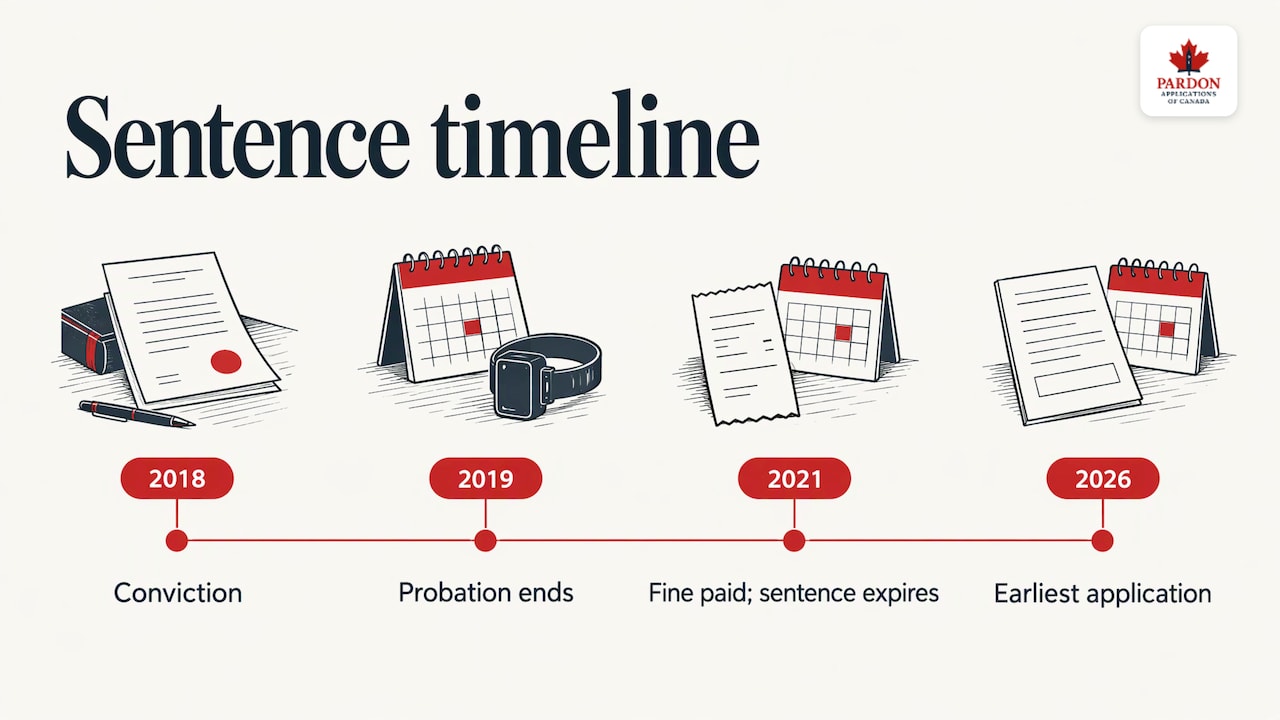
Suppose someone was convicted of a summary offence in 2018 and received a $1,000 fine and 12 months of probation. The probation ended in 2019, but the fine was paid in monthly instalments and the last payment cleared in 2021. The sentence expired in 2021, not 2019. With a 5 year wait for a summary offence committed after March 12, 2012, the earliest date to apply is in 2026. Counting from the probation end date would have produced an application two years too early.
The waiting period, in plain terms
The length depends on the date of your first offence, because the PBC applies the rules in force at that time. Since a March 2020 Federal Court decision, the Board no longer applies the 2010 and 2012 amendments backwards to earlier first offences. The PBC’s eligibility table sets out these periods:
| First offence date | Indictable | Summary |
|---|---|---|
| Before June 29, 2010 | 5 years | 3 years |
| June 29, 2010 to March 12, 2012 | 5 years, or 10 years for serious personal injury offences, prison terms of 2+ years or indictable Schedule 1 offences | 3 years |
| On or after March 13, 2012 | 10 years | 5 years |
The table is drawn from the PBC’s eligibility page. If your history has several convictions, or you are unsure whether an offence was summary or indictable, an eligibility assessment before you apply saves you from a rejected file. Our guide on starting the Pardon process before you are eligible covers what you can prepare while you wait.
If you are reading this because of a conviction for impaired driving, the same rules apply. See our page on DUI record suspensions.
Living with probation while you wait
Probation conditions affect more than the date. They shape your daily life, and a breach can damage a future application.
What every probation order requires
Section 732.1(2) of the Criminal Code makes certain conditions compulsory in every probation order:
- Keep the peace and be of good behaviour.
- Appear before the court when required.
- Tell the court or your probation officer in advance about any change of name or address, and promptly about any change of employment or occupation.
The court can add optional conditions, such as reporting to a probation officer, counselling or no-contact terms.
Can you leave Canada while on probation?
It depends on your order. One optional condition in section 732.1(3)(b) requires you to stay within the court’s jurisdiction unless the court or your probation officer gives written permission to leave. If your order contains it, travel outside that area, and certainly outside the country, needs written permission first. Read your order carefully, ask your probation officer before booking anything, and keep the written permission with you.
Travel to the United States raises a second issue: a Canadian Pardon is not enough on its own to cross the border, as the next section explains.
What happens if probation is breached
Failing or refusing to comply with a probation order is a separate offence. Consequences can include further conditions, an extended order, a fine or imprisonment, according to a Manitoba legal-education guide on criminal law. If you are convicted of another offence during probation, the court can also change the optional conditions or extend the order by up to one year.
A breach conviction is a new conviction. It can add a new waiting period and, for someone who already holds a Pardon, a new indictable conviction can lead to revocation. If you are facing a breach allegation, speak to a lawyer. Once the matter is resolved, we can assess where it leaves your eligibility.
Applying: the steps and where files go wrong
Once your sentence has expired and the waiting period has passed, you apply to the Parole Board of Canada. The PBC’s application page sets out the required elements. In practice the file includes:
- The application form, with a full address history.
- Your RCMP criminal record, obtained through fingerprints.
- Court information from each court that sentenced you, confirming the sentence is complete.
- Local police records checks for the places you have lived.
- Government ID.
- The consent and privacy form.
- The $50 PBC fee.
Our record suspension process guide walks through the documents one by one.
Why the $50 fee is not the whole cost
The PBC filing fee is $50, and it is only one line in the budget. You also pay for fingerprinting, your RCMP record, court documents and local police checks, each from a different provider, and those costs vary by city and by how many courts and police services are involved. Do not budget for the full process at $50. For our own pricing, see the cost of a Canadian Pardon.
Incomplete files are the main risk
The PBC’s 2025-2026 Report to Parliament says it received 15,809 applications that year. Of those, 11,693 (74%) were accepted as eligible and complete, while 4,042 (25.5%) were rejected at screening for ineligibility, a missing or wrong payment, or missing documents. Roughly one in four files did not make it past the first check.
That is where preparation counts. A probation end date that is wrong by a few months, a missing court form, or a stale police check can send a file back and cost you time.
How long it takes
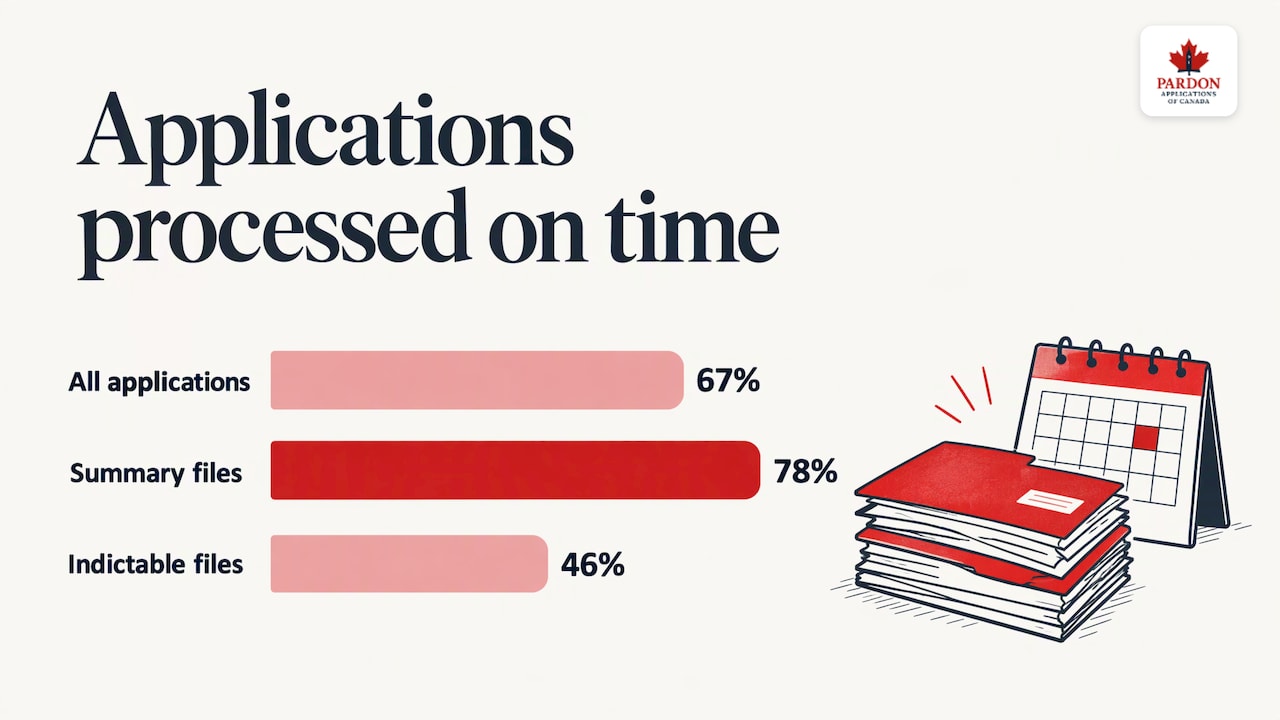
After your application is accepted, the PBC’s targets are within 6 months for summary offences and within 12 months for indictable offences, and up to 24 months when it proposes a refusal. Actual performance varies. In its 2025-26 Departmental Results Report, the Board states that 67% of applications were processed within those timeframes, with 78% of summary and 46% of indictable files on time, and it points to Board member capacity. Our article on how the PBC backlog affects you explains what this means for planning.
Since October 1, 2026, applicants and their designated representatives can also use the PBC’s Service Portal to submit applications, upload documents and track progress. Processing times are the same online or by mail, so the quality of the file is what matters.
Why a guided application suits probation cases
Probation cases are where the paperwork is most easily wrong: multiple sentences, a probation order that began after custody, fines paid over years, courts in more than one province. Each of these affects the date you may apply and the documents the PBC expects.
Our accredited Pardon and Waiver officers offer personalized consultations to assess your eligibility, so you know whether you can apply now or when you will be able to. We then prepare a complete, accurate application, and we keep you informed with dedicated support channels. A complete file is built to reduce the chance of delays or denials, though no one can promise an outcome, because the decision belongs to the Parole Board.
Pardons and travel to the United States
A Canadian Pardon does not carry weight at the U.S. border. The PBC itself notes that a record suspension does not guarantee entry or visa privileges to another country. Someone found inadmissible to the United States may need a U.S. Entry Waiver (Form I-192) to cross legally.
If travel is part of your plans, it helps to treat the Pardon and the waiver as two separate tracks that can be prepared in parallel. We handle both. Read why you may need a U.S. waiver or how I-192 processing times work to see how they fit your situation.
Is a change in the law coming?
In October 2025, Senator Kim Pate spoke in support of Bill S-207, which would amend the Criminal Records Act. As she described it, the bill proposes shorter wait times and automatic, cost-free record expiry once the wait has passed without new convictions. It is a proposal, not law. Under the rules in force today, you still need to apply to the PBC. Waiting for a bill that may or may not pass can mean years of closed doors, so most people with a clear eligibility date do better to plan around the current rules.
Ready to find out where you stand
If your probation is done and you want to know your exact date, or you want your file prepared properly the first time, we can start with your eligibility. Our Pardon Only plan is $80 per month, and you can see what it includes on our Pardon cost page.
For a U.S. Entry Waiver, see our I-192 services, or book a free consultation through Pardon Applications of Canada.
FAQ
Can I apply for a Pardon while I am still on probation?
No. You must complete all parts of your sentence first, including probation, before the waiting period can even start. You can prepare in the meantime by gathering court records, payment receipts and your probation end date.
Does a Pardon mean I am no longer guilty?
No. A record suspension keeps your conviction separate and apart from other criminal records and removes it from CPIC searches, but it does not erase the conviction. It can be revoked, for example after a new indictable conviction.
Can I leave Canada while on probation?
Only if your order allows it. If it includes a condition to stay within the court’s jurisdiction, you need written permission from the court or your probation officer. Always get that permission in writing before you travel.
How long does a Pardon application take?
Once the PBC accepts your application, its targets are 6 months for summary offences and 12 months for indictable ones, and up to 24 months if it proposes a refusal. In 2025-26 only 67% of applications met those targets, so allow extra time.
Does a Pardon let me enter the United States?
Not by itself. Canada’s record suspension does not guarantee entry or visa privileges in another country. People who are inadmissible may need a U.S. Entry Waiver (I-192).
Sources
- What is a record suspension? (Parole Board of Canada)
- Who is eligible for a record suspension? (Parole Board of Canada)
- Criminal Records Act, section 4
- Criminal Code, section 732.1
- Decision-Making Policy Manual, Chapter 12
- Applying for a Record Suspension (Parole Board of Canada)
- Record Suspension Program 2025-2026 Report to Parliament
- 2025-26 Departmental Results Report (Parole Board of Canada)
- Parole Board of Canada launches Service Portal
- Criminal Law and Procedure guide (Community Legal Education Association, Manitoba)
- Senator Kim Pate on Bill S-207, October 2, 2025
Recommended
- Timeline For Pardon Or Record Suspension In Canada
- Pardon (Record Suspension) Waiting Period in Canada: 5 or 10 Years
- Restitution and Pardons in Canada: What Counts Before You Apply
- Ontario Record Suspension: Why the 5 or 10 Year Clock Starts Late
This content brings together contributions from PAC, our content team, and AI tools, with PAC retaining editorial responsibility. It is shared for general information, not legal advice. Laws and procedures may change; seek qualified legal advice for your circumstances.