

Secondary inspection at the U.S. border is a second, more detailed check by a U.S. Customs and Border Protection (CBP) officer. For most Canadians it is routine and ends with admission. If you have a criminal record, it can be the moment you learn that the United States does not see your past the way Canada does. This guide explains why travellers are referred, what happens in the room, how long it can last, and what to do before your next trip if a record is the reason you worry.
TL;DR
- Secondary inspection is a closer look at your admissibility, your documents or your belongings. Being sent there is not an accusation.
- Canadians are referred for many reasons, including an active warrant, a criminal record, or a possible ground of inadmissibility under U.S. law.
- There is no regulatory time limit. Some referrals take about 20 minutes and others take hours.
- The United States does not recognize Canadian Pardons, so a Record Suspension does not on its own clear you for entry.
- If a conviction makes you inadmissible, a U.S. Entry Waiver (Form I-192) is the route to advance permission. Apply before you travel, not at the booth.
Table of Contents
- What secondary inspection is, and what it is not
- Why Canadians are sent to secondary
- What happens during secondary inspection
- How long does it take?
- Possible outcomes
- Does a Canadian Pardon fix this?
- The U.S. Entry Waiver (Form I-192)
- Planning your next trip with a record
- How we can help
- FAQ
- Sources
What secondary inspection is, and what it is not
When you reach a U.S. port of entry, the first officer (primary inspection) asks a few quick questions and checks your documents. If that officer needs more time, more information or a closer look at your records, you are sent to a separate area for secondary inspection.
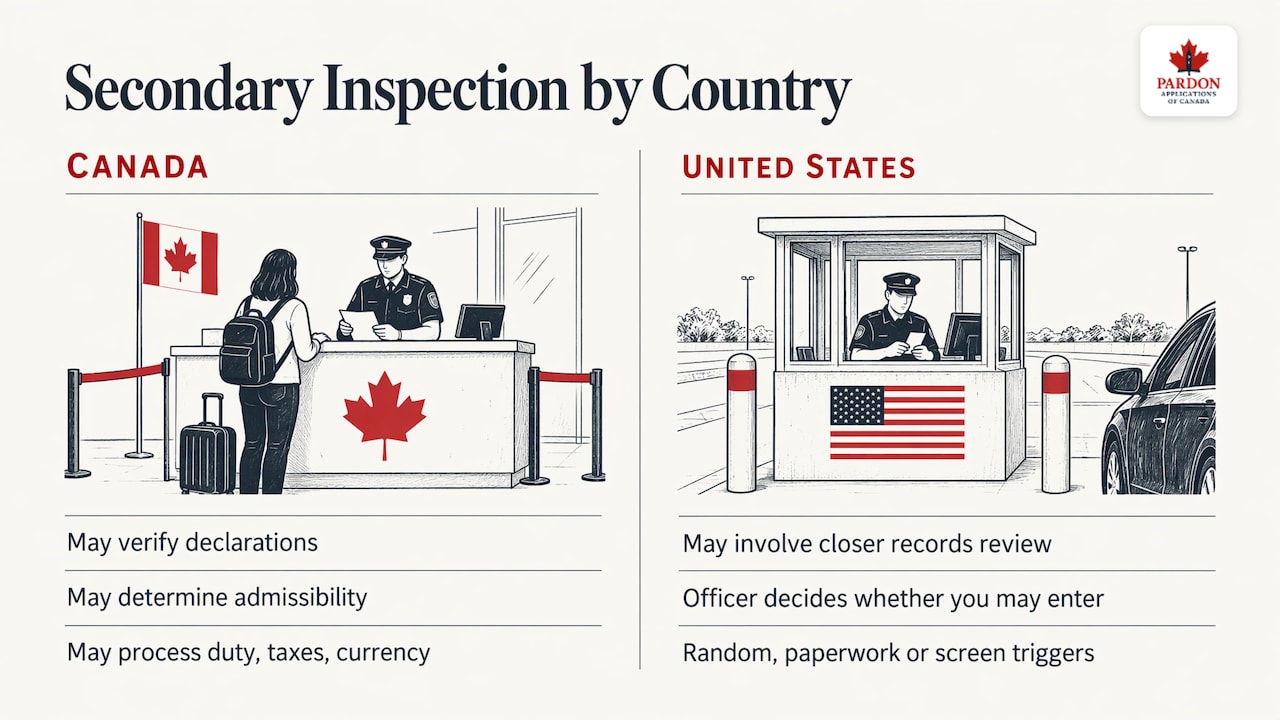
The idea is familiar to Canadians because we run the same system at home. The Canada Border Services Agency explains that it may refer travellers to secondary to verify declarations, determine admissibility, or process duty, taxes and currency. The U.S. version has the same basic purpose, but the stakes for a person with a record are different, because the officer is deciding whether you may enter at all.
A referral can be random, and it can be triggered by something as ordinary as a paperwork question about work or a long-term stay. It can also come from what the officer sees on screen. That last category is the one that worries people with a conviction in their past, and it is the focus of the rest of this article.
Why Canadians are sent to secondary
Officers are working from databases, not just from your answers. Canada and the United States share criminal record information, so an offence that feels distant to you can appear in front of the officer within seconds.
According to a Congressional Research Service report, travellers may be referred if they have an active warrant, a criminal record, or a potential ground of inadmissibility under U.S. law, such as a conviction or admission relating to a crime involving moral turpitude or a controlled substance violation. CBSA’s description of how its own system works notes that travellers above a certain risk-score threshold are generally selected, and that law-enforcement and national-security watchlists are part of the checks.
In practice, common reasons include:
- A conviction that is a ground of inadmissibility. Impaired driving, theft, assault, drug offences and fraud are examples that Canadians ask us about most. Our page on travelling to the U.S. with a DUI walks through the most common one.
- An open warrant or unresolved charge. If you are unsure whether anything is outstanding, you can read how to check warrants in the United States, and it is wise to confirm the status of any Canadian matter with the court that handled it.
- Admissions about past drug use or offences. What you say at the booth can matter as much as what is on file.
- Document or purpose-of-travel questions. Unclear answers about where you are going, how long you are staying or why can prompt a referral even with a clean record.
Many people are surprised to learn that a conviction from decades ago, or one that earned only a fine, can still count. Our article on how Canadians with a criminal record may be surprised by U.S. border restrictions explains why.
What happens during secondary inspection
Expect a waiting area, then a longer conversation with an officer, possibly a different one from the booth. According to a guide by the American Immigration Lawyers Association, officers may ask questions, run checks, take fingerprints and photographs, and search or temporarily keep electronic devices.
Typical questions cover:
- Where you are going, who you are seeing and how long you will stay.
- Your work, home and ties to Canada.
- Your history, including any arrests, charges or convictions, and any past entry refusals.
- Whether you have used or carried controlled substances.
Tell the truth, stay calm and keep answers short and accurate. A misstatement at the border can create a separate and more serious problem than the record itself. If a document is put in front of you for signature, do not sign something you do not understand. You can ask what it is, and a lawyer can advise you on U.S. immigration rights.
Searches of your phone and belongings
The U.S. border is a place where ordinary privacy expectations are lower. Harvard’s Office of the General Counsel notes that officials may conduct routine border searches without probable cause or reasonable suspicion, and that foreign nationals face a CBP review of their admissibility. That covers bags, vehicles and, as above, electronic devices.
Sensible preparation is simple. Carry only what you need, keep your devices charged, know your passwords and understand that anything on a phone could be looked at. Do not carry anything you could not explain.
How long does it take?
There is no fixed answer. Harvard’s guidance states that there is no regulatory time limit for secondary inspection, and that some referrals resolve in about 20 minutes while others take several hours.
Build slack into your plans if you know your record could be an issue: a flight connection, a hotel check-in or a business meeting you cannot move. A person with a clean record and a straightforward trip is usually through quickly. A person whose file shows a conviction in a listed category should expect the longer end of that range.
Possible outcomes
Most secondary inspections end with admission. When they do not, the outcomes typically look like this:
| Outcome | What it means for you |
|---|---|
| Admitted | You continue your trip. Nothing further is needed. |
| Withdrawal of application for admission | A nonimmigrant found inadmissible may be offered the chance to withdraw rather than be referred to an immigration judge. You turn around, with no entry. |
| Formal refusal | A formal denial is recorded. Academic and legal sources note that CBP has broad discretion and that challenging a formal denial is extremely difficult. |
Both of the unfavourable outcomes can follow you. A refusal on file makes the next crossing harder, which is why the smartest move for anyone with a known conviction is to deal with admissibility before they reach the booth.
Does a Canadian Pardon fix this?
This is the question we hear most, and the honest answer is no, not by itself.
A Canadian Pardon (Record Suspension) is valuable. It sets your record aside in the Canadian Police Information Centre (CPIC) database, and the Parole Board of Canada is clear that it does not guarantee entry or a visa to another country. On the U.S. side, CBP’s own guidance says plainly that the United States does not recognize Canadian pardons.
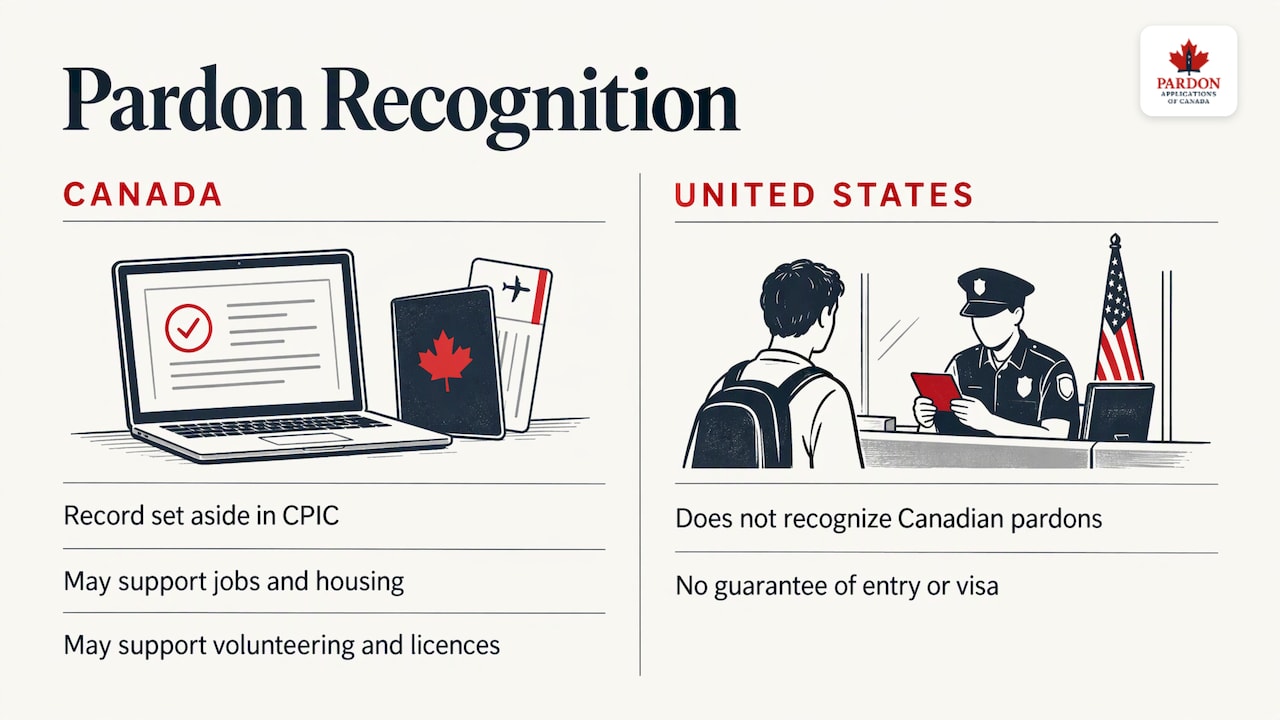
In practice, that means a Pardon can open doors in Canada, such as employment, housing, volunteering and professional licences, while leaving a U.S. entry question unresolved. You can read more in our pages on why a Canadian Pardon will not get you into the United States and whether U.S. Border Patrol recognizes Canadian Pardons.
A related point for anyone with a cannabis history: the same CBP guide explains that U.S. federal law does not change when Canada legalizes marijuana, and that controlled-substance violations can still be grounds of inadmissibility. Our article on the impact of Canada’s marijuana legalization on U.S. border entry goes deeper.
The U.S. Entry Waiver (Form I-192)
If a conviction makes you inadmissible, the established route is advance permission. CBP states that a Canadian inadmissible because of a criminal conviction may apply with Form I-192. The package calls for RCMP records, official court records, and a signed statement about the offence and your rehabilitation.
That is a lot of paperwork, and each piece has to be consistent with the others. Common sticking points include:
- Court records that are incomplete or hard to obtain from older files.
- An RCMP report that does not match the court documents.
- A personal statement that is vague, defensive or inconsistent with what is on file.
Processing is measured in months. See our guide to I-192 processing time for Canadians, which describes weeks of preparation followed by a wait of 6 to 12 months. That is why timing matters: do not book non-refundable travel on the assumption that a waiver will arrive in time.
For a closer look at the requirements, see why you may need a U.S. waiver, what you need to know about U.S. Entry Waivers and the steps to a successful U.S. Entry Waiver. Outcomes are decided by U.S. authorities, and no one can promise approval.
Planning your next trip with a record
If you have any conviction, work through these steps before you leave:
- Get your facts straight. Collect your court documents and know the exact offence, date and sentence.
- Confirm nothing is outstanding. An open charge or warrant changes everything.
- Decide whether you need a waiver. If your offence falls in a category that makes you inadmissible, plan for an I-192 well before travel.
- Allow lead time. Months, not weeks.
- If you already hold a waiver, watch the expiry. Renewal is its own process, covered on our I-192 Renewal page.
- Carry your waiver paperwork when you cross, and answer questions truthfully.
If Europe or other destinations are also on your list, see where you can travel with a Canadian criminal record, including travel to Europe.
Coming home to Canada
The reverse direction has its own secondary inspection. CBSA may send you to secondary on re-entry to verify declarations, check admissibility, or process duty, taxes or currency. Citizens always have the right to enter Canada, but a foreign national with a record faces admissibility rules of their own. Our page on getting into Canada with a criminal record covers that side.
How we can help
A secondary inspection is stressful because it comes as a surprise. You do not have to leave it to chance. At Pardon Applications of Canada, accredited officers assess your situation, explain whether a Canadian Pardon, a U.S. Entry Waiver, or both make sense, and prepare complete applications designed to reduce delays and avoidable errors.

Our Pardon Only plan is $80 per month. The Parole Board of Canada’s filing fee is $50, but that is only one part of the process: records searches, court documents and fingerprints all carry their own costs, so the application as a whole costs more than the filing fee. For U.S. waivers, priority processing is available as a one-off $95 to $150 option. Ready to talk it through? Schedule a free consultation and learn where you stand.
FAQ
Is secondary inspection the same as being denied entry?
No. Secondary inspection is a closer review, and many travellers are admitted afterward. Denial or withdrawal is only one possible outcome, and it is more likely when a record or an unresolved issue is involved.
Can I be sent to secondary if I have a Canadian Pardon?
Yes. The United States does not recognize Canadian Pardons, and the Parole Board of Canada says a Record Suspension does not guarantee entry to another country. An officer may still see the underlying conviction and decide on your admissibility.
How long will I be held in secondary?
There is no regulatory time limit. Some referrals resolve in about 20 minutes, while others take several hours, so leave room in your schedule.
Can officers search my phone?
Officers at the U.S. border may conduct routine searches without probable cause or reasonable suspicion, and may search or temporarily keep electronic devices. Carry only what you need and speak to an immigration lawyer if you have specific concerns.
What should I do if I have a conviction and want to travel to the U.S.?
Check whether your offence makes you inadmissible, then consider applying for advance permission with Form I-192 well before your trip. An accredited officer can review your file and explain your options.
Sources
- Canadian customs: Secondary inspections (CBSA)
- Border Security: Immigration Inspections at Ports of Entry (Congressional Research Service)
- Know Your Rights: What to Do if You Are Detained at a U.S. Port of Entry (AILA)
- Entering or re-entering the U.S.: Guidance about border security measures (Harvard OGC)
- Legalization of Marijuana in Canada (CBP information guide)
- Applying for a Record Suspension (Parole Board of Canada)
- Form I-192: Application for Advance Permission to Enter (CBP)
- How to check San Diego warrants
Recommended
- Canadians With A Criminal Record May Be Surprised By U.S. Border Restrictions
- Canadians denied access into U.S. caught by surprise due to tighter border security
- I-192 Renewal for Canadians: The Wrong Agency Can Cost Months
- Does US Border Patrol Recognize Canadian Pardons?
This content brings together contributions from PAC, our content team, and AI tools, with PAC retaining editorial responsibility. It is shared for general information, not legal advice. Laws and procedures may change; seek qualified legal advice for your circumstances.