


Court records, police records and a criminal record are not the same thing in Canada. Court records are the public file of what happened in a courtroom. Police records are the notes and reports police keep about their own contact with you. A criminal record is the national file, managed by the RCMP, listing charges and sentences. Which one an employer, border officer or volunteer organization sees depends on the kind of check being run, and that difference decides what a Pardon (Record Suspension) can and cannot do for you.
If you have been staring at a background check form wondering what it will actually pull up, this guide is for you. We will walk through each type of record, who can see it, and what happens to each one after a Record Suspension.
TL;DR
- Court records are kept by the courts, are generally public, and show charges, appearances and outcomes.
- Police records are kept by local police and can include contact that never led to a charge. How much is released depends on the type of check.
- A criminal record is the RCMP-managed national file of charges and sentences, searched through the CPIC system.
- A Record Suspension sets your criminal record aside in CPIC, but it does not erase it, and it does not make you admissible to the United States.
- The Parole Board of Canada’s filing fee is $50, but there are many other costs in the process, such as court documents, police checks and fingerprints.
Table of Contents
- The three kinds of record, side by side
- What a criminal record is
- What court records are
- What police records are
- Police record vs criminal record: the difference that matters
- Can I check online if I have a criminal record?
- What a Record Suspension changes (and what it does not)
- Travel: why a Canadian record follows you to the border
- What to do first if you are not sure what is on your record
- What a Pardon really costs
- How we help
- FAQ
- Sources
The three kinds of record, side by side
People use “record” loosely. A police officer, a clerk of the court and an HR manager each mean something different by it. Here is the simplest way to separate them.
| Court records | Police records | Criminal record | |
|---|---|---|---|
| Who keeps it | The court that heard your case | The local police service or RCMP detachment | The RCMP, in the national repository |
| What it shows | Charges, court appearances, outcomes | Police contact, reports, occurrences, sometimes charges that went nowhere | Charges and sentences, plus identity information such as fingerprints |
| Who can see it | Generally the public, at the courthouse or online depending on the court | Police, and others only through a check you consent to | Police and authorized CPIC users, plus the checks you authorize |
| Does it disappear after a Record Suspension? | The court file may still exist | Local police files may still exist | It is set aside in CPIC, not erased |
The first two columns are where most confusion begins, so let us take them one at a time.
What a criminal record is
In Canada, a criminal record is a computerized file managed by the RCMP. It lists your criminal charges and sentences, along with identity information such as fingerprints or DNA, according to Éducaloi’s guide to criminal records. It is a single national file, which is why a conviction in Alberta can show up when you are checked in Nova Scotia.
The RCMP explains that this National Repository of Criminal Records holds personal and fingerprint information, and that authorized CPIC users can access biographical information, criminal charges and court decisions. The same page notes that this information is shared with foreign authorities, which matters a great deal if you travel.
The key point: a criminal record is a centralized database entry. It is not the court’s file and it is not a police officer’s notebook. It is the summary that police services and courts send up to the national level.
What court records are
Court records are what the courts themselves keep about your case. They typically provide information about charges, court appearances and case outcomes, and they are usually available to the public.
So, are criminal convictions public record in Canada? Generally yes. Court decisions and the information in public court files (in Quebec, the plumitif) are considered public and may be accessible online or at the courthouse, unlike the RCMP’s national repository. That is a distinction many people miss. Your criminal record in CPIC is restricted. A courtroom is not.
This openness has practical consequences:
- A journalist, neighbour or prospective employer can sometimes find a court decision without your consent.
- Court decisions published online can sit in search results long after the sentence has been served.
- A court file can exist even where a CPIC entry has been set aside.
Access varies by province and territory
There is no single national rulebook for looking at court files. One legal analysis of the policies of Canada’s provincial and territorial common-law courts found that access policies are inconsistent: some courts acknowledge openness without really adopting it, while others create barriers to public access. In practice, what you can see in Ontario, Quebec or British Columbia, and how (online subscription, courthouse terminal, written request), differs. If you need your own court documents, start with the court registry in the jurisdiction where you were charged.
Public access to court and custody information also works differently across borders. In the United States, for instance, county-level jail in-custody lists and inmate searches are a common way to see who is being held. That has nothing to do with your Canadian record, but it explains why American authorities often find records Canadians assumed were private.
What police records are
Police keep their own information about events: reports, occurrences, and records of stopping or investigating someone. The Éducaloi guide describes police records as information police keep about events when they stop a person, which is a broader category than convictions. That is the reason a police record can feel “bigger” than a criminal record.
What is released from a police file depends on the check:
- Criminal record check. Determines whether you have been charged or convicted. The RCMP says fingerprints may be requested if a name-based check cannot definitively confirm your identity.
- Criminal record and judicial matters check. Typically goes further and can include court orders and other judicial information. Exact content depends on the police service issuing it.
- Vulnerable sector check. Used for work or volunteering with children or other vulnerable people. It can include non-conviction information about charges you were not convicted of, but only in certain circumstances.
We cover what each check typically shows in more detail in our guide to background check types in Canada.
Police record vs criminal record: the difference that matters
The other common question is how a police record differs from a criminal record. Think of it this way.
- A criminal record exists because of charges and sentences that made it to the national database.
- A police record can exist because you were investigated, stopped, named in a report or charged without being convicted.
So you can have a police record without a criminal record. The reverse is rare, since a conviction normally generates both. Where people get caught out is the vulnerable sector check, which is the one most likely to reach beyond convictions. If you are applying to work in a school, hospital or care home, do not assume “I have no criminal record” means a clean result.
Can I check online if I have a criminal record?
Not in the way you might check a credit score. A criminal record check is a process: you apply through police or an accredited service, consent to the search, and sometimes provide fingerprints to confirm identity. Your own court file may be searchable through the relevant court’s online system, depending on the province, but that only shows court records, not your national criminal record.
A practical sequence:
- List every jurisdiction where you were ever charged, including the year and the court location.
- Request a criminal record check through your local police or the RCMP process.
- Request the court documents (information, sentence, proof of fine payment) from each courthouse.
- Compare. If something in the police results does not match the court’s documents, you want to know before an employer or border officer does.
The documents you collect in step 3 are also the ones you will need for a Pardon application. Our checklist of 8 documents to check in the Record Suspension process walks through them.
What a Record Suspension changes (and what it does not)
A Record Suspension, still widely called a Pardon, is the main legal route for setting aside the effects of a conviction. The Parole Board of Canada explains that it sets the criminal record aside in CPIC but does not erase it. Sexual offences continue to be flagged in vulnerable sector checks, and a suspension does not guarantee entry or a visa to another country.
Here is how that plays out across the three record types.
Your criminal record
The entry is set aside and kept separate from other criminal records. That is what changes the result of most standard employer and volunteer checks. For many people, it lifts what feels like an invisible ceiling over jobs, housing and licences.
Your court records
A suspended record does not rewrite history in every public file. A court decision from years ago can still exist in a courthouse or in an online database. A Pardon works on the national criminal record, not on every copy of a public court document. If a particular decision is online and troubling you, raise that early in a consultation so you know what to expect.
Your police records
Local police files are separate from the CPIC entry. How a service treats its own files after a suspension depends on the service and the type of check requested, which is another reason to know exactly what each check can reach.
Employment
Employment can be affected by a criminal record. In Quebec, the Charter of human rights and freedoms protects people with a record suspension from discrimination by employers. For the wider picture across provinces, see our article on how criminal records impact work authorizations in Canada.
Travel: why a Canadian record follows you to the border
The RCMP says the information in the national repository is shared with foreign authorities. For Canadians heading south, that is the heart of the problem: American authorities do not recognize Canadian record suspensions, and entry to the United States is not guaranteed. If you are considered inadmissible, a U.S. Entry Waiver (Form I-192) is the tool that can give you permission to enter for a set period.
That is why the two services belong together. A Pardon addresses Canadian checks. A waiver addresses U.S. admissibility. We explain the gap in why a Canadian Pardon will not get you into the United States, and the planning side in how long an I-192 takes. Travelling to Europe instead? See travel to Europe with a criminal record.
What to do first if you are not sure what is on your record
Uncertainty is the most stressful part. Many people avoid checking for years because they dread what they will find, and they carry the weight of a conviction that may already be old enough to address.
A sensible order:
- Find out what exists. Get your own police check and court documents.
- Confirm your sentence is complete. Applicants must complete all sentences, including paying fines, surcharges, costs, restitution and compensation orders, and they are responsible for the cost of obtaining court documents.
- Check your waiting period. The wait before you can apply depends on the type of offence. You can read about it in our complete guide to Record Suspensions, and about preparing early in starting the Pardon process before you are eligible.
- Decide what you need it for. Work, volunteering, housing and travel each depend on different records.
What a Pardon really costs
The Parole Board of Canada’s application processing fee is $50. That is only the Board’s filing fee. There are many other costs in the process: police record checks, fingerprinting, court documents from each courthouse, and, if you use a preparation service, that service’s fees. Budget for the whole process, not just the form fee. Our Pardon cost page sets out how we handle this.
How we help
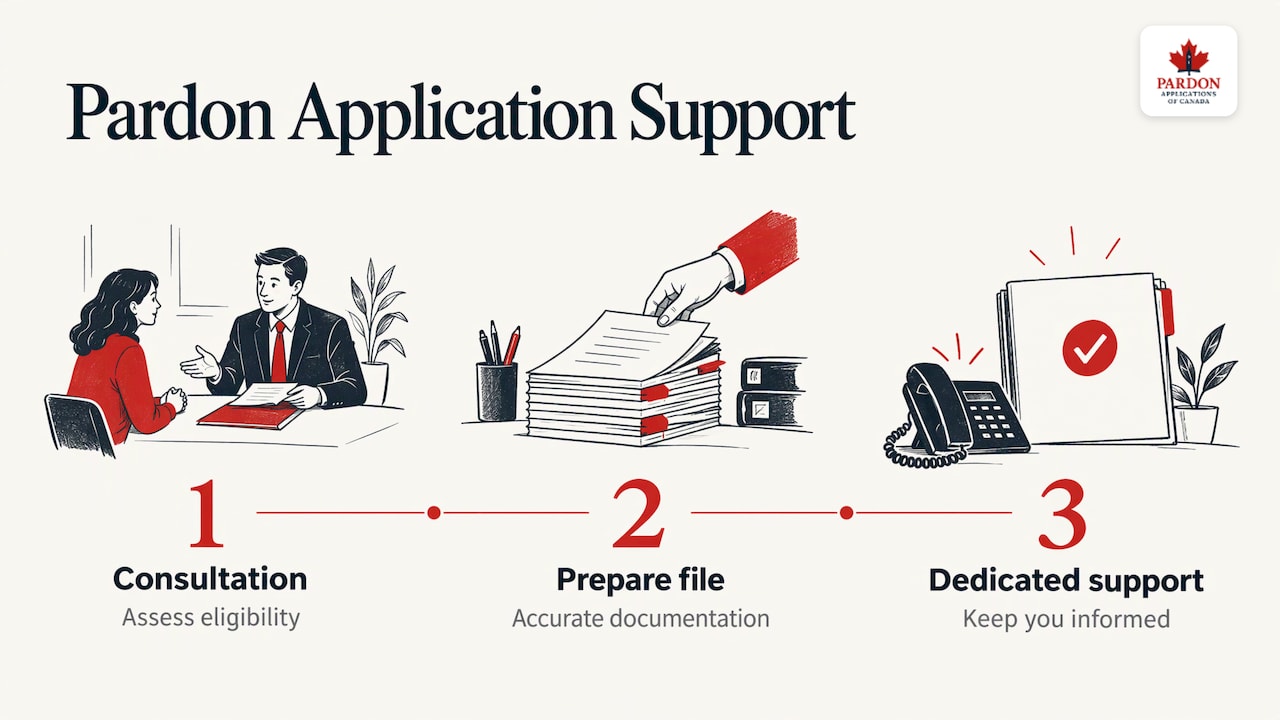
The hardest part of a Pardon is rarely the form itself. It is gathering records from several courts and police services, making sure they agree, and presenting a complete file. At Pardon Applications of Canada, accredited Pardon and Waiver officers give you a personal consultation to assess your eligibility, then prepare complete, accurate documentation and keep you informed with dedicated support. A complete file is designed to reduce avoidable delays, though the Parole Board makes every decision and no outcome can be guaranteed.
Our Pardon Only plan is $80 per month. If you also need to travel to the United States, we prepare U.S. Entry Waiver (I-192) applications and renewals, and offer priority processing for $95 to $150 as a one-off fee.

Ready to talk through your situation? Schedule a free consultation and we will look at what is on your record and which steps apply to you. If you already hold a waiver, see our I-192 renewal service.
FAQ
Are criminal convictions public record in Canada?
Generally, court decisions and the information in public court files are public and may be reached at the courthouse or online. The RCMP’s national repository of criminal records is different: it is restricted to authorized users and to checks you consent to. Access rules differ from one province or territory to the next.
What is the difference between a police record and a criminal record?
A criminal record is the RCMP-managed national file of charges and sentences. A police record is broader and can include information about events where police stopped or investigated someone, even without a conviction. What is released depends on the type of check, and a vulnerable sector check can go furthest.
Does a Record Suspension delete my court records?
No. A Record Suspension sets your criminal record aside in CPIC, but it does not erase it, and it does not automatically remove every public court document. If a specific court decision worries you, ask about it during your consultation.
Does a Canadian Pardon let me enter the United States?
No. American authorities do not recognize Canadian record suspensions, and entry is never guaranteed. People who are inadmissible may apply for a U.S. Entry Waiver (I-192) to request permission to enter.
How much is the Parole Board’s fee for a Record Suspension?
The Board’s filing fee is $50, but the full process involves other costs, including police checks, fingerprints and court documents, plus any preparation service you use.
Sources
- Éducaloi, Criminal records guide
- Tech Safety, Definitions of Legal Terms: Criminal Law
- RCMP, Managing criminal records
- RCMP, Criminal record checks
- Steps to Justice, What is included in a police record check?
- A Legal Analysis of the Access to Court Record Policies of Canada’s courts
- Parole Board of Canada, Applying for a Record Suspension (publication)
- Parole Board of Canada, Applying for a Record Suspension (fee and steps)
- Becker County jail in-custody list
Recommended
- Background Check Types in Canada: What Each One Shows
- A Brief History of the Criminal Records Act in Canada
- Clearing Your Criminal Record Starts by Understanding Record Suspension in Canada
This content brings together contributions from PAC, our content team, and AI tools, with PAC retaining editorial responsibility. It is shared for general information, not legal advice. Laws and procedures may change; seek qualified legal advice for your circumstances.