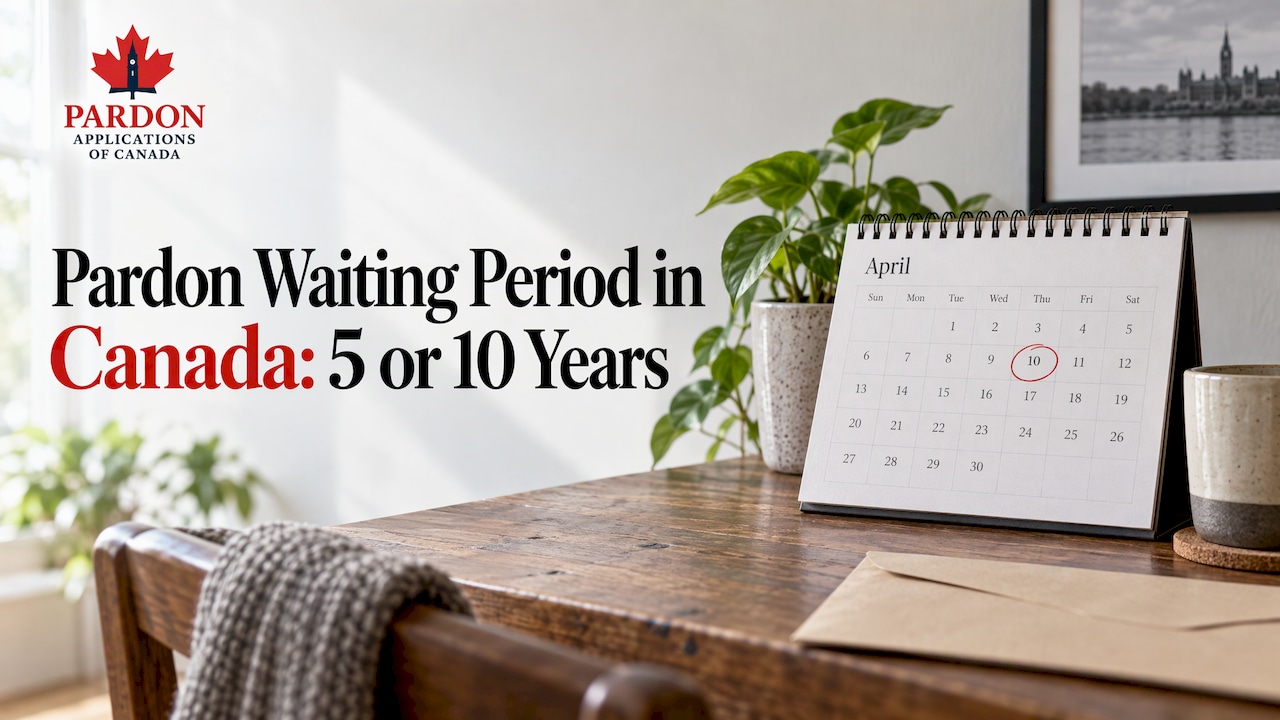
The waiting period for a Canadian Pardon (now officially called a record suspension) is generally 5 years for a summary offence and 10 years for an indictable offence. The clock starts only after every part of your sentence is finished, including probation and payment of fines. That is the short version. The details below decide your own date, and they are where most people get tripped up.
If you have been living in the shadow of a past conviction, knowing exactly when you can apply is the first step toward moving past it. This guide walks you through how the period is set, when it starts, what can postpone it and what happens once you are eligible.
TL;DR
- The standard waiting periods are 5 years for a summary conviction and 10 years for an indictable offence, counted after your sentence is fully completed.
- “Completed” includes jail time, parole, probation and every fine, surcharge, cost and restitution order. An unpaid fine keeps the clock from starting.
- The period that applies is set using the date of your first offence and the way the offence was prosecuted, not simply the sentencing date.
- Some offences, such as certain Schedule 1 offences, can make you ineligible no matter how long you wait.
- The waiting period is not the end of the wait: processing by the Parole Board of Canada (PBC) takes months after you apply.
Table of Contents
- The two standard waiting periods
- Which rules apply to you: the first-offence date
- When the clock actually starts
- Multiple convictions and mixed procedures
- Offences that can block eligibility
- DUI and other common situations
- Can you prepare before you are eligible?
- After the waiting period: how long does processing take?
- What a Pardon costs: more than the filing fee
- Your Pardon and travel to the United States
- How we can help you reach your date with confidence
- FAQ
- Sources
The two standard waiting periods
The rule sits in section 4 of the Criminal Records Act. It sets 10 years after the end of your sentence for an indictable offence and 5 years for an offence punishable on summary conviction. Certain service offences under military law have their own rules.
In plain terms:
| Type of offence | Waiting period |
|---|---|
| Summary conviction (less serious) | 5 years |
| Indictable offence (more serious) | 10 years |
Many common charges can be prosecuted either way, and the Crown chooses. What matters for your Pardon is the way your case actually proceeded, which is recorded in your court documents. If the court cannot confirm it, the PBC says it applies the longest period that could apply, so it is worth getting that paperwork right early.
Which rules apply to you: the first-offence date
The PBC says the applicable waiting period is determined by the date of your first offence, not the date you were sentenced, together with whether the matter was summary or indictable. This is explained on its eligibility page, which lists the periods in force at different times:
- Offences committed before June 29, 2010: 3 or 5 years.
- Offences committed from June 29, 2010 through March 12, 2012: 3, 5 or 10 years.
- Offences committed on or after March 13, 2012: 5 or 10 years.
You may have heard that the law changed in 2010 and 2012 and wonder if it affects an older record. The PBC states that since March 19, 2020 those changes are no longer applied retroactively to applicants whose first offence predates them. Eligibility is assessed under the criteria in force when the first offence was committed.
So if your first offence was years ago and your most recent was recent, the date of the first offence is the one that points to the rules for your whole application. Work it out carefully, because getting it wrong can mean a rejected or returned application.
When the clock actually starts
Most people assume the clock starts at conviction. It does not. According to the PBC, it starts after all your sentences are completed. That covers:
- Imprisonment or a conditional sentence.
- Parole or statutory release.
- Probation.
- Payment of fines, surcharges, costs, restitution and compensation orders.
Weapons and driving prohibitions do not have to be expired, according to the same PBC page.
The payment point catches people out. The PBC says fines, costs and similar amounts should be paid in full as soon as possible because the period starts only once the required payment has been made, and proof of payment must accompany your application. A small surcharge you forgot about from years ago can quietly keep your clock from running. If you suspect something is outstanding, find out now rather than at the application stage.
Our article on why the 5 or 10 year clock starts late in Ontario shows how this plays out in real situations.
A simple worked example
Say someone was convicted of a summary offence and received a fine plus 12 months of probation. Probation ended in one year, but the fine was paid a year after that. The 5 years do not begin when probation ended. They begin when the last piece, the fine, was paid. That is two years of waiting the person never needed to lose.
Multiple convictions and mixed procedures
If you have more than one conviction, the governing period is selected using the date of the first offence, and the way each offence was prosecuted determines whether the summary or indictable period applies. Every sentence and every monetary order has to be completed before the clock starts. In practice, the later, longer or less-completed matter often sets your real date.
Before applying, list each conviction with:
- the offence date and the court location,
- whether it proceeded by summary conviction or indictment,
- the sentence imposed and the date each part ended,
- proof that every fine and surcharge was paid.
That list is the foundation of a clean application. Our guide to the documents to check in the record suspension process goes into each item.
Offences that can block eligibility
The waiting period is a necessary test, but not the only one. The Criminal Records Act generally bars applicants who were convicted of a Schedule 1 offence, or of more than three qualifying indictable or service offences each carrying a sentence of at least two years. A limited Schedule 1 exception exists only if the Board is satisfied that all of these are true:
- you were not in a position of trust or authority toward the victim,
- the victim was not in a relationship of dependency with you,
- no violence, intimidation or coercion was used or threatened,
- you were less than five years older than the victim.
There is also a special rule for people convicted only of a Schedule 3 offence, who may apply before the ordinary period expires once any sentence other than a fine or victim surcharge has expired. When other offences are on the record, the ordinary waiting period applies. All of this is in section 4 of the Act.
If you are unsure whether a particular conviction is on the wrong side of that line, read what offences are ineligible for a Pardon before you spend money.
DUI and other common situations
A conviction for impaired driving in Canada can be dealt with through the record suspension process. Immigration, Refugees and Citizenship Canada says that if you were convicted of driving while impaired in Canada, you must apply for a record suspension. Whether you wait 5 or 10 years depends on how the charge proceeded, and our page on DUI record suspensions and the 5 or 10 year wait breaks that down.
Drug offences follow the same logic, with travel considerations on top. See drug trafficking Pardons in Canada for the specifics.
Can you prepare before you are eligible?
Yes, and it is often the smartest use of a waiting period. You cannot file until the time has run, but you can gather court records, obtain a police record check and confirm that every fine is paid. Our article on starting the Pardon process before you are eligible explains what is worth doing early.
That way, on the first day you qualify, you are ready to file instead of starting a months-long document hunt.
After the waiting period: how long does processing take?
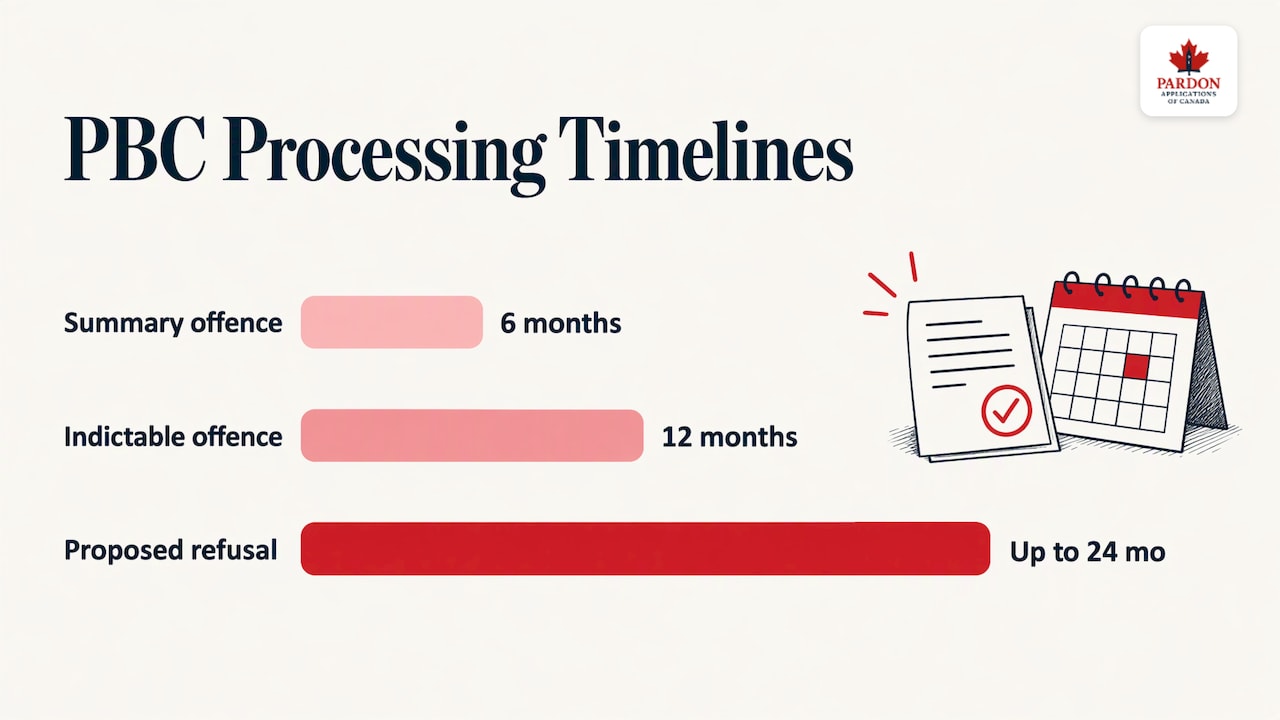
Being eligible is not the end of the wait. After your application is accepted as eligible and complete, the PBC says it strives to process a summary-offence application within six months and an indictable-offence application within 12 months. If the PBC proposes to refuse, final processing can take up to 24 months after acceptance, because you must receive written notice and a chance to respond. These timelines appear on the PBC application questions page.
An incomplete application is the most avoidable cause of delay. Our timeline for a Pardon or record suspension in Canada gives more detail on what to expect at each stage.
What a Pardon costs: more than the filing fee
The PBC’s own application processing fee is $50, and the PBC notes you are also responsible for additional fees tied to your application. Those add up quickly: fingerprinting and police record checks, court documents from each jurisdiction, and certified copies of records. If you hire help, there is that cost too. The $50 filing fee is only one line in the whole budget.
The PBC says you can apply directly without a lawyer or third-party company. Many people choose support because a mistake in dates or documents can set an application back by months. Neither route is a shortcut around the waiting period, and no one can promise a result: the PBC makes the decision.
Your Pardon and travel to the United States
A Canadian Pardon (record suspension) is a Canadian measure. It changes how your record is handled in Canada, but it does not by itself settle whether U.S. border officers will admit you. Some people with a conviction still need a U.S. Entry Waiver (Form I-192) to travel lawfully, even after a record suspension. Our pages on why you might need a U.S. waiver and what to know about U.S. Entry Waivers explain how the two fit together, and U.S. Customs and Border Protection has the final word on your admissibility.
How we can help you reach your date with confidence
At Pardon Applications of Canada, you speak with an accredited Pardon and Waiver officer who can assess your eligibility, confirm when your clock started and prepare a complete, accurate application designed to reduce avoidable delays. We cannot promise an outcome, but we can make sure nothing preventable stands in your way.
Our Pardon Only plan is listed at 80 $ per month, and you can see how it works on the Pardon costs page. To start with a free conversation, visit Pardon Applications of Canada and schedule your free consultation.
FAQ
How long do I have to wait to apply for a Pardon in Canada?
Generally 5 years for a summary offence and 10 years for an indictable offence, counted from the completion of your whole sentence. Older offences may have shorter periods depending on the date of your first offence. The PBC’s eligibility rules set which applies to you.
Does the waiting period start on the day I was convicted?
No. It starts after everything in your sentence is finished: custody, probation and payment of all fines, surcharges and restitution. Weapons and driving prohibitions do not have to be expired. An unpaid fine can keep the period from starting.
Can I apply early if I am close to the end of the waiting period?
Generally no, because the PBC requires the full period to have passed before you apply. The exception in the Act is for people convicted only of a Schedule 3 offence. You can, however, collect documents in advance so you can file the day you qualify.
How long does it take after I apply?
The PBC says it strives to finish a summary-offence application within six months and an indictable one within 12 months after accepting it as complete. A proposed refusal can take up to 24 months. A complete application helps avoid unnecessary delays.
Is a $50 fee all I need to pay?
No. The PBC’s $50 processing fee is only one cost. You will also pay for items such as police record checks, court documents and fingerprinting, plus professional fees if you use a service.
Sources
- Who is eligible for a record suspension? (Parole Board of Canada)
- Determining your eligibility for a record suspension (Parole Board of Canada)
- Got a question about your application? (Parole Board of Canada)
- Applying for a record suspension (Parole Board of Canada)
- Criminal Records Act, section 4 (Justice Laws Website)
- Impaired driving and inadmissibility (Immigration, Refugees and Citizenship Canada)
Recommended
- Timeline For Pardon Or Record Suspension In Canada
- Ontario Record Suspension: Why the 5 or 10 Year Clock Starts Late
- DUI Record Suspension in Canada: PBC Forms, 5 or 10 Years to Apply
- Record Suspension Process in Canada: 8 Documents to Check
This content brings together contributions from PAC, our content team, and AI tools, with PAC retaining editorial responsibility. It is shared for general information, not legal advice. Laws and procedures may change; seek qualified legal advice for your circumstances.