


Yes, many Canadians with a criminal record can still travel to Europe, but it is no longer a matter of simply booking a flight and hoping nobody asks. The UK already requires an advance travel authorisation that asks about convictions, and the EU’s ETIAS system is expected to ask the same. What decides your trip is the type of offence, the sentence you received, how long ago it ended and whether you answer every question honestly.
This guide walks you through how the UK and the EU treat criminal records, what the new forms will ask, where a Canadian Record Suspension fits in, and how to prepare so a past conviction does not cast a shadow over your next trip.
TL;DR
- Europe is not one border. Each country sets its own entry rules, and the UK sits outside the EU system entirely.
- The UK’s ETA asks about convictions, and the UK refuses entry for certain sentences unless 12 months have passed since they ended.
- ETIAS, the EU’s travel authorisation, is expected to start in the last quarter of 2026 and will ask about criminal convictions.
- Never hide a conviction on a form. A false answer can cause far more trouble than the record itself.
- A Record Suspension changes your status in Canada. It does not rewrite how a foreign border officer reads your history, so plan accordingly.
Table of Contents
- Why a criminal record matters at a European border
- Travelling to the UK with a criminal record
- Travelling to the EU: what ETIAS will change
- Does a Record Suspension help when travelling to Europe?
- A step-by-step plan before you book
- Mistakes that turn a manageable record into a travel ban
- What if you also want to visit the United States?
- How Pardon Applications of Canada can help
- FAQ
- Sources
Why a criminal record matters at a European border
Canada’s CPIC database is not open to European border officers the way it is for U.S. officials. Instead, European authorities rely on what you declare, on their own databases and on international information sharing. That is changing quickly. The EU is building systems that will connect travel authorisations to security databases, and the UK already screens applicants before they board.
For you, the practical meaning is simple: the old assumption that “nobody checks” is becoming unreliable. A trip you could once have taken without a second thought may now involve an online form with a question about your past. Preparing early removes the anxiety, and in most cases it is a matter of knowing which rules apply to you.
Travelling to the UK with a criminal record
The UK is not part of the EU, and its rules are the most concrete of any European destination today. Canadians generally need an Electronic Travel Authorisation (ETA) before visiting. The UK government is clear that an ETA does not guarantee entry, and that if you have a criminal record you may want to apply for a Standard Visitor visa instead. Its guidance also explains that an ETA is advance permission to travel, not permission to enter, so a border officer still decides on arrival.
What you must disclose
When you apply for an ETA, declaring criminal convictions is mandatory, and the application cannot go forward without that self-declaration. You cannot skip the question or leave it vague.
Which sentences cause refusal
The same guidance sets out when an ETA must be refused: for a UK or overseas conviction with a custodial or suspended sentence of 12 months or more, or where less than 12 months have passed since the conviction. Read the wording carefully on the official page, because the thresholds depend on the type of sentence.
For visitors, the UK’s separate grounds for refusal say entry must be refused for custodial or suspended sentences under 12 months unless more than 12 months have passed since the sentence ended. They apply a similar 12-month test to recorded non-custodial sentences and out-of-court disposals.
In plain terms:
| Your situation | What the UK guidance says |
|---|---|
| Custodial or suspended sentence under 12 months | Entry must be refused unless more than 12 months have passed since the sentence ended |
| Non-custodial sentence or out-of-court disposal that was recorded | Entry must be refused unless more than 12 months have passed since the sentence or disposal |
| Conviction with a sentence of 12 months or more | An ETA application must be refused, and a visa route is the next step to look into |
This table summarises the guidance and does not replace it. Individual circumstances matter, so confirm the details on the official pages before you apply.
Canadian convictions are judged by their substance
The UK looks at the nature of an overseas conviction rather than its title alone when it asks whether the conduct has a direct equivalent in UK law. According to the same ETA guidance, a conviction for conduct that is not criminal in the UK should not alone cause refusal. That can matter for older Canadian offences, but whether yours qualifies is a question for the UK authorities, not for guesswork.

Travelling to the EU: what ETIAS will change
There is no single European criminal record rule. Each Schengen country has its own authority over who may enter, and until now most short tourist visits have not involved a conviction question. ETIAS is the shift that matters.
Where ETIAS stands
The official EU page states that ETIAS is not currently in operation and that the EU will announce its start date several months before launch. A European Parliament briefing notes that it is expected to start in the last quarter of 2026, once the Entry/Exit System has been fully rolled out. Because a launch date can slip, check the official ETIAS site before you book rather than relying on any article, including this one.
What the application will ask
When you fill out the ETIAS form, you will be asked for details about criminal convictions, past travel to war or conflict zones, and any recent decision requiring you to leave a country. Nobody can say today exactly how each answer will be weighed in your case, and no honest service can promise an outcome.
What happens to your answers
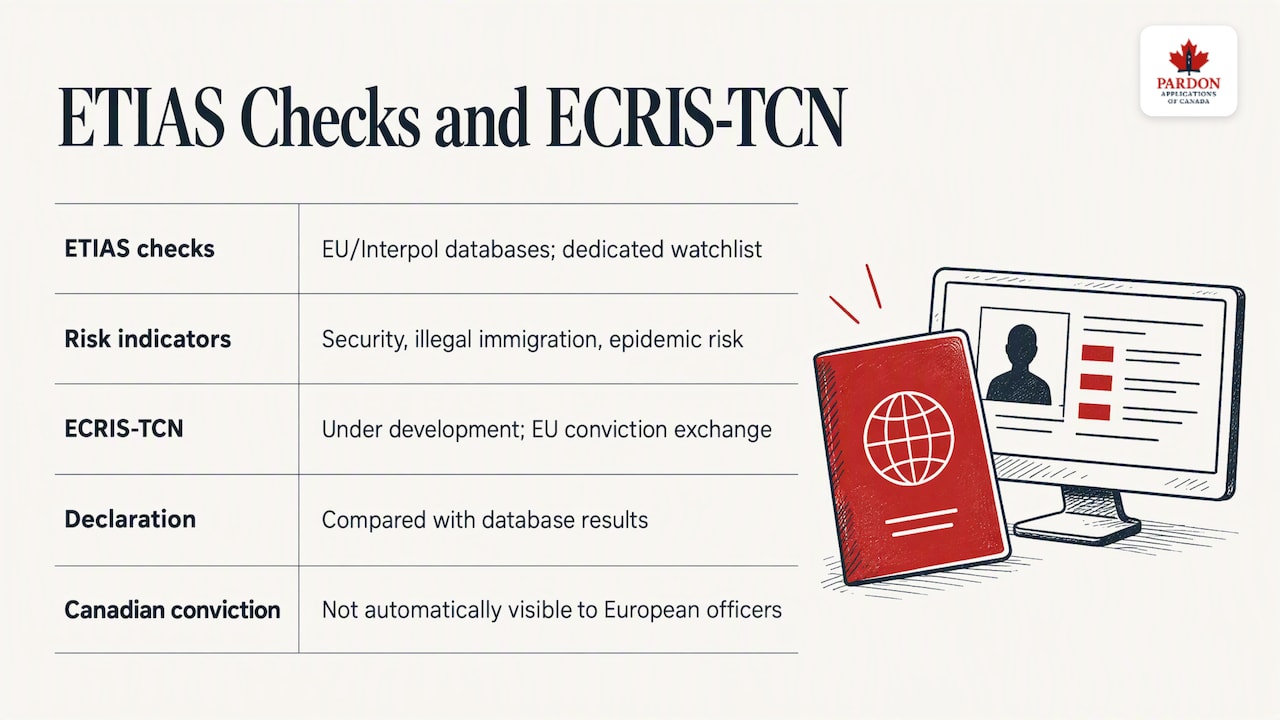
Applications will be checked against EU and relevant Interpol databases, a dedicated ETIAS watchlist and risk indicators tied to security, illegal immigration or high epidemic risk. The same briefing describes ECRIS-TCN, a system under development that will let EU Member States exchange information on the criminal records of third-country nationals convicted in the EU. In other words, a conviction you received in Canada is not automatically visible to European officers, but what you declare, and what appears in those databases, will be compared.
Does a Record Suspension help when travelling to Europe?
A Record Suspension (the term that replaced “Pardon” in the law, though most people still search for a Pardon) separates your conviction from your everyday Canadian life. It sets your record apart from the CPIC database in Canada and, according to Immigration, Refugees and Citizenship Canada, you will no longer be inadmissible to Canada once you have one. That is a real and valuable benefit for anyone who has felt the invisible ceiling of a record at work or in housing.
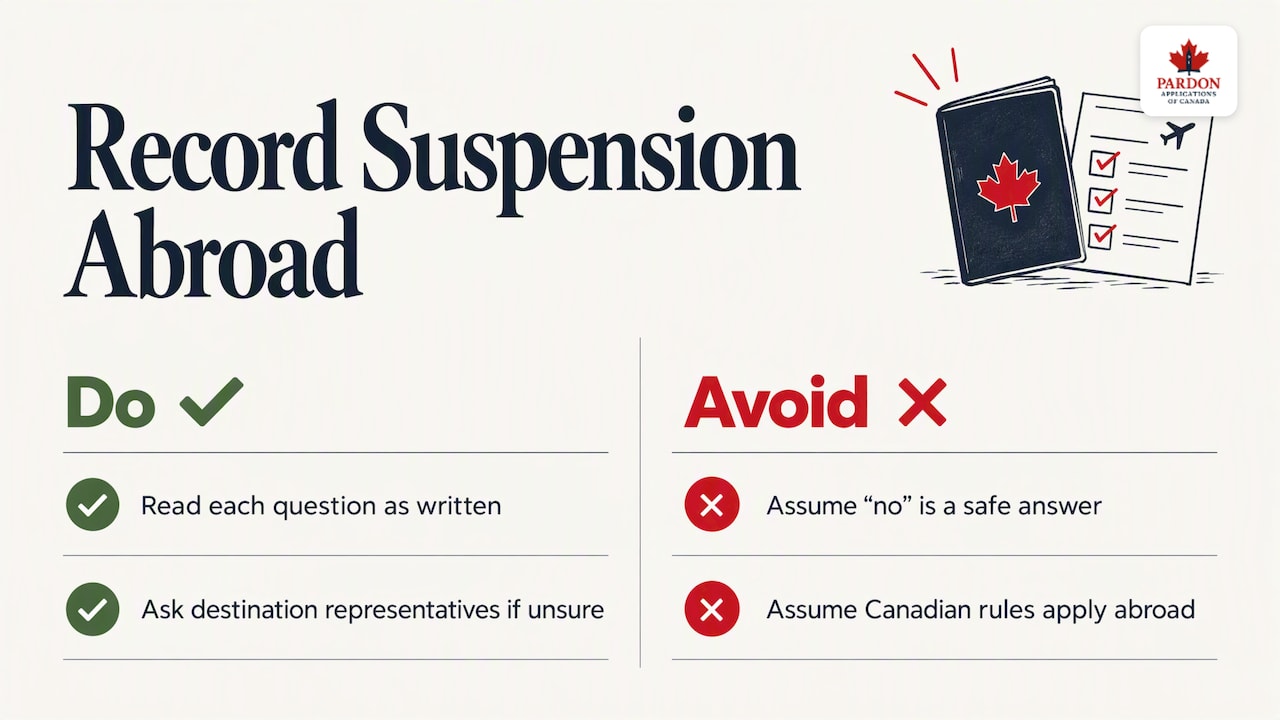
It is important to be realistic about what it does abroad. The rules of the UK and the EU are their own, and a foreign authority decides how to treat a conviction that has been suspended in Canada. The UK and ETIAS forms ask about convictions, and we would not tell you that you can safely answer “no” because of a Record Suspension. Read each question as written, and if the wording leaves you unsure how a suspended record applies, ask the destination country’s representatives in Canada before you submit anything.
What a Record Suspension can do is remove years of uncertainty at home, open employment and volunteer doors, and make planning easier overall. If you want to understand the process itself, our guide to understanding Record Suspension in Canada is a good place to start, and our timeline for a Pardon or Record Suspension explains how long to allow.
A step-by-step plan before you book
The aim is to find out where you stand before you spend money on flights and hotels. Work through these steps in order.
- Gather your paperwork. Collect your court documents, sentence details and any completion certificates. You need to know the offence, the sentence type and the date it ended. Those three facts drive almost every rule above.
- Check your conditions. Probation, bail or a conditional sentence can limit your travel no matter what a foreign border says. If you are on bail, read about travel while on bail and get the permissions you need in writing before you plan anything.
- Identify every country on your route. A trip through London, Paris and Rome involves two different systems. Check each one, including airport transit stops.
- Read the official entry page for each country. The Government of Canada recommends that you check destination requirements on Travel Advice and Advisories well before you travel and contact the destination country’s government representatives in Canada about visa or travel authorisation rules.
- Apply early and answer truthfully. Submit the UK ETA, or later the ETIAS form, with accurate answers. Do not apply the day before you fly.
- Keep a copy. Carry your court documents and your authorisation confirmation. A clear document at a counter can settle a question that might otherwise become a refusal.
- Have a fallback. If a refusal is possible, consider a visa route or a different destination rather than a non-refundable booking.
Mistakes that turn a manageable record into a travel ban
Most of the serious problems we see start with the form, not the conviction. Avoid these.
- Answering “no” when the answer is “yes”. Misrepresentation can lead to a refusal and may affect future applications. Honest disclosure is almost always the safer path.
- Assuming a conditional discharge or old offence does not count. The UK looks at outcomes such as recorded non-custodial sentences and out-of-court disposals as well as jail terms.
- Treating Europe as one place. The UK, Ireland and the Schengen countries each have separate rules.
- Relying on forum posts. Online threads repeat half-remembered rules. Use the government pages and confirm anything you hear.
- Booking before authorisation. Where an authorisation is required, wait until it is approved before paying for non-refundable travel.
What if you also want to visit the United States?
Many Canadians who want to see Europe also cross into the U.S. for work or family, and that border is far less forgiving, because American officials can see Canadian records. A conviction may require a U.S. Entry Waiver (I-192) before you can cross. If that sounds like you, read about why you might need a U.S. waiver and the steps to a successful U.S. Entry Waiver. For a wider picture, our page on where you can travel with a criminal record from Canada covers other destinations.
How Pardon Applications of Canada can help
A clean, complete application is the difference between months of waiting and months of waiting twice. At Pardon Applications of Canada, accredited Pardon and Waiver officers assess your eligibility, prepare the full documentation and keep you informed through dedicated support channels. We cannot guarantee a result, because the decision belongs to the Parole Board of Canada, but we can make sure your application is accurate and complete.
On cost, be aware that the Parole Board of Canada’s filing fee is $50, but that is only one piece. Court records, police record checks, fingerprinting and other documents each carry their own charges. Our Pardon Only plan is $80 per month, and you can see how it works on our Pardon Only pricing page. If you are ready to talk it through, you can schedule a free consultation with one of our officers.

If you need to renew an existing waiver before a trip, see our I-192 Renewal service.
FAQ
Can a Canadian with a criminal record travel to Europe?
Often, yes, but it depends on the country, the offence and the sentence. The UK already asks about convictions through its ETA, and the EU’s ETIAS is expected to do the same. Check each destination’s official page before booking, and answer every question truthfully.
Can you travel to the UK with a criminal record?
Possibly. The UK says an ETA does not guarantee entry, and it may suggest a Standard Visitor visa if you have a record. Certain custodial, suspended and recorded non-custodial sentences lead to refusal unless 12 months have passed, so look at your sentence type and dates closely.
Will ETIAS ask about my criminal record?
Yes. The application is set to ask about criminal convictions, travel to conflict zones and any recent decision to leave a country. It is not yet in operation, and the EU will announce a start date several months ahead.
Does a Record Suspension let me answer “no” on a foreign form?
Not automatically. A Record Suspension changes your standing in Canada, but other countries set their own rules and their forms ask their own questions. Read each question as written, and ask the destination country’s representatives in Canada if the wording is unclear.
Can I get a Canadian passport with a criminal record?
In many cases people can, but it depends on your situation. Our article on obtaining a Canadian passport with a criminal record explains the details.
Sources
- Get an electronic travel authorisation (ETA) to visit the UK, what you can and cannot do
- UK Electronic Travel Authorisation Guidance (advance permission)
- UK Electronic Travel Authorisation Guidance (criminality and disclosure)
- UK Suitability: grounds for refusal, criminality
- ETIAS: what you need to apply
- European Parliament: EU-wide information systems for border management
- Canada.ca: Overcome criminal convictions
- Government of Canada: Bon voyage, but…
Recommended
- Discover Where Can You Travel With A Criminal Record From Canada?
- How to Travel to the US with a Criminal Record
- Can I Travel Abroad for Business with a Criminal Record?
- Can I Obtain a Canadian Passport with a Criminal Record?
This content brings together contributions from PAC, our content team, and AI tools, with PAC retaining editorial responsibility. It is shared for general information, not legal advice. Laws and procedures may change; seek qualified legal advice for your circumstances.