

A charge that never ended in a conviction can still leave a trail. Police files, court files and the RCMP’s national repository may hold information about it, and depending on the type of record check, some of it can surface when an employer, a volunteer organization or a border officer asks. A non-conviction record is not a criminal record in the legal sense, but it can feel like one when it costs you a job offer or a trip. This guide explains what these records are, who can see them, what happens with youth records and travel to the United States, and when a Pardon (record suspension) or a U.S. Entry Waiver is the right next step.
TL;DR
- A non-conviction record means you were charged, but not convicted. Withdrawn charges, dismissed charges and stays of proceedings all fall into this group.
- Whether it appears depends on the check. A fingerprint-based certified check can include non-conviction information held in the national repository where authorized, while local police checks follow each police service’s own policy.
- A Pardon (record suspension) addresses convictions. If your charges ended without one, your question is usually about disclosure, not suspension.
- Youth records are sealed or destroyed after set periods, but they are not permanently invisible, and U.S. border officers can still ask questions.
- If you have been refused entry to the U.S., the usual route is a U.S. Entry Waiver (Form I-192), not a Canadian Pardon.
Table of Contents
- What a non-conviction record is
- Who can see a non-conviction record
- How to find out what is on your record
- Does a Pardon deal with a non-conviction record?
- Youth records in Canada
- Youth records and travel to the United States
- Non-conviction records and U.S. entry
- When a U.S. Entry Waiver (I-192) makes sense
- What it costs: be clear about the numbers
- How we can help
- Practical next steps
- FAQ
- Sources
What a non-conviction record is
The RCMP describes non-conviction information as the result of police charging you with a crime when you were not convicted. It includes withdrawn or dismissed charges and stays of proceedings. The RCMP also maintains the National Repository of Criminal Records, which is where much of this information lives.
In plain terms, three things can be true at the same time:
- You were arrested or charged.
- The matter ended in your favour, or simply ended.
- A record that you were ever charged still exists somewhere.
That third point is what surprises people. The Canadian Civil Liberties Association explains that, unlike a criminal record, which involves a finding of guilt, non-conviction records reflect contacts or investigations without a conviction. Both can still appear on various levels of police record checks, depending on the policy of the local police service.
Discharges: a grey area
An absolute or conditional discharge sits between the two categories. A person is found guilty but is not formally convicted. Discharge records are not kept forever: the Parole Board of Canada states that they must be removed from a criminal record more than one year after an absolute discharge or more than three years after a conditional discharge. Until those periods pass, a discharge can show up on certain checks.
Who can see a non-conviction record
There is no single answer, because there is no single kind of record check. Think of it as layers.
Local police record checks
Most employers ask for a check from your local police service. What that check discloses is set by the service’s own policy, which is why the same file can look different in two cities. The CCLA notes that police practices vary across jurisdictions and that people without convictions may have information disclosed.
Certified, fingerprint-based checks
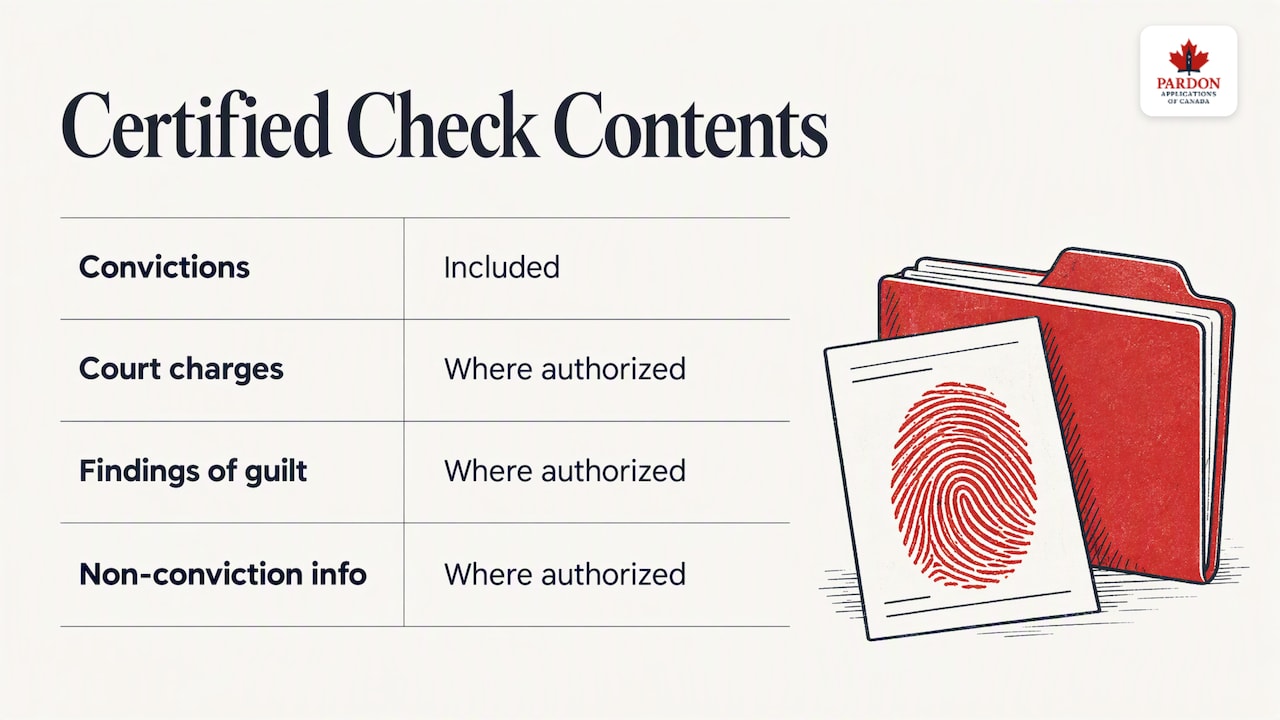
The RCMP says that certified criminal record checks include information on convictions and, where authorized, charges before the courts, findings of guilt, and non-conviction information held in the national repository. This is the most complete check available to you as an individual, and it is the one most likely to answer the question of what is on file.
Limits on release
Release of criminal record information by the RCMP is not unrestricted. It is governed by federal legislation and ministerial directives that name authorized recipients such as police services, parole agencies and employers with consent. The same directive says information must not be disclosed where that would contravene an Act of Parliament. In practice, that means consent matters: an employer generally cannot pull your file without your agreement.
How to find out what is on your record
You cannot fix what you cannot see, so start by finding out. A sensible order:
- Request a certified, fingerprint-based check through the RCMP process. It covers the national repository, which is the broadest source. The RCMP’s explanation of how your information is used is a good place to confirm what a certified check includes.
- Request a check from your local police service. This shows you what an employer or volunteer organization would likely see in your area.
- Ask the court where your matter was heard how it recorded the outcome, and keep any paperwork you already have showing the charge was withdrawn, dismissed or stayed.
- Compare the results. If a result does not match what happened, raise it with the police service or the RCMP with your court documents in hand.
Not every conviction or outcome reaches the national system at the same time, and local police services say so themselves, so a recent matter may not appear yet. If you have lived abroad, our guide to getting a police record check from outside Canada walks you through the options.
Does a Pardon deal with a non-conviction record?
This is where people often mix up the terms. A Pardon, formally a record suspension, exists for people who were convicted and have completed their sentences and waiting periods. The Supreme Court of Canada has affirmed that the primary aim of a pardon is removing the negative consequences of a conviction once a person has shown law-abiding behaviour. If you were never convicted, there is no conviction for a Pardon to set apart.
Two other tools are easy to confuse with it:
- Expungement is a separate process for certain historical convictions. Under the Expungement of Historically Unjust Convictions Act, it allows destruction or permanent removal of judicial records of eligible convictions from federal databases. It applies to specific historical offences, not to ordinary non-conviction records.
- Record suspension keeps a criminal record separate from other records. The Parole Board describes it as a way to remove barriers to reintegration, while expungement recognizes historical injustice.
So what does this mean for you? If your only entry is a charge that was withdrawn, dismissed or stayed, you are not waiting on a Pardon. If you also have a conviction somewhere in your history, even an old one, that is the point where a Pardon can change your situation. Our overview of how record suspension works in Canada explains who qualifies, and how to get a Pardon in Canada lays out the steps.
Youth records in Canada
Youth records follow different rules. They are managed under the Youth Criminal Justice Act and are generally sealed or destroyed after defined timeframes, although they can be accessed or disclosed in specific, limited circumstances set out in the Act.
The RCMP gives these periods:
| Type of youth offence | What happens to the record |
|---|---|
| Summary offence | Destroyed three years after the sentence is completed |
| Indictable offence | Sealed five years after the sentence is completed |
A new offence can extend these periods. Also, protection runs both ways: the Department of Justice notes that unauthorized disclosure of youth record information is a criminal offence under the Youth Criminal Justice Act, punishable by summary conviction or up to two years of imprisonment on indictment.
That is reassuring. But the next section is the part that catches families off guard.
Youth records and travel to the United States
Canadian youth records are confidential, but they are not permanently invisible. The Province of British Columbia states that foreign countries may still gain information through international cooperation or by asking questions at the border. A U.S. officer can ask whether you have ever been arrested, and a vague or incorrect answer can create a bigger problem than the original matter.
There is also a published example of how this plays out. A U.S. Customs and Border Protection document describes a Canadian with a Fingerprint Sheet for juvenile offences who was allowed to withdraw an application for admission. That is one case, not a rule, and outcomes differ from person to person. It does show that a youth record can matter at the border even when Canadian law treats it as sealed.
If you or your child has a youth record and plans to cross, consider these steps before you go:
- Find out what exactly is on file, using the checks described above.
- Keep court and sentencing documents in a safe place.
- Answer officer questions truthfully and consistently.
- If you have ever been turned back, speak to an accredited waiver specialist before you try again.
Our article on why the United States cares about your Canadian criminal record explains the background in more detail.
Non-conviction records and U.S. entry
Canada and the United States share access to criminal record and public safety information. Travel.gc.ca warns that a person with a criminal record may be refused entry to the U.S. The word to notice is “may”: admissibility decisions are made by U.S. officers, case by case, and a charge that did not end in a conviction is treated differently from a conviction. Still, if a charge appears in the data shared across the border, expect to be asked about it.
For your preparation, the practical points are:
- Know the outcome of every charge. Withdrawn, dismissed, stayed, discharged and convicted are different outcomes with different consequences.
- Carry proof. Documents showing the result of the matter are far more convincing than your memory.
- Do not assume a Canadian Pardon fixes U.S. access. It does not, as we explain in why a Canadian Pardon won’t get you into the United States.
Trusted traveller programs are stricter still. U.S. Customs and Border Protection says Global Entry applicants may not qualify if they have been convicted of a criminal offence, have pending criminal charges, or have received a criminal pardon from any country.
When a U.S. Entry Waiver (I-192) makes sense
If a U.S. officer has found you inadmissible, your path to lawful entry is a waiver. U.S. Customs and Border Protection explains that inadmissible nonimmigrants may apply for advance permission to temporarily enter the United States using Form I-192.
The application requires a verified criminal record, or evidence that you have none, from the RCMP, dated and endorsed within 15 months of submission, according to the same CBP page. That detail matters for timing. An RCMP result that is too old can delay the whole file, so the order in which you gather documents makes a real difference.
What tends to go wrong is not the form itself but the package around it: missing court documents, inconsistent dates, or an incomplete explanation of the circumstances. We cover this in steps to ensure a successful U.S. Entry Waiver and why you may need a U.S. Waiver. For a realistic sense of timing, see our page on I-192 processing time. No one can promise a result, because the decision rests with the U.S. authorities, but a complete and accurate application gives your case its best footing.
What it costs: be clear about the numbers
People researching Pardons often see one figure and assume it is the whole bill. The Parole Board of Canada’s filing fee is $50, but there are many other costs in the process, such as the records, documents and checks that must accompany an application. A full Pardon application does not cost $50.
On our side, the Pardon Only plan is $80 per month, and the details are on our Pardon costs page. If you want a U.S. waiver file moved along faster, priority processing is a one-off $95 to $150, described on our U.S. waiver costs page. For ways to keep expenses down, read saving money during the Pardon application process.
How we can help
Whether you are holding an old conviction, a youth record, or a file that ended without one, the hardest part is often not knowing where you stand. Pardon Applications of Canada pairs you with accredited Pardon and Waiver officers who assess your situation, tell you plainly whether a Pardon or a U.S. Entry Waiver fits, and then prepare a complete application with support along the way.

If you want a straight answer about your record, schedule a free consultation and bring whatever paperwork you have. You can also browse all our services or see how a U.S. Entry Waiver application works from start to finish.
Practical next steps
If you are carrying the weight of a charge that went nowhere, here is a simple order of action:
- Collect every document from the case: court outcome, release papers, any letters.
- Request a certified check and a local police check, and compare them.
- Decide what you need the record to do for you: pass an employer’s screening, support a volunteer application, or clear the way across the border.
- If any conviction appears, or a U.S. officer has turned you away, speak to an accredited specialist before you apply or travel.
The shadow of a past charge is real, but it is also something you can measure, and once you know exactly what is on file, you can plan around it with confidence.
FAQ
Can you check if you have a criminal record in Canada?
Yes. A certified, fingerprint-based check through the RCMP process is the most complete option, and it can include non-conviction information held in the national repository where authorized. You can also request a check from your local police service to see what an employer in your area would likely receive.
Does a withdrawn or stayed charge show on a police record check?
It can. Withdrawn or dismissed charges and stays of proceedings are non-conviction information, and whether they are disclosed depends on the type of check and on the local police service’s policy. Request your own check first so you know what is there.
Can a youth record stop me from entering the United States?
Possibly. Youth records are confidential in Canada and are sealed or destroyed after set periods, but foreign authorities may still learn of them through international cooperation or by questioning you at the border. If you have been refused entry, a U.S. Entry Waiver may be the next step.
Will a Canadian Pardon clear a non-conviction record for U.S. travel?
No. A Pardon addresses convictions in Canada and does not give you the right to enter the United States. If you have been found inadmissible, advance permission is requested through Form I-192.
Sources
- Managing criminal records, Royal Canadian Mounted Police
- How your personal information is used, Royal Canadian Mounted Police
- Ministerial directive concerning the release of criminal records, Public Safety Canada
- What is a Criminal Record?, Canadian Civil Liberties Association
- Frequently asked questions about expungement, Parole Board of Canada
- What is expungement?, Parole Board of Canada
- Youth Records, Department of Justice Canada
- Youth Records, Province of British Columbia
- United States travel advice, Government of Canada
- Form I-192, U.S. Customs and Border Protection
- Global Entry FAQ, U.S. Customs and Border Protection
- CBP report on a juvenile record and admission
Recommended
- Getting Into Canada with a Criminal Record
- Clearing Your Criminal Record Starts by Understanding Record Suspension in Canada
- Can a Non-Conviction Record Affect an Immigration Application?
- Record Suspension Process in Canada: 8 Documents to Check
This content brings together contributions from PAC, our content team, and AI tools, with PAC retaining editorial responsibility. It is shared for general information, not legal advice. Laws and procedures may change; seek qualified legal advice for your circumstances.