



In Canada, “background check” is an everyday label for several different checks. The main ones are a criminal record check, a criminal record and judicial matters check, and a vulnerable sector check. A fingerprint-based certified check from the RCMP sits beside them. Each one searches different records and discloses different information, and the right one depends on who is asking and why. If you have a record, the difference decides whether an old conviction follows you into a job interview, a volunteer role or a border crossing.
This guide explains each type in plain language, shows what employers can and cannot ask for, and explains where a Record Suspension (a Pardon) changes the picture.
TL;DR
- Most employers ask for a police record check. In Ontario there are three levels: criminal record check, criminal record and judicial matters check, and vulnerable sector check.
- A fingerprint-based certified criminal record check comes from the RCMP and is a different product from a local police check.
- Only local police can complete a vulnerable sector check. It goes deepest and is reserved for work with children or vulnerable people.
- A Pardon (Record Suspension) changes what most checks show, but vulnerable sector checks can still reach suspended information, subject to ministerial approval.
- A Canadian Pardon does not by itself clear you to enter the United States. That takes a separate U.S. Entry Waiver.
Table of Contents
- Why “background check” means different things
- The three police record checks (Ontario’s model)
- Criminal record check vs. police information check
- The fingerprint-based certified criminal record check
- Vulnerable sector checks: who needs one and why
- What employers can ask for
- How to find out what is on your record
- When a record leaves you stuck: Pardons and waivers
- What a Pardon application really costs
- Ready to move past your record?
- FAQ
- Sources
Why “background check” means different things
When a hiring manager says “we’ll run a background check,” they may mean a police search, a call to your former employer, a degree verification or all three. The police part is the one that touches your criminal history, so it is the part this guide focuses on.
In Ontario, the province’s own guidance explains that a police record check, also known as a background check, searches police records on an individual. Other provinces use similar language, though the names and the agencies that issue the checks vary. Terms like “Police Information Check” (PIC), “Criminal Record Check” (CRC) and “Police Criminal Record Check” often describe overlapping products. That is why so many people are confused about which one they need.
The practical rule: always ask the person requesting the check exactly which check they require, and ask whether it must come from your local police service or from the RCMP. Ordering the wrong one costs you time and money.
The three police record checks (Ontario’s model)
Ontario’s framework is the clearest published breakdown, and it is a useful template for understanding checks elsewhere. The province names three types of police record check, each disclosing more than the one before.
1. Criminal record check
This is the narrowest. It discloses applicable criminal convictions. It is the level many employers need for ordinary jobs, such as retail, office or trades work, where nothing about the position involves care of vulnerable people.
2. Criminal record and judicial matters check
This check goes further. In addition to convictions, it includes absolute and conditional discharges, outstanding charges, arrest warrants and certain judicial orders. If you have a charge that is still before the courts, or a conditional discharge that has not yet run its course, this is the level at which it can appear.
3. Vulnerable sector check
This is the deepest. It includes everything in the criminal record and judicial matters check, plus specified non-criminal findings and information. In Ontario, people in positions of trust or authority over children or vulnerable persons may be asked for one. We cover it in detail below.
Quick comparison
| Check | What it generally discloses | Typical use |
|---|---|---|
| Criminal record check | Applicable criminal convictions | General employment, licences |
| Criminal record and judicial matters check | Convictions plus discharges, outstanding charges, warrants, certain judicial orders | Roles requiring a fuller court picture |
| Vulnerable sector check | All of the above plus specified non-criminal information | Work or volunteering with children or vulnerable people |
This table reflects Ontario’s definitions. If you live in another province, confirm the exact wording with your local police service.
Criminal record check vs. police information check
People search for this comparison more than almost any other, because the names sound interchangeable. The key difference is what each one searches and who is allowed to run it.
The Edmonton Police Service explains that a private-provider Criminal Record Check only indicates whether a criminal record exists. A Police Information Check may also disclose pending court appearances, relevant provincial offences and orders and, for vulnerable sector checks, local police records. The same page notes that private providers cannot conduct vulnerable sector checks.
In short:
- Criminal record check (name-based, private or police): answers a narrow question, usually whether a record exists in the national database.
- Police information check: issued by a police agency, with a broader search that can reach local records and court information.
The result wording matters too. A result of “No Information to Disclose” is treated differently from the process used when a certificate contains relevant police information. If your certificate is flagged for further review, expect a longer wait and, in some services, a separate disclosure step.
If you have ever been told your check “came back clean” from one provider and then “flagged” by another, this is usually why. The two were not searching the same things.
The fingerprint-based certified criminal record check
A certified criminal record check is the most authoritative version of a criminal record search in Canada, because it is fingerprint-based rather than name-based. Name-based searches can produce mistakes when two people share similar names or dates of birth. Fingerprints settle identity.
In British Columbia, the RCMP explains that police agencies provide Police Information Checks, while the Canadian Criminal Real Time Identification Services provides a certified, fingerprint-based check. Individuals can obtain one by having fingerprints taken at a local police service, and some services direct applicants to an accredited fingerprinting company.
The RCMP lists several certified products, and they are used for different purposes:
- For employment and volunteer purposes, the certified check lists conviction and active discharge information.
- For visa, border crossing, foreign travel or work applications, the certified products disclose conviction information.
- The RCMP also offers certified products for vulnerable sector checks, name changes and Record Suspension applications.
What it costs
The federal processing fee for a certified criminal record check is $25. That fee is often charged in addition to local police or third-party fingerprinting fees, so the total is higher than $25. Confirm the current amount on the RCMP page before you order.
If a foreign authority asks for your Canadian police certificate and requires it in another language, certified translation of police clearance certificates is the usual route, and it is worth planning for early because fingerprint-based documents often need to be submitted alongside the translation.
Vulnerable sector checks: who needs one and why
A vulnerable sector check is the one people worry about most, and it is the one with the strictest legal limits.
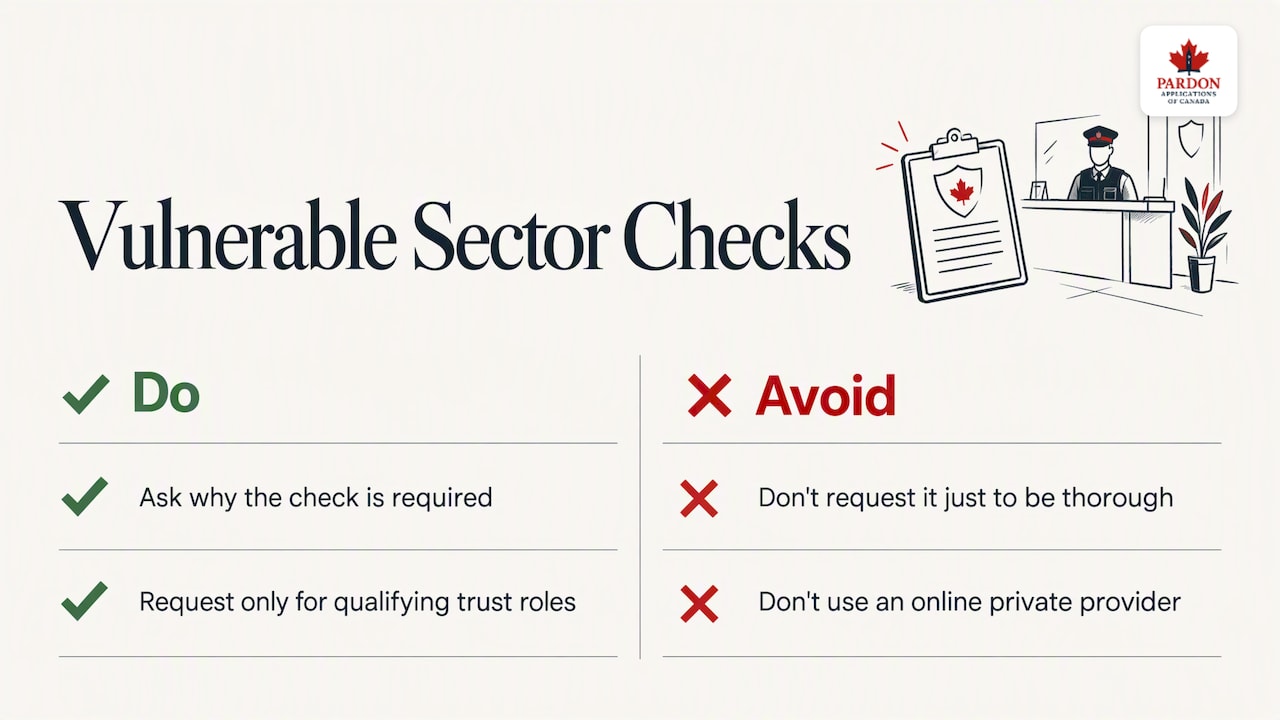
In Ontario, people in positions of trust or authority over children or vulnerable persons may be asked for a vulnerable sector check. Think of teachers, daycare staff, coaches, personal support workers, and volunteers at youth organizations or seniors’ residences. The check includes criminal record and judicial matters information plus specified non-criminal information. It must be completed by local police, so an online private provider cannot issue one.
The RCMP emphasizes that vulnerable sector checks must only be requested for positions that meet strict legal requirements under the Criminal Records Act. An organization cannot simply decide to ask for one because it feels more thorough. If you are asked for a vulnerable sector check for a job that does not involve that kind of trust relationship, you can ask the employer to explain the basis for the request.
Pardons and the vulnerable sector
This is where a Record Suspension needs careful explanation. For employment and volunteer certified checks, the RCMP lists conviction and active discharge information. But for vulnerable sector checks, suspended (pardoned) information may also be included, subject to minister approval.
That does not make a Pardon pointless. For most employment, housing and general background screening, a Record Suspension is exactly the shift people are hoping for: the shadow of a past conviction no longer sits over every application. It does mean that if your career path involves work with children or vulnerable people, you should understand how the vulnerable sector rules apply to your specific record before you count on a suspended record staying out of view.
What employers can ask for
A police check is only one part of employment screening. Employers also use reference calls, education and employment verification, and sometimes credit checks for roles involving money.
On the legal side, Indeed’s Canadian career guidance notes that employers are restricted to requesting information that is relevant to the job being applied for. The same page says employers use these checks to assess honesty and experience and cannot ask for private information that does not pertain to the job.
What that means in practice:
- A warehouse employer usually has little reason to request a vulnerable sector check.
- A bank or a government role may reasonably ask for a criminal record check.
- You are entitled to ask which type of check is required and why.
- You normally have to consent before a check is run on you.
For Ontario residents, our article on what information can be disclosed in criminal background checks explains how the province moved to define the limits on disclosure.
How to find out what is on your record
Before an employer sees your check, you can see it yourself. A few practical steps:
- Decide which check you need. Ask the requester for the exact name of the check. If it is a general employment check, a local police record check may be enough. If it is for immigration, travel or a Record Suspension application, a fingerprint-based certified check is usually the right route.
- Order from the right body. Local police for police record checks and vulnerable sector checks. The RCMP, directly or through an accredited fingerprinting company, for a certified check.
- Give yourself time. Fingerprint-based checks can take longer than name-based ones, and flagged results can take longer still.
- Keep the result. A certified check is often valid only for the purpose and the period the requester specifies, so ask how recent it must be.
Seeing the result yourself matters because errors and old entries do occur. If something appears that you did not expect, you can address it before an employer or a border officer raises it.
When a record leaves you stuck: Pardons and waivers
If your check shows a conviction and it is holding you back, there are two separate paths, and they solve different problems.
Record Suspension (Pardon)
A Record Suspension sets aside a conviction for which you have completed your sentence and waited the required period. It addresses the domestic problem: employment, housing, volunteering and licensing screens where a conviction would otherwise show. Eligibility depends on the offence and the time elapsed since you completed all parts of your sentence. Our guide to understanding Record Suspension in Canada walks through the basics, and you can read how you may be able to start preparing before you are eligible.
U.S. Entry Waiver (I-192)
A Canadian Pardon is a Canadian measure. It does not by itself let you cross into the United States. We explain the reasons in why a Pardon will not get you into the United States. If a U.S. officer has found you inadmissible, the route is a U.S. Entry Waiver, and our overview of U.S. Entry Waivers covers what that involves.
Coming into Canada with a record
The reverse also matters. Immigration, Refugees and Citizenship Canada states that criminal inadmissibility to Canada can be overcome by a record suspension, individual rehabilitation, or by being deemed rehabilitated, depending on the seriousness of the offence and the time elapsed. For more, see our piece on getting into Canada with a criminal record.
What a Pardon application really costs
People often hear a single figure and assume that is the whole bill. The Parole Board of Canada’s filing fee is $50, but there are many other costs in the process: fingerprinting, police and court record searches, document fees and the work of assembling a complete package. Budgeting for all of it up front avoids unpleasant surprises. Our page on saving money during the Pardon application process offers practical ideas.
Ready to move past your record?
If your background check shows something you would rather leave behind, you do not have to sort out eligibility and paperwork alone. Pardon Applications of Canada offers personalized consultations with accredited Pardon and Waiver officers who help assess your eligibility and prepare a complete, accurate application, aimed at reducing avoidable delays. We cannot promise any particular outcome, since the decision belongs to the authorities, but careful preparation puts your application in the strongest position it can be in.

Our Pardon Only plan is published at $80 per month, and you can see how it works on the Pardon costs page. If you would like to talk it through first, you can start from our main site and schedule a free consultation. You can also read the step-by-step Record Suspension process before you decide.
FAQ
What kind of background check do most employers use?
Most employers ask for a police record check at the criminal record check level, often alongside reference and employment verification. Which check applies depends on the job, and employers are limited to information relevant to the position. Ask the employer to name the exact check so you order the correct one.
Is a criminal record check the same as a police information check?
No. A private-provider Criminal Record Check mainly indicates whether a record exists. A Police Information Check, issued by police, may also disclose pending court appearances and relevant provincial offences or orders. Names vary by province, so confirm what your local police service includes.
Can a private company run a vulnerable sector check?
No. Vulnerable sector checks must be completed by local police. Private providers cannot conduct them, so if a volunteer or job role asks for one, apply through your local police service.
Will a Pardon hide my record from every check?
Not necessarily. For employment and volunteer certified checks, the RCMP lists conviction and active discharge information. Vulnerable sector checks may include suspended information, subject to minister approval. A Pardon is still a major step for most screening, but your situation depends on your record and the role.
How do I find out if I have a criminal record in Canada?
The most reliable way is a fingerprint-based certified criminal record check, with fingerprints taken at a local police service or an accredited fingerprinting company. The federal processing fee is $25, and local or third-party fees are often added on top.
Sources
- Police record checks, Ontario.ca
- Police Information Check FAQ, Edmonton Police Service
- Obtain a criminal record check (Police Information Check), RCMP British Columbia
- Types of certified criminal record checks, RCMP
- Processing times and fees, RCMP
- What Is a Background Check?, Indeed Canada
- Can I enter Canada if I am criminally inadmissible?, IRCC
Recommended
- How Do Criminal Records Impact Work Authorizations in Canada?
- How to Get a Police Record Check from Outside Canada
- Non-Conviction Records in Canada: What Shows Up and What to Do
- Record Suspension Process in Canada: 8 Documents to Check
This content brings together contributions from PAC, our content team, and AI tools, with PAC retaining editorial responsibility. It is shared for general information, not legal advice. Laws and procedures may change; seek qualified legal advice for your circumstances.