



In Canada, a Pardon and an expungement are two different things. A Pardon is now officially called a record suspension. It keeps your criminal record separate from other records, but it does not erase the conviction. Expungement is a much narrower remedy, reserved for convictions the law recognizes as historically unjust. If you are searching because of your own record, a record suspension is almost certainly the route that applies to you.
That can feel like a letdown if you hoped for a clean slate. It shouldn’t. For most people, a record suspension is the step that lifts the shadow of a past conviction off job applications, background checks and daily life. This guide explains the difference, who qualifies for each, what the process costs and what to expect afterwards.
TL;DR
- A Pardon (record suspension) sets aside a conviction and removes it from the CPIC database. It does not erase it.
- Expungement is available only for convictions listed in the schedule to a specific federal Act. It is not an option for ordinary criminal records.
- You can apply for a record suspension once all sentences are complete and the waiting period has passed: 5 years for summary offences, 10 years for indictable offences.
- The Parole Board of Canada charges a $50 filing fee, but that is only one cost in the process.
- A Canadian Pardon does not guarantee entry to the United States. Many people also need a U.S. Entry Waiver (I-192).
Table of Contents
- Pardon, record suspension, expungement: the terms explained
- What a Pardon (record suspension) does
- What expungement is, and who can get it
- So which is better, a Pardon or expungement?
- Does a record clear on its own after seven years?
- Who is eligible for a record suspension
- How the application works, and how long it takes
- What a Pardon really costs
- Work, volunteering and background checks
- Travel: why a Pardon is not a U.S. entry pass
- Getting help with your application
- FAQ
- Sources
Pardon, record suspension, expungement: the terms explained
People still say “Pardon” because that was the name for decades. Today the Parole Board of Canada (PBC) uses “record suspension” for the same remedy, and its own application page still notes the older word in brackets. When we talk about a Canadian Pardon at Pardon Applications of Canada, we mean a record suspension ordered by the PBC.
“Expungement” is an American-sounding term that many Canadians use for any kind of record clearing. In Canada it has a precise, limited meaning. The two remedies sit on different legal footing, and mixing them up can send you down the wrong path.
| Pardon (record suspension) | Expungement | |
|---|---|---|
| What it does | Keeps the record separate and apart from other criminal records and removes it from CPIC | Treats the conviction as though it never happened |
| Is the conviction erased? | No, it is set aside | Yes, for legal purposes |
| Who can apply | Most people who have completed their sentences and the waiting period | Only people convicted of offences listed in the schedule to the Act |
| Deceased persons | Cannot be ordered | Authorized representatives can apply |
| Decision-maker | Parole Board of Canada | Parole Board of Canada |
What a Pardon (record suspension) does
According to the Parole Board of Canada, a record suspension keeps your record separate from other criminal records, removes it from the CPIC database, and sets aside but does not erase the conviction. In practical terms, that means a standard criminal record check by police should no longer show the conviction.
The legal reach is worth understanding. The Criminal Records Act applies only to records held by federal organizations. Even so, most provincial and municipal criminal justice agencies also restrict access to their records once they are told a record suspension has been ordered. For most people, that is what makes the change feel real: the question on the application form no longer trips you up.
There is one important exception. A record suspension is flagged in CPIC for former sexual offenders, so a vulnerable sector check can still identify the conviction if the person applies to work or volunteer with children or other vulnerable groups. If this applies to you, talk to an accredited officer before you apply so you know what to expect.
And because the conviction is set aside rather than erased, a record suspension can be revoked or cease to have effect in certain circumstances. It is a protection you keep by staying on the right side of the law.
What expungement is, and who can get it
Canada does have an expungement process, but it is not a general-purpose tool. The Parole Board explains that expungement is recognition that a historical conviction was unjust, while a record suspension is meant to remove barriers to reintegration. The first corrects a wrong. The second gives someone who has done their time a path forward.
Eligibility is tightly drawn. The Expungement of Historically Unjust Convictions Act established the process in 2018, and the PBC states that eligibility is restricted to convictions listed in the Schedule to the Act. If your offence is not on that list, expungement is not available to you, regardless of how long ago it happened or how much your life has changed.
Two features set expungement apart:
- It can be applied for after death. Authorized representatives can apply on behalf of someone who has died, whereas record suspensions cannot be ordered for a deceased person.
- You can say you were never convicted. People ordered an expungement would be able to state that they were never convicted of the offence in question. That is a stronger effect than a record suspension offers.
So which is better, a Pardon or expungement?
Expungement is the stronger remedy, but for nearly everyone with a criminal record it is not on the table. The more useful question is which one you can actually get. If your conviction is not in the schedule, the answer is a Pardon.
That is also why we encourage readers not to wait for a law that would “wipe” ordinary records. A record suspension is available now, it is well understood by employers and agencies, and the sooner you are eligible and apply, the sooner it can begin working for you.
Does a record clear on its own after seven years?
No. A record does not disappear automatically after a set number of years. You have to apply and be granted a record suspension. Time matters because you must wait out a mandatory period before you can apply, but passing that period does not clear anything by itself. Until the Parole Board orders the suspension, your conviction can continue to appear in CPIC.
If you want to see how the clock works in a specific province, our article on why the 5 or 10 year clock starts late in Ontario walks through a common source of confusion.
Who is eligible for a record suspension
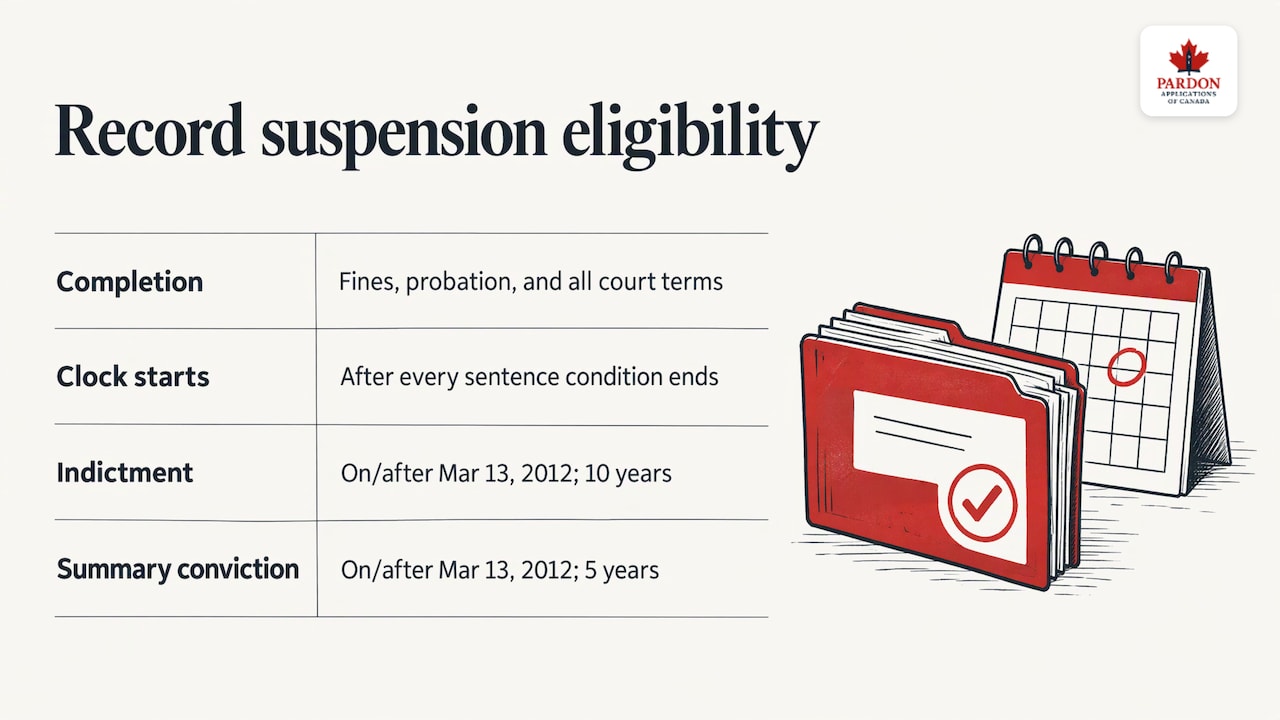
To apply, you must have completed all of your sentences and the appropriate waiting period. “Completed” includes fines, probation, conditional sentences and any other conditions the court imposed, not just time served.
For offences committed on or after March 13, 2012, the Parole Board sets the waiting period at 10 years for an offence prosecuted by indictment and 5 years for an offence punishable on summary conviction. The clock starts when every part of your sentence is finished, not on the date of the offence or the conviction.
Some people are ineligible. For instance, someone whose first offence was committed on or after March 13, 2012, and who has been convicted of more than three indictable offences, each with a prison term of two or more years, may not qualify. Other exclusions exist for certain categories of offences, so check the full criteria before you assume either way. If your case involved drugs, our guide to drug trafficking Pardons and the 5 or 10 year rule explains how those convictions are treated.
Not sure where you stand?
Eligibility is the step where many people stall, because court records, sentence end dates and offence classifications are not always clear. Our accredited officers can review your situation and tell you whether you are ready to apply, and if not, when you will be. For a first look at what the paperwork involves, see our overview of the record suspension process and the documents to check.
How the application works, and how long it takes
The process follows a clear sequence:
- Confirm eligibility. Check your offences, sentence completion and waiting period.
- Gather your records. You will need a police record check, court documents showing the sentence and its completion, and proof of identity and residence.
- Complete the forms. Errors and gaps are the most common reason files are delayed or returned.
- Pay the filing fee. The Parole Board requires its processing fee with your application. If it is missing or inaccurate, the application may not be processed and may be returned.
- Submit and wait for the decision. The Parole Board reviews the file and decides whether to order the suspension.
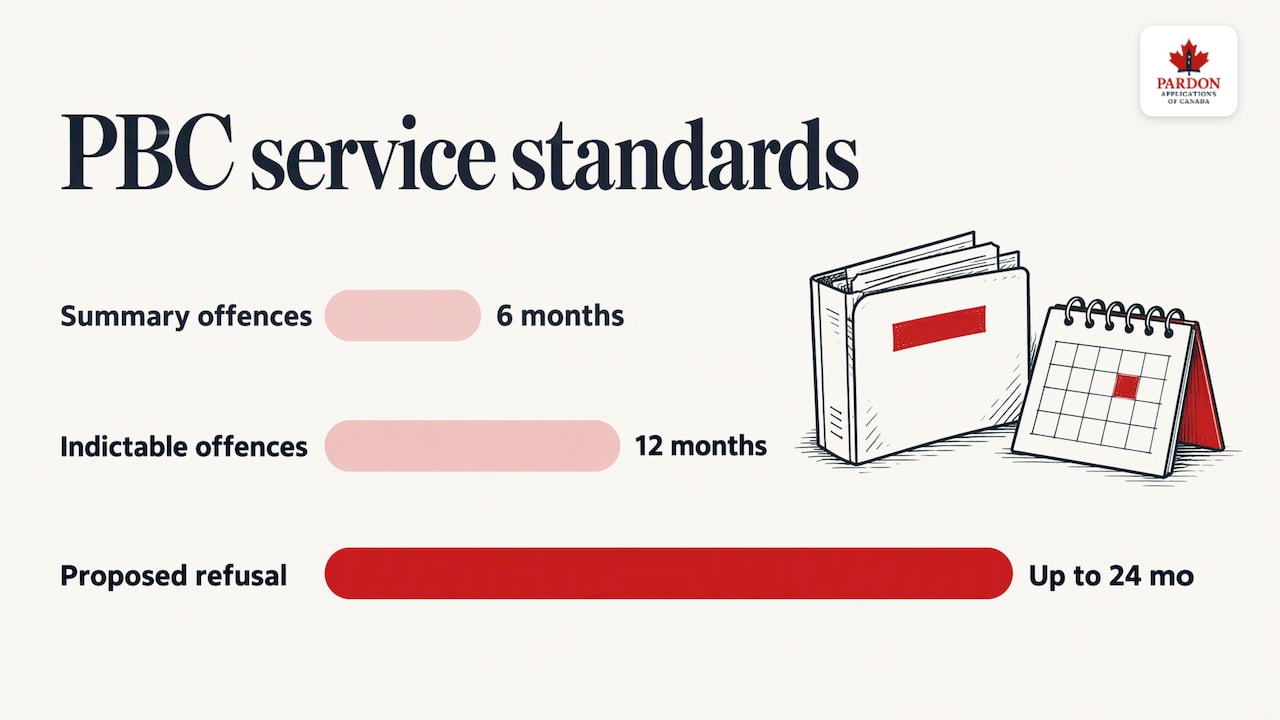
On timing, the PBC’s service standards are 6 months for summary offences, 12 months for indictable offences, and up to 24 months when a refusal is proposed. Those are targets from the 2022-2023 performance report, and real-world times can differ. Our timeline for a Pardon or record suspension and our piece on how the Parole Board’s backlog affects you go into more detail.
If you want to understand the legal steps behind the paperwork, we explain them in the legal process behind a Pardon application.
What a Pardon really costs
The Parole Board of Canada’s record suspension processing fee is $50.00. The PBC also says you are allowed to apply directly without a lawyer or third-party company.
But the $50 filing fee is only one line on the bill, and a full application should not be expected to cost $50. Around it sit other costs that add up:
- a police records check or fingerprint-based check
- court documents and certified copies, which can carry fees from each court or agency
- postage or courier costs
- your own time tracking down records, sometimes from several jurisdictions
- professional help, if you choose it
If you prefer to have an expert prepare and check your file, our Pardon Only plan is listed at $80 per month. You can see what is included on our Pardon cost page.
Work, volunteering and background checks
For many readers, the real goal is a job. A record suspension is designed to remove the barrier a conviction creates in a standard background check, and for many people that opens the door to roles, promotions and licences that felt out of reach. The invisible ceiling many people feel can lift.
Two points to remember:
- Vulnerable sector work. As noted above, a flagged record for former sexual offenders can still be identified in a vulnerable sector check.
- Your story still needs telling well. A Pardon changes what a check shows. It does not rewrite your work history. If you are rebuilding your career or applying for roles that involve screening, a well-prepared security clearance resume can help you present your timeline clearly and avoid delays caused by gaps in the information you submit.
For a broader introduction, our guide to what a Canadian Pardon is and our article on clearing your criminal record cover the employment side in more depth.
Travel: why a Pardon is not a U.S. entry pass
This is where many people get caught out. A Canadian record suspension or expungement operates under Canadian law. The United States decides admissibility under its own rules, and the two countries have an arrangement under which they may share criminal history and conviction information when relevant to administering or enforcing their immigration and citizenship laws, subject to the agreement’s conditions.
So a suspended record does not by itself guarantee you will be admitted at the border. Depending on your offence, you may need a U.S. Entry Waiver (Form I-192) to cross legally. We explain the reasoning in why a Canadian Pardon won’t get you into the United States and why you may still need a waiver after a Pardon. For timing, see our I-192 processing time article, and if you already hold a waiver, our I-192 renewal page explains the next step.
Getting help with your application
We believe nobody should feel stuck under the weight of a record they have already answered for. At Pardon Applications of Canada, you meet with accredited Pardon and Waiver officers who assess your eligibility, prepare a complete and accurate application, and keep you informed through dedicated support channels. A complete file is designed to reduce avoidable delays, though no one can promise a particular outcome, because the decision belongs to the Parole Board.

We handle Canadian Pardon applications and U.S. Entry Waivers under one roof. If you are ready to find out where you stand, schedule a free consultation and we will tell you plainly whether you can apply now, what you need, and what the next step looks like.
FAQ
Is expungement the same as a Pardon in Canada?
No. A Pardon, now called a record suspension, sets aside a conviction and removes it from CPIC but does not erase it. Expungement treats a conviction as though it never occurred, and it is limited to offences listed in the schedule to the Expungement of Historically Unjust Convictions Act.
Does a Pardon clear my record in Canada?
It keeps your record separate from other criminal records and removes it from the CPIC database, so it should not appear on a standard check. The conviction is set aside, not erased, and a vulnerable sector check can still identify a flagged record for former sexual offenders.
Can I get an expungement for an ordinary conviction?
Not unless your offence appears in the schedule to the Act. For most people, the available remedy is a record suspension once all sentences are complete and the waiting period of 5 or 10 years has passed.
How much does it cost to apply for a Pardon?
The Parole Board of Canada charges a $50 processing fee, but that is only one cost. Records checks, court documents, postage and optional professional help all add to the total, so the full process costs more than $50.
Will a Pardon let me travel to the United States?
Not automatically. The U.S. makes its own admissibility decisions and Canada and the U.S. can share criminal history information in some cases. Depending on your offence, you may need a U.S. Entry Waiver (I-192).
Sources
- What is a record suspension? – Parole Board of Canada
- Frequently asked Questions about Expungement – Parole Board of Canada
- Expungement of Historically Unjust Convictions Act – Justice Laws Website
- Who is eligible for a record suspension? – Parole Board of Canada
- Applying for a record suspension – Parole Board of Canada
- Record Suspension Decisions and Clemency Recommendations, 2022-2023 – Parole Board of Canada
- Statement of Mutual Understanding on Information Sharing – Government of Canada
Recommended
- How to Get a Pardon in Canada
- What is a Canadian Pardon? The Complete 2026 Guide to Record Suspensions
- The Legal Process Behind a Pardon Application in Canada
- How Long a Pardon Really Takes to Obtain in Canada
This content brings together contributions from PAC, our content team, and AI tools, with PAC retaining editorial responsibility. It is shared for general information, not legal advice. Laws and procedures may change; seek qualified legal advice for your circumstances.