

A peace bond is not a conviction, and agreeing to one does not give you a criminal record in Canada. That said, it is not invisible either. While it is active, it can appear on certain police record checks, and a breach is a crime that can leave you with a record. This guide explains exactly where the line sits, so you can stop worrying about the wrong things and deal with the right ones.
TL;DR
- A peace bond is a court order to keep the peace. It is not a charge, a conviction or a finding of guilt, and it does not appear on a criminal record.
- While it is active, it can show on a Criminal Record and Judicial Matters Check and a Vulnerable Sector Record Check, but not on a basic criminal record check.
- Breaching a condition is a crime. A conviction for breach does create a criminal record.
- A Pardon (record suspension) is for convictions. If you only have a peace bond, you generally have nothing to suspend. If you have a breach conviction or another conviction, a Pardon may be the next step.
Table of Contents
- What a peace bond is, and why people sign one
- Does a peace bond give you a criminal record?
- What shows up on a police record check
- Peace bond and employment
- When a peace bond can lead to a criminal record
- Does a peace bond affect a Pardon (record suspension)?
- Clearing fingerprints and photos after a peace bond
- Peace bond and entry to the United States
- What a Pardon costs, and what the filing fee does not cover
- How Pardon Applications of Canada can help
- Practical next steps if you are under a peace bond
- FAQ
- Sources
What a peace bond is, and why people sign one
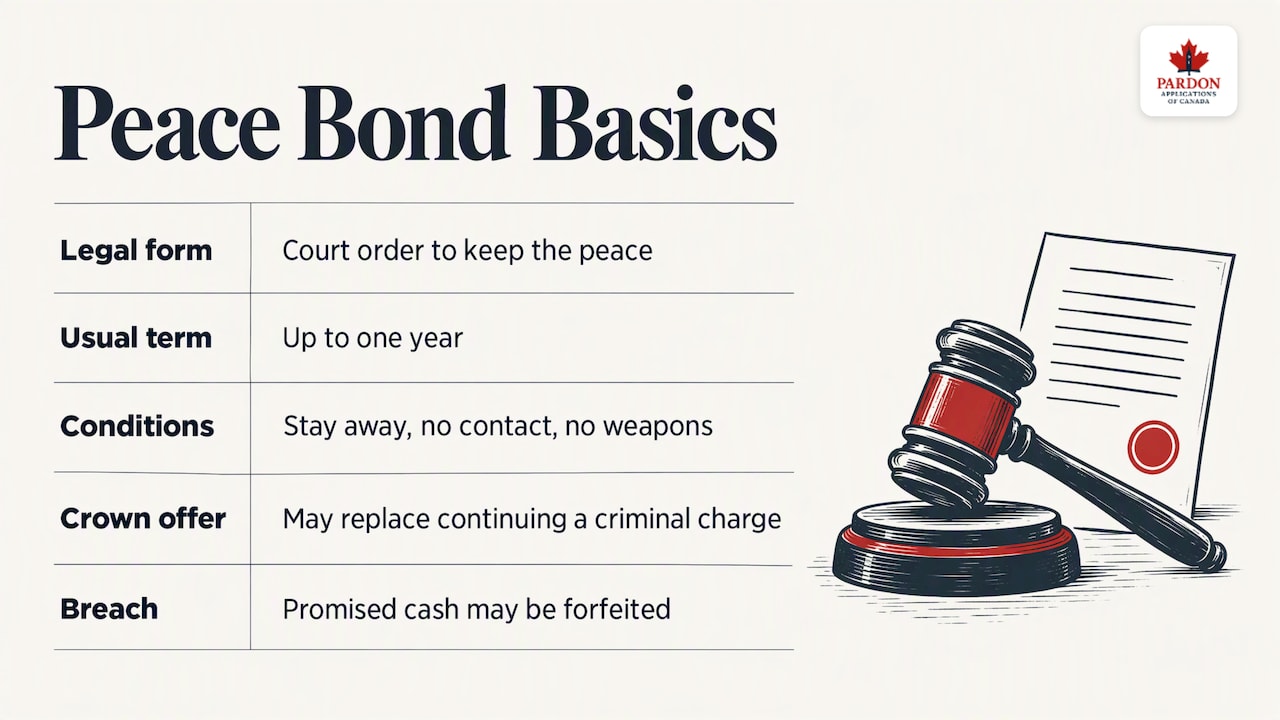
A peace bond is a court order that requires a person to keep the peace and be of good behaviour for a set period. Under section 810 of the Criminal Code, it is usually for up to one year. According to the Department of Justice, peace bonds are enforceable by police across Canada for up to one year and may be renewed by a court application if the threat persists. Common law peace bonds can run longer.
The conditions vary. They often include staying away from a named person, not contacting them, and not possessing weapons. Sometimes the court also asks for a promise of money, called a surety. If you breach a condition, cash paid or promised to the Court may be forfeited.
Many people meet a peace bond in one of two ways. Someone applies for one against them, or the Crown offers one in place of continuing with a criminal charge. The second route is the one that raises the record question. Agreeing to a peace bond is often a way to avoid a conviction, and that is precisely why so many people choose it.
If this is where you are, take a breath. You are probably in a much better position than you feared. But the details matter, so let’s go through them.
Does a peace bond give you a criminal record?
No. Steps to Justice, a legal education project, states plainly that entering a peace bond does not give you a criminal record. A Western University legal clinic guide makes the same point: a peace bond is not a criminal charge, an offence, a conviction or a finding of guilt.
That is the answer to the question many readers type: does a peace bond drop the charges and leave no record? When the Crown offers a peace bond instead of prosecuting, the charge is typically withdrawn or stayed once you sign. You have no conviction. In legal terms, there is nothing to be pardoned.
Two cautions belong here, because “no criminal record” and “nothing anywhere” are not the same thing:
- The peace bond can be visible while it is active. More on this below.
- The police file on the original charge can still exist. Police may hold fingerprints and photos taken at arrest, even when no conviction followed. We cover how to ask for these to be destroyed further down.
What shows up on a police record check
Canadian police services offer different levels of record check. What a peace bond does depends on which one is asked for.
| Type of check | Peace bond while active | Peace bond after it expires |
|---|---|---|
| Basic criminal record check (used for most job applications, volunteering and some immigration purposes) | Not shown | Not shown |
| Criminal Record and Judicial Matters Check | Shown | Not expected to show |
| Vulnerable Sector Record Check | Shown | May still be included, depending on the police service’s policy |
This table reflects Steps to Justice’s guidance: while active, a peace bond appears on a Criminal Record and Judicial Matters Check and a Vulnerable Sector Record Check, and after it expires it may still be included in a vulnerable sector check depending on police-service policies. Standard checks, used for job applications, volunteering and immigration purposes, exclude withdrawn or stayed charges as well as peace bonds.
Policies differ between police services, so the safest move is to ask your local service what it includes for the level of check you need.
How police know: CPIC
The reason a peace bond can appear at all is that police share information through the Canadian Police Information Centre. CPIC includes records relating to a person’s criminal history and police investigations, and it holds details about active peace bonds so that officers across the country can see them during an investigation. This is the same national system that matters when you apply for a Pardon, because a Record Suspension is about restricting access to conviction records held in these databases.
Peace bond and employment
For most jobs, you will be asked for a basic criminal record check. A peace bond will not appear on it.
The situation changes for roles that call for a deeper check. Steps to Justice notes that a peace bond will be visible on a Criminal Record and Judicial Matters Check or a Vulnerable Sector Record Check, often required for positions of trust, management or government roles. Work with children, seniors or other vulnerable people typically requires a vulnerable sector check.
A practical approach:
- Find out which check the employer actually requires before you assume the worst.
- Check the dates. If your peace bond is active during the application, expect it to show on the deeper checks. If it has expired, the picture may be different.
- Be ready to explain it briefly and calmly. A peace bond is not a finding of guilt, and you can say so truthfully.
- Ask a lawyer if an employer or licensing body requires you to disclose it. Rules differ by profession.
The invisible ceiling many people fear after a charge does not apply to a peace bond the way it does to a conviction. But if the peace bond was tied to a conviction as well, or you breached it, the analysis changes.
When a peace bond can lead to a criminal record
The order itself does not create a record. The consequences of breaking it can. The Department of Justice explains that breaching peace-bond conditions is a crime, and if convicted, a person can be fined and/or jailed and will have a criminal record.
This is the most common way a peace bond turns into a long-term problem. A breach can be as simple as one message sent to a person you were told not to contact. If you are under a peace bond:
- Read every condition on your copy of the order, and keep it with you.
- If a condition is unclear or unworkable (for example, you share a workplace or children with the other person), ask the court or a lawyer about it before it becomes a problem. Do not decide on your own what you can get away with.
- Refusing to sign a peace bond when the court orders you to is also an offence.
If you are already facing a breach charge, speak to a criminal defence lawyer or your provincial legal aid office right away. That is a legal matter beyond what any Pardon service can fix.

Does a peace bond affect a Pardon (record suspension)?
A Pardon, now formally called a record suspension, is for people who have a conviction. The Parole Board of Canada describes it as being for people convicted of a criminal offence who completed their sentence and demonstrated law-abiding conduct for a prescribed number of years.
In practice, this means:
- Peace bond only, no conviction: there is no conviction to suspend. You generally do not need a Pardon for the peace bond itself.
- Peace bond plus a separate conviction: the conviction is what a Pardon addresses. The peace bond is not the part you are waiting out, but keeping out of trouble is essential to the “law-abiding conduct” the Board looks for.
- Breach conviction: this is a conviction like any other. Once you have completed the sentence and the required waiting period, you may be able to apply. Our guide to how the Pardon process works walks through the steps, and our page on the timeline for a Pardon explains what to expect.
Not sure which category you fall into? The most reliable first step is to get your own record. An accurate picture of what is on file, and what is not, saves you time and money. Our guide on whether you can start before being eligible is useful if you are close to a waiting-period milestone.
Clearing fingerprints and photos after a peace bond
Even without a conviction, the police may still hold the fingerprints and photos taken when you were arrested. Steps to Justice explains that after a peace bond expires, you can ask local police to destroy fingerprints and photos. The police consider the request only if you have no convictions or outstanding charges and were 18 or older at the time of arrest.
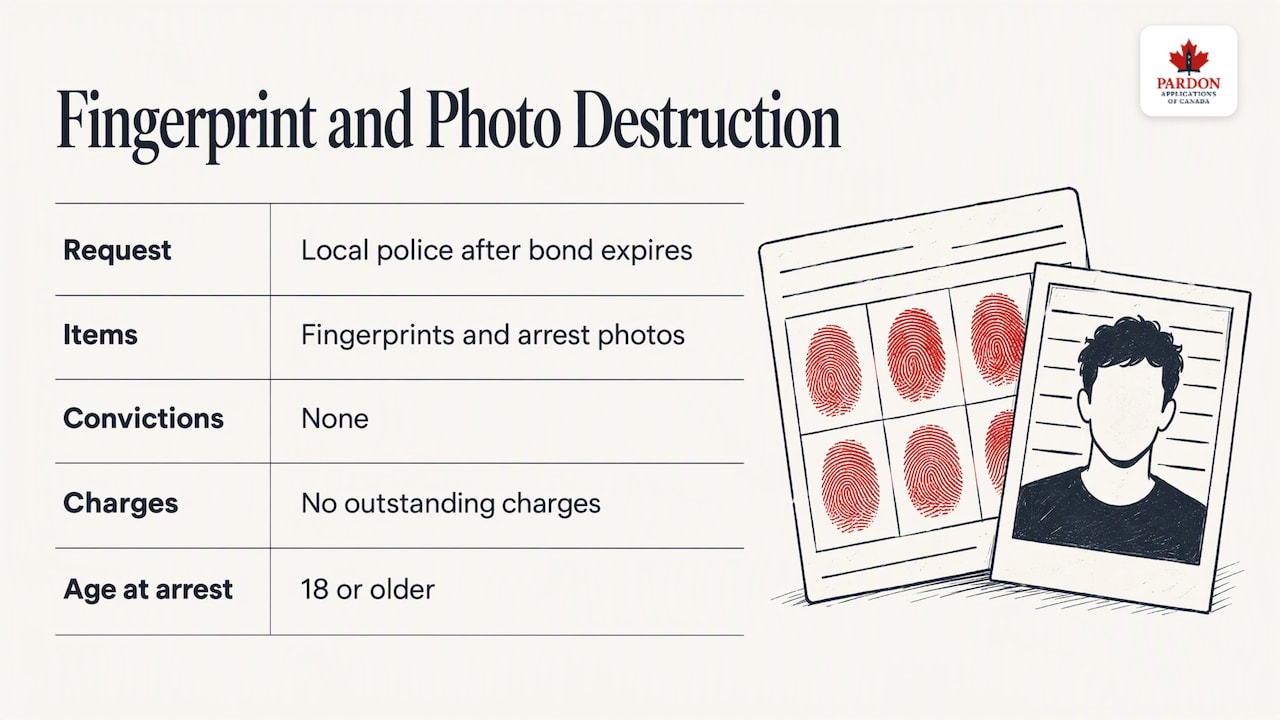
This is a different process from a Pardon. It is a request to the police service, not an application to the Parole Board. It is worth making if you qualify, because it reduces what remains on file about an arrest that never ended in a conviction. Our page on peace bonds and what they leave behind looks at this area in more detail.
Peace bond and entry to the United States
This is the question that worries travellers most, and it deserves a careful answer. A peace bond is not a conviction, so it is not the same as a criminal record. But travellers are often caught out by what came before the peace bond: the arrest, the charge and the police report.
The United States decides admissibility under its own laws, and Canadian outcomes do not bind it. U.S. Customs and Border Protection says, for example, that Global Entry applicants may not qualify if they have pending criminal charges, are subject to ongoing investigations or are inadmissible under U.S. immigration regulation. If your peace bond was offered in place of a charge, make sure that charge has actually been withdrawn or stayed before you apply for any trusted traveller program or cross the border.
A sensible approach:
- Get your court paperwork showing how the charge ended.
- Never answer border questions untruthfully. If you are asked, answer honestly and calmly.
- If you have any conviction in your history, find out whether you need a waiver before you travel. Our explainer on why you may need a U.S. waiver covers who is affected, and our U.S. Entry Waiver overview shows how the application works.
A waiver is for people who are inadmissible. Whether a particular history makes you inadmissible is a legal question, so if your case is unclear, ask an immigration lawyer who handles U.S. matters.
What a Pardon costs, and what the filing fee does not cover
If you do need a Pardon because of a conviction, plan the budget honestly. The Parole Board of Canada’s filing fee is $50, but that is only one line in a longer list. There are also costs for obtaining your police records, court documents, fingerprints, and any other paperwork the application needs. People who try to assemble all of this alone often pay more in lost time and repeated requests than they expected.
We lay out what is involved on our cost of a Pardon page, and our guide to saving money during the Pardon application process shows where it makes sense to economize. Our Pardon Only plan is $80 per month.
How Pardon Applications of Canada can help
If your peace bond came alongside a conviction, or if you have breached an order and been convicted, you may feel you are living in the shadow of a past mistake. We help people take that next step with clarity.
At Pardon Applications of Canada, accredited Pardon and Waiver officers assess your eligibility, gather and check your documents, and keep you informed throughout the process. A complete and accurate application reduces the risk of avoidable delays. We cannot promise any particular result, because the decision belongs to the Parole Board of Canada, but we can make sure your application is as strong and as complete as it can be.

If you want to know where you stand, schedule a free consultation and we will review your situation. You can also see our full list of services, including U.S. Entry Waivers (I-192) and I-192 renewals.
Practical next steps if you are under a peace bond
- Keep a copy of the order and read every condition. Set reminders for the expiry date.
- Do not breach it, even if the other person contacts you first. A breach is a crime and the record is lasting.
- Confirm how the original charge ended. You want written proof it was withdrawn or stayed.
- Find out which police check you will need for any job, volunteer role or licence.
- After expiry, consider asking police to destroy fingerprints and photos, if you qualify.
- If you have a conviction anywhere in your history, look at a Pardon, and at a U.S. waiver if you travel south.
Our record suspension process checklist is a good place to see which documents you will need.
FAQ
Does a peace bond show up on a criminal record check in Canada?
Not on a basic criminal record check. While the peace bond is active, it can show on a Criminal Record and Judicial Matters Check and on a Vulnerable Sector Record Check. After it expires, it may still be included in a vulnerable sector check, depending on the police service’s policies.
Is a peace bond a conviction?
No. A peace bond is not a charge, an offence, a conviction or a finding of guilt. It is a court order with conditions. Breaking those conditions, however, is a crime that can lead to a conviction.
Do I need a Pardon for a peace bond?
Generally no, because a Pardon (record suspension) applies to convictions. If you also have a conviction, including one for breaching a peace bond, you may be able to apply once you have finished your sentence and the required waiting period has passed.
Will a peace bond stop me from entering the United States?
A peace bond is not a conviction, but U.S. border officers decide admissibility under U.S. law, and the arrest or charge behind it may matter. Keep your court documents showing how the charge ended, answer questions honestly, and speak to an immigration lawyer if you are unsure.
How long does a peace bond last?
Usually up to one year under the Criminal Code, and the court can renew it if the threat continues. Common law peace bonds can run for longer.
Sources
- Will peace bonds appear on my criminal record? Steps to Justice
- What is included in a police record check? Steps to Justice
- Try to get your fingerprints and photos erased, Steps to Justice
- Peace Bonds, Department of Justice Canada
- Peace Bonds fact sheet, Department of Justice Canada
- Applying for a peace bond, Department of Justice Canada
- Peace Bond Information Package, Western University
- What is a record suspension? Parole Board of Canada
- Classes of Records, RCMP
- Global Entry FAQ, U.S. Customs and Border Protection
Recommended
- Record Suspension Process in Canada: 8 Documents to Check
- A Brief History of the Criminal Records Act in Canada
- U.S. Entry Waiver Eligibility
- Why a Canadian Pardon (Record Suspension) Won’t Get You Into the United States
This content brings together contributions from PAC, our content team, and AI tools, with PAC retaining editorial responsibility. It is shared for general information, not legal advice. Laws and procedures may change; seek qualified legal advice for your circumstances.