
Yes, an assault conviction can usually be cleared with a Pardon, now officially called a record suspension, once you have finished every part of your sentence and waited the required time. That wait is 5 years for a summary conviction and 10 years for an indictable one, and the Parole Board of Canada (PBC) decides each application. The hard part is rarely the law. It is getting every document, date and sentence condition right the first time, which is where our accredited Pardon officers work with you.
TL;DR
- An assault Pardon (record suspension) is ordered only by the Parole Board of Canada, never by a court.
- For a first offence on or after March 13, 2012, you wait 5 years after your sentence is fully completed if it was summary, and 10 years if it was indictable.
- The PBC’s filing fee is $50, but fingerprints, record checks, court documents and police checks add other costs, so the total is higher.
- A Pardon helps with work, housing, education and volunteering, but the United States does not recognize it. You may still need a U.S. Entry Waiver (I-192).
- No one can promise an outcome. A complete, accurate application is what gives you the best footing.
Table of Contents
- What an assault Pardon does for you
- How long you wait after an assault conviction
- Who is not eligible, and who does not need to apply
- What the Parole Board looks at
- The steps to apply for an assault Pardon
- What an assault Pardon really costs
- How long it takes
- What a Pardon changes at work
- Assault, a Pardon and travel to the United States
- Getting help with your application
- FAQ
- Sources
What an assault Pardon does for you
A conviction for assault can sit behind you like a shadow. It shows up on background checks, slows down job offers and can make a simple trip feel risky.
A record suspension keeps your criminal record separate from other records and removes it from the CPIC database, the national police database, so a search shows no record. In practice that helps you access employment and education. Under the Criminal Records Act, the Parole Board of Canada is the only federal agency that can order, refuse to order or revoke a record suspension.
It is worth knowing the limits too, so there are no surprises. A record suspension removes disqualifications that result from a federal conviction and supports access to employment, housing, education and volunteer work. It does not erase the fact that you were convicted, it does not guarantee entry to another country, and it does not affect a prohibition order under section 109 of the Criminal Code (the weapons ban that can follow certain violent offences).
How long you wait after an assault conviction
The waiting period depends on how your assault was prosecuted. Your court documents show whether it was by indictment (the more serious route) or summary conviction (the less serious route).
For a first offence on or after March 13, 2012, the wait after you complete all sentences is 10 years for an indictable offence and 5 years for a summary offence. The same periods are set out in section 4 of the Criminal Records Act.
| How the assault was prosecuted | Waiting period (first offence on or after March 13, 2012) |
|---|---|
| Summary conviction | 5 years after all sentences are completed |
| Indictment | 10 years after all sentences are completed |
If your first offence was earlier, the rules are different. Since March 19, 2020, the PBC assesses applications under the eligibility criteria in place at the time of your first offence, not the later changes. Older offences can fall under the earlier 3, 5 and 10-year tables, so the date of your first offence matters.
When the clock actually starts
This is where many people miscount. The waiting period starts only after every part of your sentence is finished. That includes:
- all fines, surcharges, costs, restitution and compensation orders
- all time in custody, including parole and statutory release
- any probation order
A weapons or driving prohibition does not need to have expired before the clock starts. An unpaid fine from years ago, however, can quietly keep the clock from starting. If you are unsure whether you are complete, your court records and your fine balance are the first things to check. Our officers review this with you before anything is filed. We also have a page on starting the Pardon process before you are eligible.
Who is not eligible, and who does not need to apply
Most people with a single assault conviction are in the eligible group once they have waited. Two situations are barred under the Criminal Records Act:
- a conviction for a Schedule 1 offence (a list that includes sexual offences), unless an exception applies. The exception requires that you were not in a position of trust or authority, did not use or threaten violence, and were less than five years older than the victim
- more than three indictable convictions that each carried a sentence of two years or more in prison
On the other side, you do not need to apply at all if you only received an absolute or conditional discharge, or if your only convictions are from youth court. Those records are handled differently. Check which outcome your court gave you before paying for anything.
What the Parole Board looks at
Eligibility gets you in the door. The PBC then decides. Board members assess your good conduct and, for certain offences, whether the suspension would give you a measurable benefit, support your rehabilitation and not bring the administration of justice into disrepute. The PBC’s own policy manual also notes that the presumption of innocence does not apply to record suspension applications, so your file needs to show your life since the conviction clearly.
For an assault, that usually means being ready to explain what has changed: steady work, family responsibilities, volunteering, a clean record since. A strong application tells that story in documents, not just in a paragraph.
The steps to apply for an assault Pardon
The process is laid out in Alberta’s public guide to record suspensions. Here it is with what tends to go wrong at each stage.
- Get your criminal record. You book RCMP-accredited fingerprinting to obtain your record. Where it goes wrong: poor-quality prints or a missed entry that you did not know was on file.
- Obtain police information checks. You need one from every jurisdiction where you lived during the past 5 years (summary) or 10 years (indictable). Where it goes wrong: forgotten addresses and a check from the wrong police service.
- Collect court documents. Each conviction needs a signed Court Information Form. Where it goes wrong: courthouses differ in speed, and old files can be hard to track down.
- Complete the application forms. This is the Record Suspension Application Form, plus the Measurable Benefit/Sustained Rehabilitation Form where it applies. Where it goes wrong: inconsistent dates, missing sentence details or an unclear explanation of the benefit to you.
- Pay the PBC fee and submit. Where it goes wrong: an incomplete package, which can be rejected at screening.
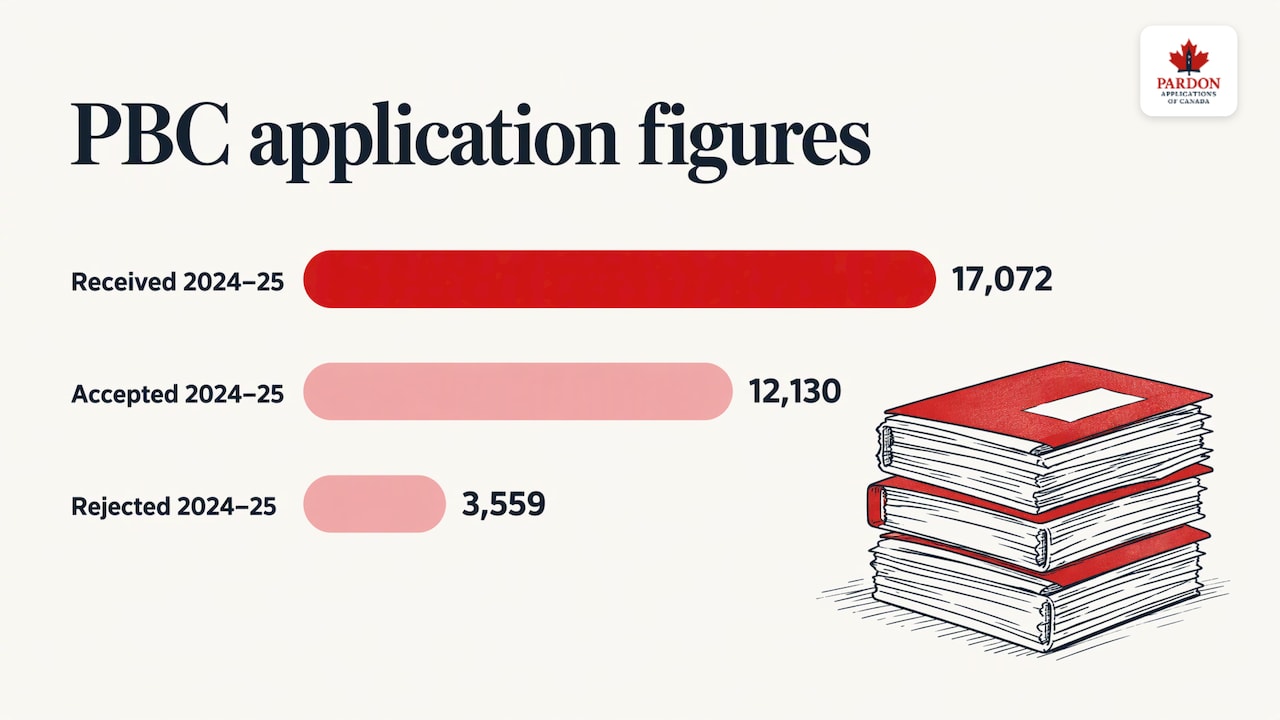
That last point is not rare. In 2024-2025, the PBC received 17,072 applications, accepted 12,130 (71%) as eligible and complete, and rejected 3,559 (21%) at screening. Those are the figures for that reporting year. A rejection at screening means lost time and, depending on the case, lost fees.
We build the file with you. Our accredited Pardon officers assess your eligibility first, then work through the documents so the application is complete and accurate before it goes to the Board. That is how we aim to reduce delays and denials, though the decision always belongs to the PBC. Our record suspension process guide lists the documents to check.
What an assault Pardon really costs
The PBC’s application fee is $50. It was reduced from a higher amount effective January 1, 2022, and it is not subject to CPI adjustments. That $50 is only the filing fee. It is not the cost of the whole application.
On top of it you pay for fingerprints, your criminal record, court documents and police checks, and each of those is charged separately by a different office. The totals vary with how many jurisdictions you have lived in and how many court files you need. If you prepare the package with us, our Pardon Only plan is $80 per month. The costs page explains what is involved, and a lower-cost route is covered in our article on whether you can get a Pardon for free.
How long it takes
The PBC’s targets are six months from acceptance for summary applications and 12 months for indictable applications. That clock begins only once the Board accepts your application as eligible and complete, so the time you spend gathering documents comes first. Targets are not promises for any one file. A complete package from the start is the best way to avoid extra waiting.
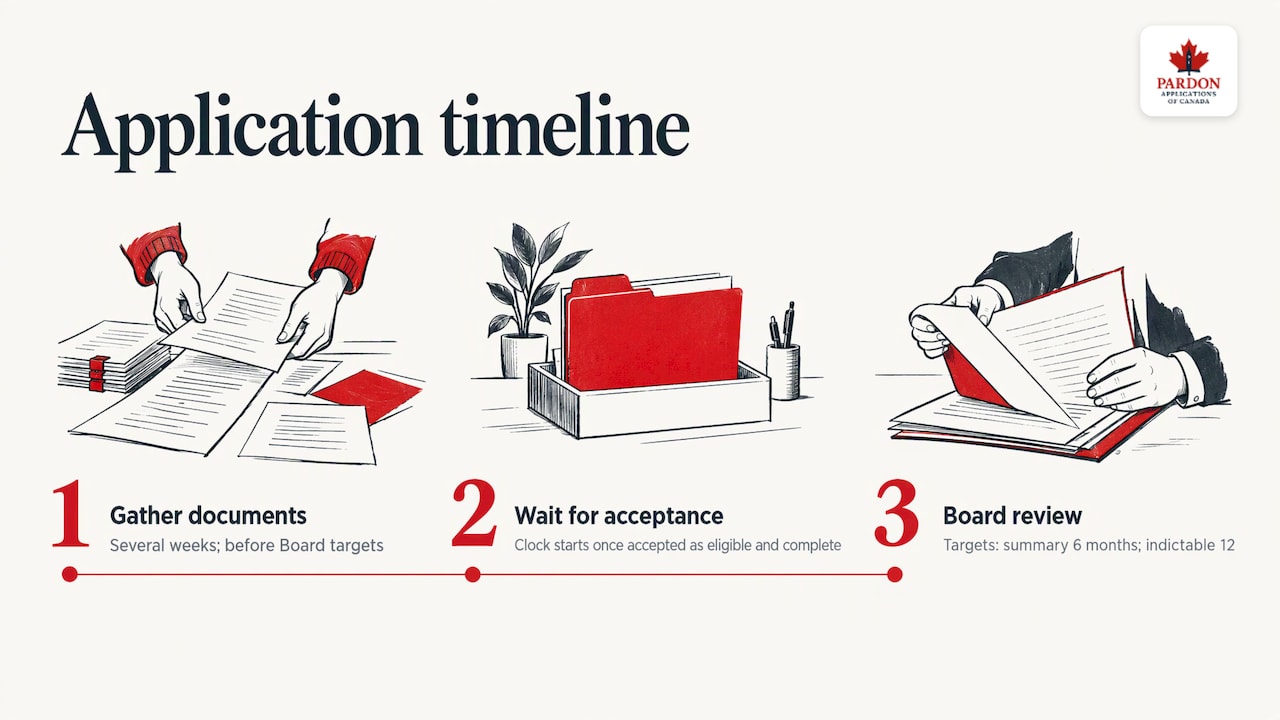
For a person with an assault on their record, the practical timeline looks like this: gather documents over several weeks, then wait for acceptance, then the Board’s review. Plan your job applications or travel around the longer end.
What a Pardon changes at work
For many of our readers, the reason for applying is a job. Employers who run a standard criminal record check will not see a suspended record, because it is removed from CPIC. That can open doors that felt closed: licensed trades, security roles, professional programs, volunteer positions. The Pardon is a way past that invisible ceiling.
Know the edge of it. A record suspension does not erase the conviction itself, and it does not change a section 109 prohibition order. If your work involves vulnerable people, ask the screening body how it handles suspended records for your specific role.
A suspension can also be lost. It can be revoked or cease to have effect if you are convicted of a new indictable offence (or in some cases a summary offence), if you are found to be no longer of good conduct, if you made a false or misleading statement in your application, or if you were not eligible when it was ordered. In that case the record goes back onto CPIC. If that happens, you can reapply after one year if you can show you have been law-abiding. That is why accurate answers on every form matter so much.
Assault, a Pardon and travel to the United States
This is the part that surprises people most. A Canadian record suspension is not recognized by U.S. authorities, so you can still be inadmissible to the United States with a suspended assault record. Courthouse Libraries BC adds that any criminal record must be declared at the border, and that trying to enter without disclosing an arrest can lead to permanent ineligibility or detention. It advises contacting U.S. Customs and Border Protection or Homeland Security well before you travel.
The tool for this is a U.S. Entry Waiver (form I-192, the Application for Advance Permission to Enter as a Non-Immigrant). The same source lists what the package involves:
- form I-192 and form G325A
- fingerprints on an RCMP C216 form
- a certified RCMP criminal record
- possibly court documents, and a Privacy Act request for a certified document of pardoned offences
We prepare U.S. Entry Waivers as well as Canadian Pardons, so one team can look at both sides of your record. Read more in our guides on assault and U.S. entry and why a Canadian Pardon will not get you into the United States. Priority processing for U.S. waivers is a $95 to $150 one-off, described on our U.S. waiver costs page. If you already hold a waiver, see the I-192 renewal page.
Getting help with your application
We are Pardon Applications of Canada, and we have more than 55 years of experience preparing Canadian Pardon and U.S. Entry Waiver applications. You speak with an accredited Pardon and Waiver officer who looks at your conviction, your sentence and your dates, tells you where you stand, and prepares a complete application with ongoing support while it is with the Board.
If you are ready to start, see our Canadian Pardon and U.S. Entry Waiver services or the Pardon Only plan. We cannot promise a result, because the decision is the Parole Board’s. What we can do is take the paperwork off your shoulders so your story is presented clearly.
FAQ
How long before I can apply for an assault Pardon in Canada?
You wait 5 years if your assault was prosecuted as a summary offence and 10 years if it was by indictment, for a first offence on or after March 13, 2012. The wait begins only when every fine, probation term and custody period is complete. Earlier first offences can fall under the older tables.
Do I need a Pardon if I received a discharge?
Not if your only outcome was an absolute or conditional discharge. The PBC says people in that situation do not need to apply. Check your court paperwork to confirm which outcome you received before you start.
Does a Pardon let me enter the United States?
No. U.S. authorities do not recognize a Canadian record suspension, so you may still need a U.S. Entry Waiver (I-192). Any record has to be declared at the border, so deal with the waiver before you travel.
Is the Pardon fee really $50?
The PBC’s filing fee is $50, but it is only one cost. Fingerprints, your criminal record, court documents and police checks are paid separately, so the full process costs more than the filing fee.
Sources
- What is a record suspension? – Parole Board of Canada
- Who is eligible for a record suspension? – Parole Board of Canada
- Determining your eligibility for record suspension – Parole Board of Canada
- Criminal Records Act, section 4 – Justice Laws
- Decision-Making Policy Manual, Chapter 12 – Parole Board of Canada
- Record Suspension Program 2024-2025 Report to Parliament
- Applying for Record Suspensions (Pardons) – Alberta ALIS
- Record Suspensions (Pardons) – Courthouse Libraries BC
Recommended
- How to Get a Pardon in Canada
- Timeline For Pardon Or Record Suspension In Canada
- How Long a Pardon Really Takes to Obtain in Canada
- Assault and U.S. Entry: What Canadians Need to Know
This content brings together contributions from PAC, our content team, and AI tools, with PAC retaining editorial responsibility. It is shared for general information, not legal advice. Laws and procedures may change; seek qualified legal advice for your circumstances.