


An I-192 denial is discouraging, but it is not the end of the road. CBP notifies you of its decision in writing, the decision generally cannot be appealed, and the usual path forward is to work out what was missing and file a new, stronger application. No one can guarantee how a new application will be decided, because the waiver is discretionary. A complete, honest and well-documented file is the best thing you can put in front of the officer.
If you are a Canadian with a criminal record who was refused a U.S. entry waiver, this guide explains what the denial means, why applications are refused, and how to rebuild your case.
TL;DR
- Form I-192 is the application inadmissible travellers use to ask for permission to enter the U.S. temporarily. A denial means the officer was not satisfied by that file.
- Under the KIND guidance, an I-192 denial cannot be appealed. The practical route is a new application that fixes what went wrong.
- Missed biometrics, outdated RCMP records, missing court documents and thin rehabilitation evidence are the most avoidable problems.
- A Canadian Pardon (Record Suspension) does not guarantee entry to the U.S., so a waiver and a Pardon do different jobs.
- The waiver is discretionary. Nobody can promise approval, but a complete application gives you the strongest footing.
Table of Contents
- What an I-192 denial actually means
- How you are told about the decision
- Why I-192 applications get denied
- Can you appeal an I-192 denial?
- Your next steps after a denial
- Building a stronger application the second time
- I-192 and your Canadian Pardon (Record Suspension)
- How long a new application takes
- Why many applicants get help with the second attempt
- Let us review your situation
- FAQ
- Sources
What an I-192 denial actually means
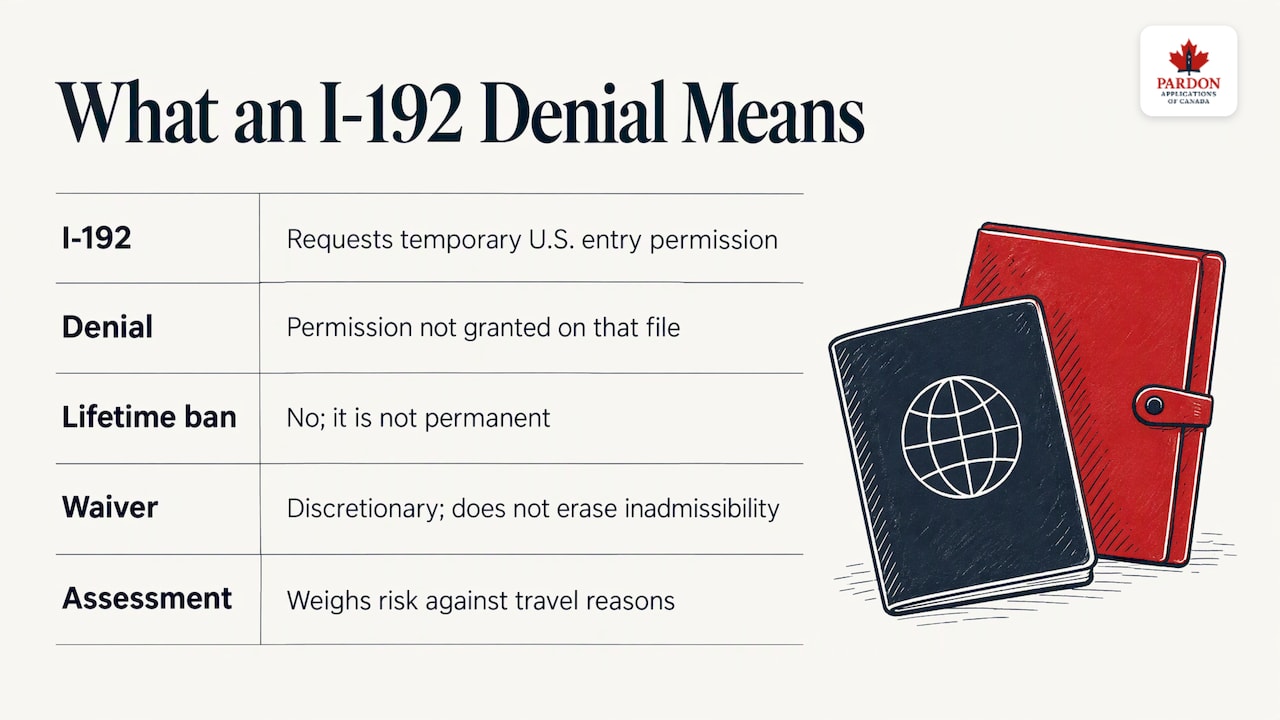
Form I-192, the Application for Advance Permission to Enter as a Nonimmigrant, is the document inadmissible travellers use to ask for legal permission to enter the United States temporarily. For Canadians, that usually means a criminal conviction, or sometimes a prior immigration problem, has made you inadmissible under U.S. law.
A denial means the adjudicator decided, on the file in front of them, not to grant that permission. It does not mean you are banned for life, and it does not label you permanently. It does mean that on the day of the decision, the file did not persuade the officer.
It helps to understand the nature of the decision. The waiver is discretionary and does not erase the underlying ground of inadmissibility. Adjudicators weigh the risk you present against your reasons for travelling. A strong case tends to pair honesty about the past with evidence of a settled, stable life. A denial is often a signal that one side of that balance was under-documented.
How you are told about the decision
CBP notifies applicants in writing of its decision. If you filed electronically, you receive an email when the status changes, and you must log into the e-SAFE portal to view the written decision.
Read that decision carefully, and keep a copy. It is the single most useful document you have for the next step, because it tells you where the officer’s concerns lay. If the wording is unclear, a specialist who prepares waiver applications every week can help you read it.
Why I-192 applications get denied
The reasons are rarely mysterious. Most fall into a handful of categories, and many can be fixed.
Procedural problems
Some denials have nothing to do with your character. For electronic filers, failing to report for biometrics at a designated port within 45 days of filing means the application is deemed abandoned and then denied. If that happened to you, the lesson is simple: build the biometrics appointment into your timeline from day one.
Other procedural issues include:
- An RCMP record that is too old. CBP requires fingerprint verification on Form C216C, and the returned Civil Product must be dated and endorsed by the RCMP within 15 months of submission.
- Missing court dispositions for one or more offences.
- Missing a properly executed Form G-28 when a representative acts for you, which the official instructions require.
- Inconsistencies between your answers, your RCMP record and your court documents.
Weak or missing supporting evidence
The official instructions call for an RCMP record and court dispositions, and recommend evidence of rehabilitation. Applicants who treat that last item as optional sometimes submit little more than the forms. The officer then has the conviction but not the story of who you are today.
An unclear reason for travel
Because the officer weighs risk against purpose, a vague or unexplained reason for entering the U.S. weakens the file. A specific, believable purpose (family, work, a recurring commute, a planned trip) gives the balance something to rest on.
Inaccurate or incomplete disclosure
Leaving out an offence, even a minor or very old one, is a serious problem. The officer can see what the RCMP record shows, so a mismatch damages your credibility far more than the original conviction would.
Can you appeal an I-192 denial?
The KIND guidance on next steps after a denial states that an I-192 denial cannot be appealed. That is a hard fact to read, but it points you toward what does work: a fresh application that responds directly to the reasons for the refusal.
That means you should not simply resubmit the same package. A second filing with the same gaps is likely to meet the same result. Instead, treat the denial as feedback.
Your next steps after a denial
- Gather the decision and everything you filed. Collect the written decision, your original forms, your RCMP report and all supporting documents.
- Identify the cause. Was it procedural (biometrics, expired RCMP record, missing documents) or substantive (thin rehabilitation evidence, unclear purpose of travel)?
- Do not travel on the assumption it will be fine. If you were refused, an attempt to cross the border without valid permission can compound the problem. Courthouse Libraries BC advises Canadians with any record to contact DHS or CBP at a port of entry well before travelling to find out whether they need a waiver.
- Order a fresh RCMP record if needed. If your Civil Product is nearing or past 15 months, you will need a new one anyway.
- Rebuild the evidence. Work through the checklist below.
- File a complete new application. Follow the official instructions exactly, including biometrics timing.
- Plan for the wait. Do not book non-refundable travel on the expectation of a quick answer.
Building a stronger application the second time
Think of the application as telling one clear story with documents behind every claim. Here is what a well-prepared file typically contains.
Complete, current records
- An RCMP Civil Product within the 15-month window.
- Certified court dispositions for every offence, including those you consider minor.
- Police records where relevant, so the circumstances of each offence are documented rather than left to assumption. A discussion of bail and immigration status also touches on why court and police paperwork matters when a case involves immigration consequences.
Evidence of rehabilitation and a settled life
This is where many files fall short. Consider including:
- Proof of stable employment: a letter from your employer, recent pay records.
- Evidence of community and family ties: property, lease, family responsibilities, volunteer work.
- Completion of sentences, programs or counselling.
- Character references that are specific and signed, rather than general praise.
- A clear personal statement that acknowledges the offence honestly, explains what has changed and avoids minimizing.
A specific reason for travel
Explain why you need to enter the U.S., how often, and for how long. If you travel for work, include a letter from the employer that describes the trips. If it is for family, say who and where.
Careful, consistent answers
Every answer should match your RCMP report and court documents. Before filing, compare them line by line. Dates, charges and sentences should agree everywhere.
I-192 and your Canadian Pardon (Record Suspension)
Many people assume a Canadian Pardon solves the U.S. border problem. It does not. The Parole Board of Canada states that a Record Suspension does not guarantee entry or visa privileges to another country. It sets the record aside rather than erasing it. Courthouse Libraries BC adds that a pardon issued by Canadian authorities is not recognized for U.S. entry, and that a person with any record, however minor or old, may be refused.
So the two processes run side by side:
| Canadian Pardon (Record Suspension) | U.S. Entry Waiver (I-192) | |
|---|---|---|
| Who decides | Parole Board of Canada | U.S. Customs and Border Protection |
| What it does | Sets the record aside in Canada, helping with employment and everyday life | Asks for permission to enter the U.S. despite inadmissibility |
| Guarantees entry to the U.S. | No | Discretionary, with no guarantee |
| Typical need | Employment, housing, volunteering, peace of mind | Travel to the U.S. for work, family or leisure |
If you want to read more on this, see our article on why a Canadian Pardon will not get you into the United States and our overview, US Entry Waiver 101.
Pursuing a Pardon alongside a waiver
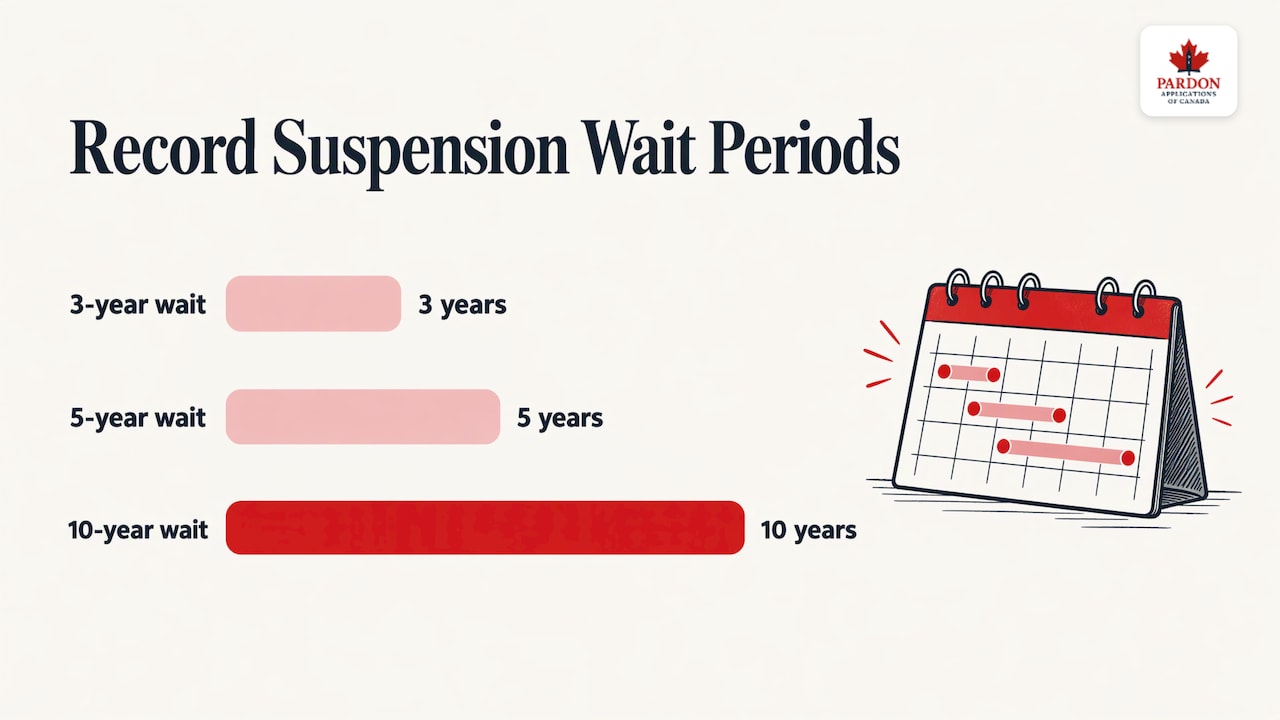
A denied waiver does not affect your eligibility for a Canadian Record Suspension. The Parole Board’s rules turn on your Canadian sentences and waiting period: you must complete all sentences and wait 3, 5 or 10 years, depending on the offence. Many people work on both at once, since a Pardon can help with jobs and licences at home while the waiver addresses travel.
A word on cost, because it often causes confusion. The Parole Board of Canada’s filing fee is $50, but that is only one piece of the process. Fingerprinting, court and police record searches, and the time to gather and verify documents all add expense, and a Pardon application is not a $50 undertaking. Our Pardon Only plan is $80 per month.
How long a new application takes
Plan in months, not weeks. Preparation takes time before anything reaches CBP: ordering the RCMP record, obtaining court documents and assembling evidence. Our own guide to I-192 processing time for Canadians breaks down the preparation stage and the wait that follows. Approvals, when granted, are time-limited and renewable, so it is worth understanding I-192 renewal before your waiver ever expires.
Why many applicants get help with the second attempt
After a refusal, the stakes feel higher. Every detail matters, and the cost of another error is months of waiting. Working with a firm that prepares these applications can bring structure and a second set of eyes. We explain the reasoning in 3 reasons to retain a firm to complete your U.S. entry waiver application, and our checklist of steps to ensure a successful U.S. entry waiver shows what a complete file looks like.
Let us review your situation
At Pardon Applications of Canada, accredited Pardon and Waiver officers meet with you, assess your eligibility and help you assemble a complete, accurate application, with dedicated support so you always know where your file stands. We are designed to reduce the avoidable errors that lead to delays and denials, though no one can promise how CBP will decide.
If your waiver was refused, we can talk through the decision with you and map out a new application. If time matters, priority processing is available for a one-off fee of $95 to $150.
Start with a Free Consultation and take the first step toward travelling with confidence again.
FAQ
Can I reapply after my I-192 is denied?
The KIND guidance says a denial cannot be appealed, so the usual route is a new application. Address the reasons for the refusal and file complete, current documents. Approval is never guaranteed, since the waiver is discretionary.
Why was my I-192 denied if I have a Pardon?
A Canadian Pardon (Record Suspension) does not guarantee entry to another country, and the U.S. does not recognize it for admission purposes. The waiver is a separate decision made by U.S. authorities, so a Pardon does not replace it.
Can a missed biometrics appointment cause a denial?
Yes. For electronic filers, failing to report for biometrics at a designated port within 45 days of filing means the application is treated as abandoned and denied. Schedule your appointment as soon as you file.
How recent does my RCMP record need to be?
The Civil Product returned from the RCMP on Form C216C must be dated and endorsed within 15 months of submitting your I-192. If it is older, order a new one before you file again.
Sources
- Form I-192: Application for Advance Permission to Enter as a Nonimmigrant, CBP
- Form I-192 Instructions, USCIS
- e-SAFE FAQ, U.S. Customs and Border Protection
- KIND guidance: next steps after a USCIS denial
- Applying for a Record Suspension, Parole Board of Canada
- Record Suspensions (Pardons), Courthouse Libraries BC
- Bail and Immigration Status
Recommended
- I-192 Processing Time for Canadians: Weeks of Prep, 6–12 Months
- I-192 Renewal for Canadians: The Wrong Agency Can Cost Months
- Why Do I Need a US Waiver?
- Steps to Ensure a Successful U.S. Entry Waiver
This content brings together contributions from PAC, our content team, and AI tools, with PAC retaining editorial responsibility. It is shared for general information, not legal advice. Laws and procedures may change; seek qualified legal advice for your circumstances.