
If all you have is a conditional discharge, you do not need to apply for a Pardon (record suspension). A conditional discharge is a finding of guilt without a conviction, and the Parole Board of Canada says you don’t need to apply for a record suspension if you have only received absolute or conditional discharges. The record is sealed automatically, three years after sentencing. Things change if you also have a conviction, if your discharge was revoked, or if you are facing a U.S. border question. This guide walks through each situation so you know where you stand.
TL;DR
- A conditional discharge is not a conviction under section 730(3) of the Criminal Code, but it does come with a probation order.
- If you received it on or after July 24, 1992, the RCMP seals the record three years after sentencing. No Pardon application is needed for the discharge alone.
- If the discharge was revoked, or you have any other conviction, a Pardon (record suspension) may be the route to a clean slate, and waiting periods apply.
- The PBC’s filing fee is $50, but that is only one cost among many in a full application.
- U.S. border questions can arise from information already shared between the two countries, and a U.S. Entry Waiver (I-192) may be part of the answer.
Table of Contents
- What a conditional discharge actually is
- Is a conditional discharge a conviction?
- When the record disappears: the three-year rule
- Do you need a Pardon after a conditional discharge?
- If you do have a conviction: waiting periods
- What a Pardon application really costs
- How long does processing take?
- Travel to the United States with a conditional discharge
- Where we can help
- A short checklist for your next steps
- FAQ
- Sources
What a conditional discharge actually is
A conditional discharge sits between an acquittal and a conviction. The court accepts that you pleaded guilty or were found guilty, but it chooses not to register a conviction. Instead, it places you on probation with conditions. When you complete them, you are discharged.
Section 730(1) of the Criminal Code sets out when a judge can do this. The offence cannot carry a minimum punishment or be punishable by 14 years or life in prison. The judge must also consider the discharge to be in your best interests and not contrary to the public interest. In practice, the Department of Justice describes discharges as reserved for less serious offences. Conditions might include not drinking alcohol or using drugs, staying away from certain places, or attending treatment or counselling.
If you want a side-by-side look at the two types, we have a separate piece on the difference between a conditional and absolute discharge.
Is a conditional discharge a conviction?
No. Under section 730(3), a person who is discharged is deemed not to have been convicted of the offence. There are narrow exceptions: you keep certain appeal rights, and you can plead autrefois convict if you are later charged with the same matter.
Legal Aid Ontario puts the distinction clearly: there is a finding of guilt, but no conviction is registered, and the conditions always come through a probation order.
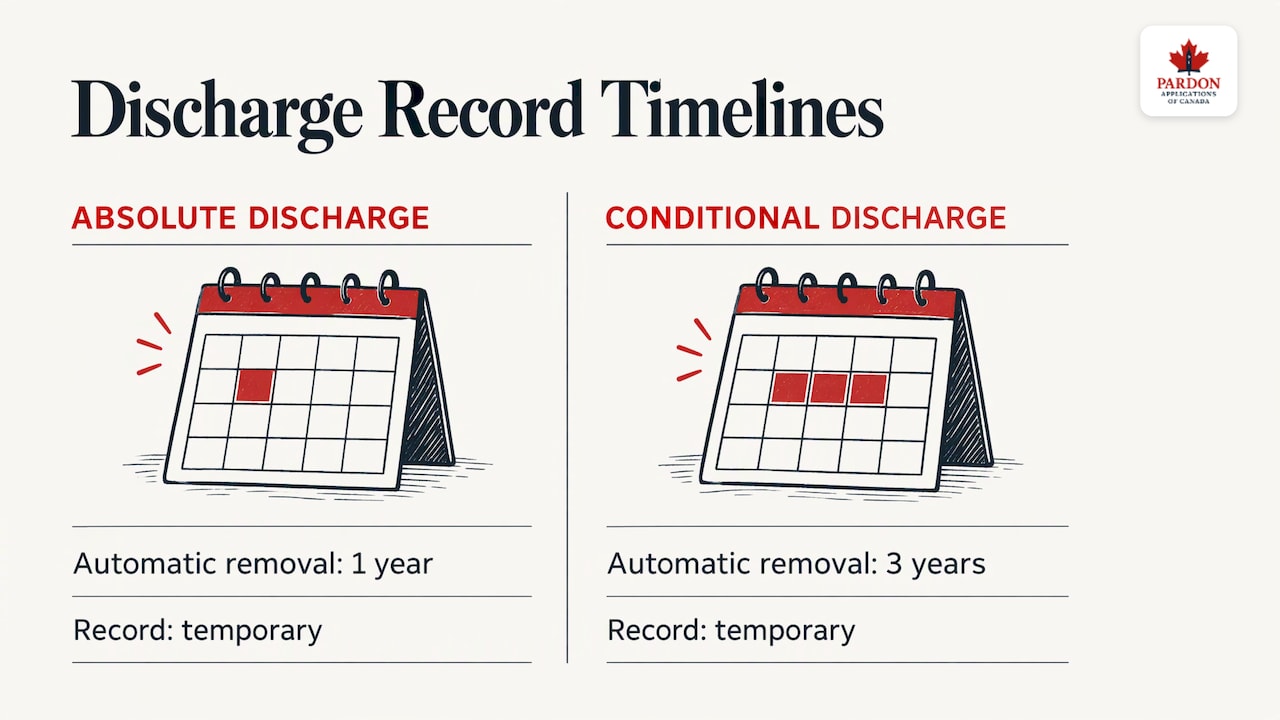
This matters in daily life. A conviction creates a permanent criminal record. A discharge creates a temporary one. Steps to Justice explains that this temporary record is removed automatically after one year for an absolute discharge and three years for a conditional discharge.
When the record disappears: the three-year rule
The clock matters, so here is how it works.
| Date of your discharge | What happens to the record |
|---|---|
| On or after July 24, 1992 | The RCMP seals the conditional discharge record three years after the date you were sentenced |
| Before July 24, 1992 | You send the RCMP a written request to seal the record |
Both rows come from the RCMP’s guidance on managing criminal records. For older discharges, the Parole Board of Canada points people to the RCMP Pardon & Purge Services office (P.O. Box 8885, Ottawa, ON K1G 3M8), as stated on its application FAQ page. Confirm the current address and process with the RCMP before you write.
Two things to keep in mind:
- Three years runs from sentencing, not from the end of probation. Because probation can last up to three years, you may find that probation ends close to the date the record is sealed.
- Sealing is not the same as the file never existing. Before it is sealed, the record can appear on certain checks. After it is sealed, it should no longer be visible in the way an active record is.
If you want to confirm what is currently on file, ask the RCMP about obtaining a copy of your criminal record. That gives you a clear picture before you fill out job, volunteer or travel forms.
Do you need a Pardon after a conditional discharge?
For the discharge alone, no. The Parole Board’s eligibility guidance is explicit that a discharge does not require a record suspension application. We say this plainly because you deserve straight information, and because the weight many people carry over a discharge often lifts on its own with time.
Where a Pardon enters the picture is when your history includes more than the discharge. Common situations:
- You also have a conviction. A separate summary or indictable conviction stays on your record until it is suspended. The discharge is not what holds you back; the conviction is.
- Your discharge was revoked. Under section 730(4), if you are bound by a probation order from your discharge and are convicted of another offence, the court that made the order may revoke the discharge. It can then convict you of the original offence and impose any sentence that could have been imposed at the time. Once that happens, you have a conviction, and a Pardon becomes relevant.
- You are unsure what your record shows. A discharge sometimes appears alongside other entries. Getting a clear copy of your record is the first step to knowing which entries are actually active.
The invisible ceiling many people feel at work or at the border usually comes from an active conviction, not a discharge that has been sealed. Identifying which one you have is half the battle.
If you do have a conviction: waiting periods
The Criminal Records Act sets the wait before you can apply. Under section 4(1), the clock starts after your sentence is fully completed, and it is:
- Five years for an offence punishable on summary conviction.
- Ten years for an indictable offence, and for certain other offences listed in the Act.
The Parole Board’s Record Suspension Application Guide notes that the periods depend on the date of the first offence:
| Date of offence | Summary | Indictable |
|---|---|---|
| On or before June 28, 2010 | 3 years | 5 years |
| June 29, 2010 to March 12, 2012 | 3 years | 5 years (10 years for serious personal injury offences) |
| On or after March 13, 2012 | 5 years | 10 years |
“Completed your sentence” is broader than many people expect. The Parole Board’s eligibility page says it includes all fines, surcharges, costs, restitution and compensation orders, all prison and conditional sentences including parole and statutory release, and any probation orders. An unpaid fine can keep the clock from starting. Our guide to the timeline for a Pardon or record suspension explains how people count it, and the article on why the clock can start later than expected covers a common trap.
Meeting the waiting period does not make approval automatic. For indictable matters, the Board may order a suspension if it is satisfied you were of good conduct and were not convicted of a federal offence during the waiting period. It also looks at whether the suspension would provide a measurable benefit, sustain your rehabilitation as a law-abiding citizen, and not bring the administration of justice into disrepute. No one can promise you a result, and we never do.
What a Pardon application really costs
The Parole Board of Canada’s filing fee is $50. That figure is the government’s processing fee only, and it is not what a complete application costs. The Board’s own guide says applicants are also responsible for other fees, including fingerprints, copies of the criminal record, court documents and police checks.
In real terms, the costs usually include:
- The PBC filing fee of $50.
- Fingerprinting and a certified copy of your RCMP criminal record.
- Local police record checks, sometimes from several police services if you have lived in more than one place.
- Court documents for each conviction, which can mean contacting courts in different provinces.
- Any application preparation help you choose to use.
If you decide you would like help, our Pardon Only plan is $80 per month. The plan page explains what it covers.
How long does processing take?
Once your application is accepted as eligible and complete, the Parole Board says it endeavours to process summary offences within 6 months and indictable offences within 12 months. That clock starts at acceptance, not when you first gather documents. Collecting records, especially older court files, is often the slowest part. Our walkthrough of the record suspension process and the documents to check lists what to line up early.
Travel to the United States with a conditional discharge
This is the question that worries people most, and it deserves care. Canada and the United States share criminal record information. The RCMP explains that U.S. law enforcement and border agencies have limited access to active records through CPIC, and that if the U.S. looked at an active record before it was suspended, it may have documented that.
What this means for you:
- Once your discharge record is sealed, it is no longer an active record.
- Before sealing, or if you have other entries, a border officer may ask questions. Answer truthfully and carry your documents.
- If you have been found inadmissible, a U.S. Entry Waiver (Form I-192) may be what lets you cross legally. U.S. Customs and Border Protection states that the form is open to Canadian citizens, and that Canadians must include an RCMP criminal record verification endorsed within 15 months of submission. If any records were pardoned, a complete copy of the Pardon or record suspension must be included too.
Admissibility decisions rest with U.S. officers, and nobody can guarantee one. For background, read why you might need a U.S. waiver and our note on I-192 processing time.
Where we can help
Pardon Applications of Canada prepares Canadian Pardon (record suspension) applications and U.S. Entry Waiver (I-192) applications. You meet with accredited officers who review your record, tell you honestly whether you are eligible, and help you assemble a complete, accurate file, because missing or inconsistent paperwork is a common cause of delays. We also support you along the way so you are never left guessing where things stand.
If you are not sure whether your discharge, a conviction or both are on your record, a conversation is a good place to start. Schedule a Free Consultation and we will look at your situation.
If you need to renew a waiver, see our I-192 Renewal page.
A short checklist for your next steps
- Find the date you were sentenced for the discharge. That date starts the three-year sealing period.
- Request a copy of your criminal record from the RCMP so you know exactly what is active.
- List every other offence, with its date, type (summary or indictable) and outcome.
- Confirm every fine, surcharge and probation order is finished.
- Work out your waiting period using the table above, then decide whether to apply yourself or with help. Our article on whether you need a lawyer explains what the paperwork demands.
- If you plan to travel to the U.S. and have been flagged, ask about an I-192 early, because it takes time.
FAQ
Does a conditional discharge show up on a background check?
It can until it is sealed. The RCMP seals a conditional discharge three years after sentencing if you received it on or after July 24, 1992. After that, it should not appear as an active record on a standard criminal record check.
Can I apply for a Pardon if I only have a conditional discharge?
You do not need to. The Parole Board of Canada says that anyone with only absolute or conditional discharges does not need to apply for a record suspension. If you also have a conviction, a Pardon application may apply once you meet the waiting period.
Can a conditional discharge be turned into a conviction?
Yes, in one circumstance. If you are convicted of a new offence while bound by the probation order, the court may revoke the discharge under section 730(4) and convict you of the original offence. That is why finishing your conditions without new charges matters.
Can I travel to the U.S. with a conditional discharge?
It depends on what is on your record and how U.S. officers view it. Canada and the U.S. share limited record information, and a sealed discharge is no longer an active record. If you have been found inadmissible, you may need a U.S. Entry Waiver (I-192) before crossing.
How much does it cost to apply for a Pardon?
The Parole Board’s filing fee is $50, but a complete application has many other costs, including fingerprints, police checks, court documents and a copy of your RCMP record. Add any preparation help you choose, so budget for the whole process rather than the fee alone.
Sources
- Criminal Code, section 730
- Criminal Records Act
- Conditional discharge, Legal Aid Ontario
- Steps to Justice: sentences with a criminal record, but no jail time
- Department of Justice: How sentences are imposed
- RCMP: Managing criminal records
- Parole Board of Canada: Got a question about your application?
- Parole Board of Canada: Who is eligible for a record suspension?
- Parole Board of Canada: Official application guide and forms
- Parole Board of Canada: Record Suspension Application Guide, July 2022
- U.S. Customs and Border Protection: e-SAFE
Recommended
- Absolute or Conditional Discharges: What You Need to Know
- Can You be Refused a Pardon?
- Breaking Down the Pardon Process, Part 2: Am I Eligible for a Pardon?
- Breaking Down the Pardon Process, Part 1: What is a Pardon?
This content brings together contributions from PAC, our content team, and AI tools, with PAC retaining editorial responsibility. It is shared for general information, not legal advice. Laws and procedures may change; seek qualified legal advice for your circumstances.