
A conditional discharge is not a criminal conviction in Canada, but the United States may still treat it as a reason to refuse you at the border. It depends on the offence behind it. If it was a crime involving moral turpitude (CIMT) or a drug offence, you may be inadmissible and may need a US Entry Waiver (Form I-192) before you travel. If you have carried that worry since your sentencing, this guide shows where you stand and what to do next.
TL;DR
- In Canada, a conditional discharge is a finding of guilt without a conviction. US immigration authorities may still treat it as a conviction for admissibility purposes.
- Whether you are inadmissible usually turns on the offence: a CIMT or a drug offence is the concern, and simple assault is one example given in legal explainers.
- A Canadian Pardon (record suspension) is not available for a discharge alone, and it does not open the US border on its own.
- A youth record does not guarantee entry either, because US officers can ask questions and keep what they learn.
- If a waiver is the right route, the I-192 is prepared in advance, so plan well before your trip.
Table of Contents
- What a conditional discharge means in Canada
- Can you be refused entry to the US with a conditional discharge?
- Does a youth offence affect US entry?
- How long a discharge stays on your Canadian record
- Why a Pardon will not solve a discharge problem
- When a US Entry Waiver is the right step
- How we can help
- What the process costs
- Frequently asked questions
- Sources
What a conditional discharge means in Canada
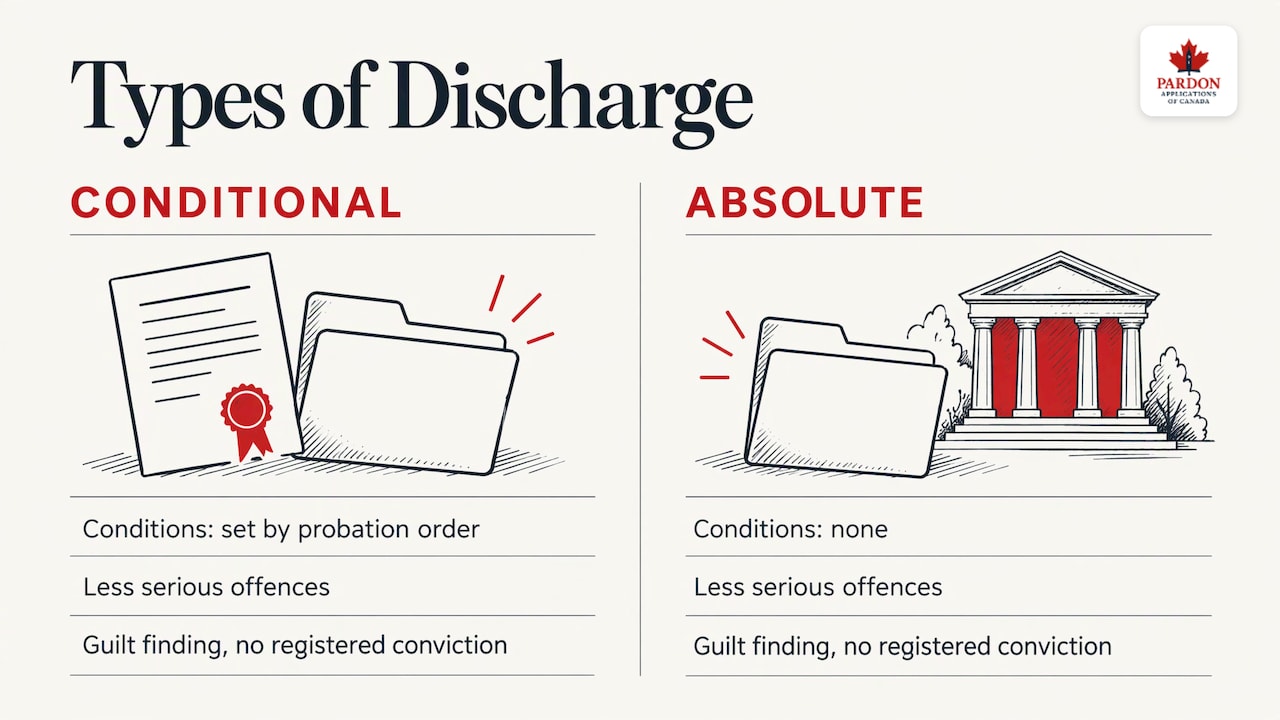
After a guilty plea or a guilty finding, a court may order a discharge instead of a conviction. According to the Department of Justice, a conditional discharge comes with conditions set through a probation order, while an absolute discharge has no conditions. Both are reserved for less serious offences, and both involve a finding of guilt without a registered conviction.
The idea behind them is a fair one. A Parliamentary background paper links discharges to avoiding the damaging effects of a criminal record for first-time offenders with minor offences. For many people, it worked at home. Employers and landlords in Canada generally see a very different picture than they would with a conviction.
The trouble starts at the border. Canada’s definition of “conviction” stops at its own border. The United States applies its own immigration law, and it looks at what happened, not at what the Canadian court called it.
If you want a plain side-by-side comparison of the two kinds of discharge, our article on the difference between a conditional and absolute discharge covers it.
Can you be refused entry to the US with a conditional discharge?
Yes, it is possible. One Canadian legal information service explains that US immigration authorities consider conditional discharges to be convictions, so a discharge may make you inadmissible when it relates to a crime involving moral turpitude or a drug offence. The same page notes that an absolute discharge is a different matter in practice only when the facts are not a CIMT or drug offence, so the offence is what counts.
That is why two people with the same type of discharge can have very different outcomes. One may cross without any issue. Another may be sent to secondary inspection, questioned and turned back.
Why the offence matters more than the label
US officers do not ask whether you were “convicted” in the Canadian sense. They ask whether the conduct behind the finding falls into a category that makes a foreign national inadmissible. Two categories come up most often:
- Crimes involving moral turpitude (CIMT). This is a US legal concept without a tidy definition. Theft, fraud and certain assaults are among the offences that raise questions.
- Drug offences. Possession and trafficking charges can trigger inadmissibility, and so can an admission of drug use made to an officer.
The outcome can also depend on how the officer reads your court documents and on what you say. This is why we do not recommend guessing. Our article on why you may need a US waiver walks through the reasoning in more detail.
What happens at the border
Border officers in the US can ask about your history, and what you tell them goes into their files. If they decide you are inadmissible, you can be refused entry that day. A refusal can also make the next crossing harder. Many travellers are caught off guard because nothing was flagged on earlier trips. Our piece on US border restrictions that surprise Canadians explains why a past crossing without trouble is not proof that the next one will go the same way.
Does a youth offence affect US entry?
It can. A youth record feels like something that belongs to another life, and in Canada the law treats it with strong confidentiality. That protection stops at the border.
Steps to Justice explains that a youth record cannot stop you from travelling within Canada, but some other countries, including the United States, may not let you in if you have one. It adds that the confidentiality rules under the Youth Criminal Justice Act do not prevent foreign border officials from asking you questions, and that those officials can keep information in their files indefinitely.
In practice, this means:
- Youth-record rules in Canada do not guarantee that you will be admitted to the US.
- Do not assume that a record has disappeared just because Canadian time periods have run out.
- If you are unsure what your youth record involved, get the facts before you book travel rather than at the border.
The Parole Board of Canada also says you do not need to apply for a record suspension if your record includes only youth court convictions, and that youth records may have been destroyed or archived once the Youth Criminal Justice Act periods have passed. That is a Canadian rule. It tells you nothing about what a US officer may already know or ask.
How long a discharge stays on your Canadian record
Time does change what Canadian checks show. The RCMP states that under the Criminal Records Act, an absolute discharge is sealed automatically one year after the sentence date, and a conditional discharge three years after, for discharges received on or after July 24, 1992. Legal Aid Ontario gives the same three-year period for a conditional discharge.
A few things are worth knowing about those timelines:
- A sealed record is removed from view for ordinary Canadian record checks. Within the retention period, though, a discharge can show up on a basic criminal record check.
- The RCMP also says its National Repository file can include non-conviction information, and that you may request its destruction in some cases.
- Sealing in Canada does not erase what a US officer may learn from you directly, from court documents, or from earlier border records.
The lesson is simple. Your Canadian record may be quiet, but the US side of your history is a separate file.
Why a Pardon will not solve a discharge problem
Many people with a discharge ask us whether a Pardon (record suspension) will fix the border problem. The honest answer is no, for two reasons.
First, record suspensions apply to convictions. The Parole Board of Canada says you do not need to apply if you have only an absolute or conditional discharge. Your discharge is handled by the automatic sealing schedule above.
Second, even where a Pardon applies to a conviction, it does not give you automatic US entry. We explain this in why a Canadian Pardon won’t get you into the United States. A Pardon is a Canadian remedy. The US decides admissibility under its own laws.
If you have both a discharge and a separate conviction, a Pardon may still be worth pursuing for the conviction, for work and housing in Canada. One of our accredited officers can look at your full record and tell you which steps fit.
When a US Entry Waiver is the right step
The route designed for this situation is the US Entry Waiver, filed on Form I-192. The Legal Line explanation recommends a waiver of inadmissibility, rather than relying on showing the discharge at the border, and adds a useful detail. If a waiver turns out not to be needed, the Admissibility Review Office (ARO) issues an official letter saying so, and you must produce it when crossing.
That gives you three possible outcomes:
| Situation | What it usually means | Next step |
|---|---|---|
| The discharge relates to a CIMT or drug offence | You may be inadmissible | Prepare an I-192 waiver application |
| The offence is not a CIMT or drug offence | A waiver may not be needed | Get the position confirmed in writing before you travel |
| You are not sure what category your offence falls into | The risk is unclear | Have your records reviewed before booking |
Approval of a waiver is discretionary, and we never promise a result. What we can do is help you present a complete and accurate application, which is the best way to reduce delays and avoid avoidable denials. For a general introduction, see US Entry Waiver 101.
Steps to take before your next trip
- Get your records. Collect the court documents for the discharge, including the charge, the finding and the probation order.
- Identify the offence. Work out which Criminal Code section applied. This is what decides whether the CIMT or drug-offence concern is real.
- Do not test the border. Crossing first to see what happens can leave a refusal on your file.
- Speak to an accredited officer. Ask whether a waiver is needed and what documents support it.
- Apply early. Waiver applications take weeks of preparation and months of processing. Read about I-192 processing time before you plan flights or work travel.
- Plan your renewal. A waiver is granted for a limited period, so diarize the renewal. Our I-192 renewal service exists for that.
How we can help
A discharge should not leave you looking over your shoulder at every crossing. At Pardon Applications of Canada, our accredited Pardon and Waiver officers review your record, assess whether a US Entry Waiver is the right step, and prepare a complete application so that nothing is missing when it is filed. We stay in touch through dedicated support channels so you always know where things stand.

If you also have a conviction that would qualify for a Canadian Pardon, we can assess both in one conversation. Start with a free consultation on our Canadian Pardon and US Entry Waiver services page, and see our US waiver costs page for priority processing, which is a one-off charge of $95 to $150.
What the process costs
Be wary of anyone who quotes a single low figure. The Parole Board of Canada’s filing fee for a Pardon (record suspension) is $50, but that is only one cost among many. There are also fees for fingerprinting, court and police record searches, and the preparation of the application itself. Our Pardon Only plan is $80 per month, and you can see how it works on our costs page.
For a US Entry Waiver, the government fee is separate from our preparation service, and your total depends on your case. We will explain every cost in writing during your consultation.
Frequently asked questions
Is a conditional discharge a conviction in the US?
Not formally, but US immigration authorities may treat it like one when deciding admissibility. Canadian legal information sources say this can make you inadmissible when the offence is a CIMT or a drug offence. The type of offence matters more than the word “discharge”.
Do I need a waiver if my discharge has been sealed?
Sealing is a Canadian process. The RCMP seals a conditional discharge three years after sentencing, but that does not remove what US officers may already hold or may ask you about. If your offence was a CIMT or drug offence, speak with an accredited officer before you travel.
Can I apply for a Pardon for a conditional discharge?
No. The Parole Board says you do not need to apply for a record suspension if you have only a conditional or absolute discharge, and that you may apply if you were convicted as an adult. See its eligibility page for the exact rules.
Will a youth offence stop me at the US border?
It may. Canadian youth-record protections do not bind US border officers, who can ask questions and keep the answers in their files, according to Steps to Justice. The safest approach is to find out what your record contains before you book travel.
How do I know if a waiver is not needed?
The Admissibility Review Office issues an official letter when a waiver is not required, and you must show it when crossing. Our officers can explain how to approach that step for your situation.
Sources
- How sentences are imposed, Department of Justice Canada
- Background Paper: Sentencing in Canada, Library of Parliament
- Can someone with a conditional or absolute discharge enter the USA?, Legal Line
- Will a youth record affect me if I want to travel outside Canada?, Steps to Justice
- Who is eligible for a record suspension?, Parole Board of Canada
- Managing criminal records, RCMP
- Conditional discharge, Legal Aid Ontario
- What is a criminal record?, Canadian Civil Liberties Association
Recommended
- US Border Secondary Inspection: What Canadians Should Know
- Absolute or Conditional Discharges: What You Need to Know
- Canadians With A Criminal Record May Be Surprised By U.S. Border Restrictions
- Steps to Ensure a Successful U.S. Entry Waiver
This content brings together contributions from PAC, our content team, and AI tools, with PAC retaining editorial responsibility. It is shared for general information, not legal advice. Laws and procedures may change; seek qualified legal advice for your circumstances.