

An assault charge or conviction does not automatically bar you from the United States, but it can. The outcome depends on how U.S. immigration law classifies the offence, not on what Canada calls it. A Canadian Pardon (Record Suspension) does not settle the question either. If a U.S. officer finds you inadmissible, the usual route back is a U.S. Entry Waiver (Form I-192). That can feel like a heavy weight when you only want to visit family, take a work trip or go on vacation. This guide explains what officers look at, what a Pardon does and does not do at the border, and how the waiver process works.
TL;DR
- An assault record can make you inadmissible to the U.S. It depends on the facts, the offence and the outcome, so the label “simple assault” does not settle it.
- A Canadian Pardon does not guarantee entry to another country, according to the Parole Board of Canada. It sets the conviction aside in Canada and does not bind U.S. border officers.
- If you are found inadmissible, you can apply for advance permission through Form I-192. Approval is discretionary and no one can promise it.
- A complete package matters. CBP will not process an incomplete application, so prepare the RCMP and court documents before you file.
Table of Contents
- Can you enter the U.S. with an assault charge or conviction?
- What the petty offence exception can and cannot do
- Does a Canadian Pardon get you into the U.S.?
- If you have a pending assault charge
- When you can apply for a Pardon after an assault conviction
- Applying for a U.S. Entry Waiver (I-192) with an assault record
- Putting the pieces together: a realistic plan
- How Pardon Applications of Canada can help
- FAQ
- Sources
Can you enter the U.S. with an assault charge or conviction?
Sometimes, but you cannot assume it. U.S. border officers do not use Canadian categories such as “summary” or “hybrid” offence to decide who gets in. They ask whether your record falls under a ground of inadmissibility in the Immigration and Nationality Act. CBP explains that these grounds are found in INA section 212(a).
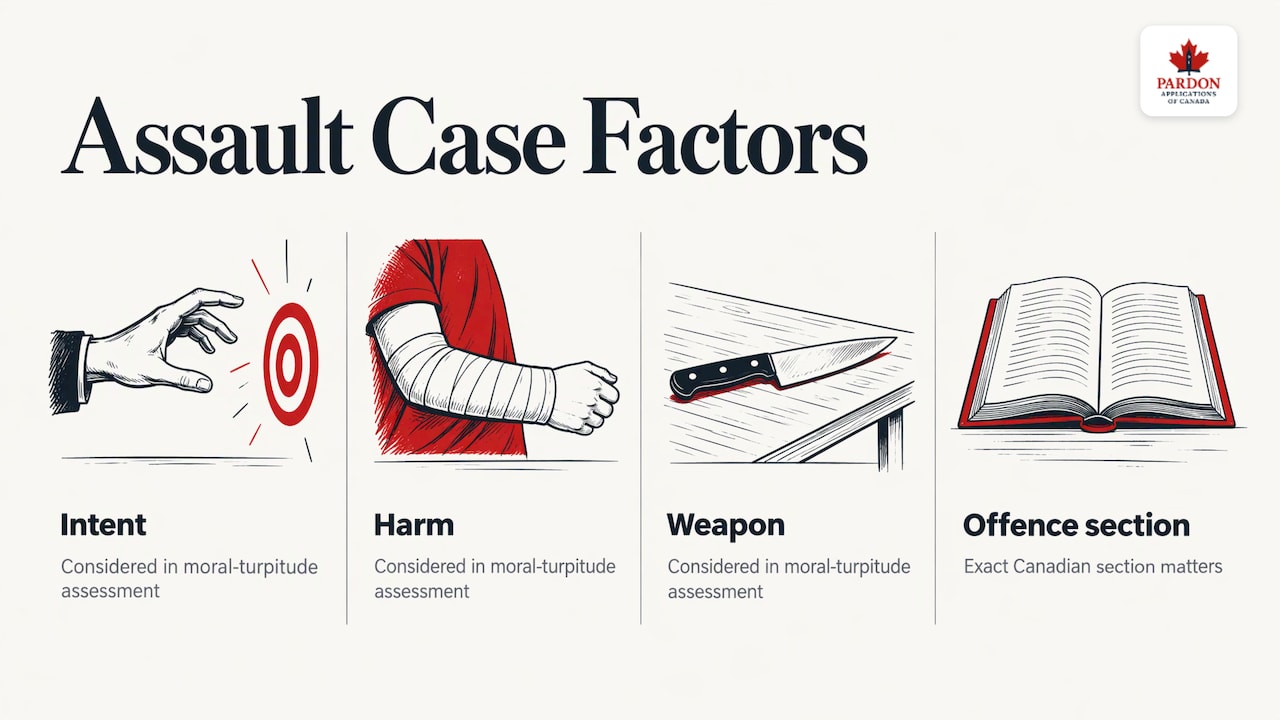
One of those grounds covers crimes involving moral turpitude. Whether a particular assault falls into that group depends on the facts: the intent, the harm, any weapon, and the exact section you were convicted under. A Canadian defence firm makes the same point: U.S. admissibility does not always track Canadian categories, so an offence that looks minor in Canada can still cause trouble at the border.
In practice, two people with a “simple assault” on their record can get very different results. One may cross without a question. The other may be turned back at the booth. That uncertainty is the real source of the anxiety, and the rest of this article is about reducing it.
Why a charge is not the same as a conviction
For immigration purposes, a “conviction” is a formal judgment of guilt entered by a court. The USCIS Policy Manual also says that a conviction can exist even where a court withholds adjudication of guilt. That happens if you pleaded guilty or admitted sufficient facts and the judge ordered some punishment or restraint on your liberty.
This matters if your case ended in a conditional discharge, a peace bond or a stay. Not every one of these outcomes works the same way in the U.S. system, and the details of your court record decide how it is read.
The rules are also not the same for every traveller. A Congressional Research Service report notes that a conviction is not always required for criminal grounds of admission. Grounds for inadmissibility and deportability are not identical. So a case that was withdrawn or dismissed can still prompt questions if the underlying facts suggest the conduct.
Why the sentence matters
The sentence is also read in a particular way. According to the USCIS Policy Manual, a “term of imprisonment or a sentence” generally means your original criminal sentence. Later changes are usually ignored unless they were based on a procedural or substantive defect in the original proceeding. A reduced sentence on appeal for other reasons will not necessarily help you at the border.
What the petty offence exception can and cannot do
U.S. law has a narrow exception for a single minor offence. According to one Canadian legal guide, it applies only if all of these are true:
- You have been convicted of, or admitted to, just one crime involving moral turpitude.
- The maximum possible sentence for that crime did not exceed one year.
- Any sentence actually imposed did not exceed six months.
If you meet all three, you may not need a waiver for that offence. It does not stretch to a second offence. Whether your own assault meets these conditions is a question of how the specific section you were convicted under is treated, so do not rely on a general rule. Get your court records and have them reviewed before you travel.
Does a Canadian Pardon get you into the U.S.?
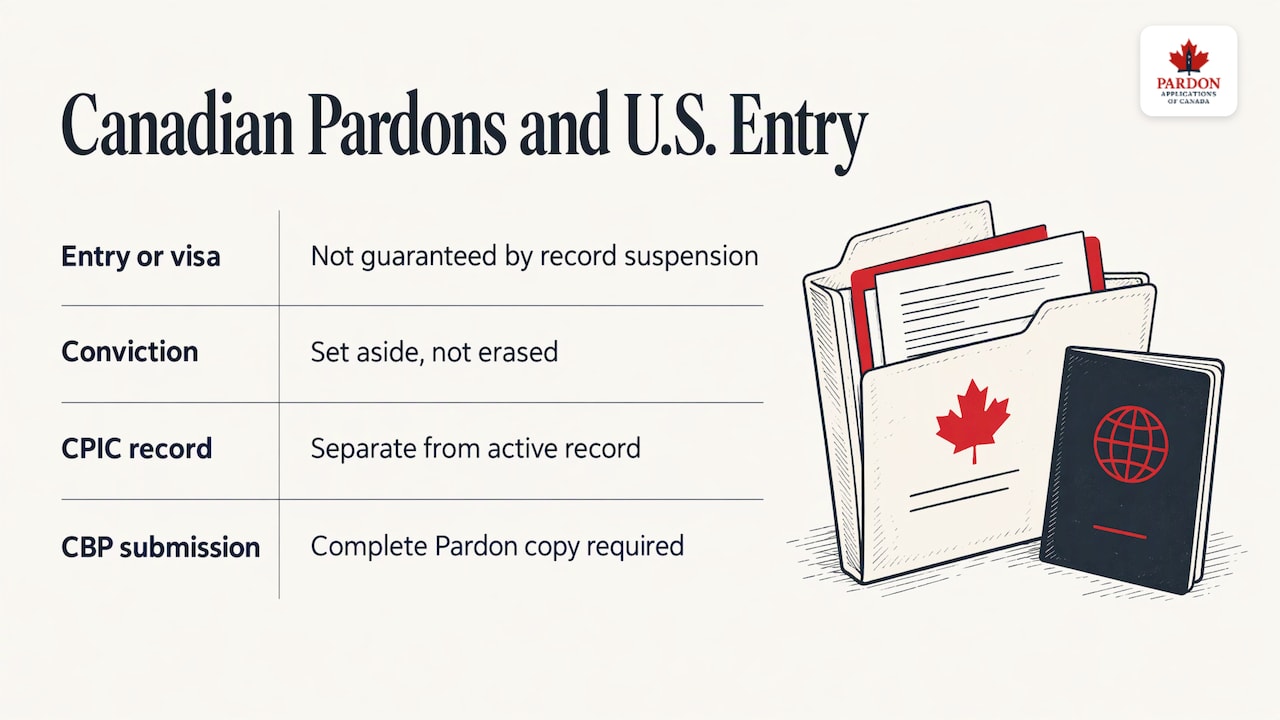
No. This is the most common misunderstanding we hear, and it is worth stating plainly. The Parole Board of Canada says a record suspension does not guarantee entry or a visa to another country. It also says that it does not erase the conviction. It sets the conviction aside and keeps it separate from your active criminal record in the CPIC database.
A Pardon still matters a great deal. It can open doors to jobs, education and volunteer work. But the U.S. makes its own decision about admission. Our own article explains why a Canadian Pardon will not, on its own, get you into the United States.
There is a practical wrinkle too. CBP’s e-SAFE system states that pardoned records must be submitted as a complete copy of the Pardon or record suspension. The U.S. side expects to see the history. It is not hidden from them.
The two tracks: Pardon and waiver
Think of these as two separate tools, each with its own job:
| Canadian Pardon (Record Suspension) | U.S. Entry Waiver (Form I-192) | |
|---|---|---|
| Decided by | Parole Board of Canada | U.S. Customs and Border Protection |
| What it does | Sets the conviction aside in Canada | Asks for advance permission to enter the U.S. despite inadmissibility |
| Helps with | Jobs, housing, volunteering, peace of mind in Canada | Travelling to the U.S. |
| Guarantee of entry | None | None, approval is discretionary |
Many of our clients need both: a Pardon to lift the shadow of the conviction at home, and a waiver to travel south.
If you have a pending assault charge
A charge alone is not a conviction, but it can still affect your plans, and it can limit your freedom to travel. If you are out on bail, an undertaking or a release order, the conditions may restrict leaving the province or the country. You should get written approval before you travel while on bail, because crossing a border without permission can lead to a breach.
If you have a pending charge, speak to your criminal defence lawyer before you cross. How the case ends (a withdrawal, a discharge, a conviction) will change your U.S. position. A Pardon is not possible until the sentence is completed and the waiting period has run, so it is a later step, not an immediate one.
When you can apply for a Pardon after an assault conviction
The Parole Board of Canada requires you to complete all of your sentences before the waiting period begins. That includes fines, surcharges, restitution, any imprisonment or conditional sentence, and probation. For offences on or after March 13, 2012, the waiting period is:
- 5 years for offences punishable on summary conviction
- 10 years for offences prosecuted by indictment
Simple assault under section 266 of the Criminal Code is commonly prosecuted by the Crown electing how to proceed, so which clock applies to you depends on how your case was prosecuted. Your court documents will show it. If you are unsure, our guide to the 5 or 10 year Pardon waiting period walks through the question. People in Ontario often find that the clock starts later than they expect, which we cover in our Ontario record suspension guide.
Note the cost side as well. The Parole Board of Canada’s filing fee is $50, but that is only one part of the process. You also pay for things such as police and court record searches, fingerprints and other paperwork. The full cost of a Pardon is not $50, and it is worth planning for the whole process. We publish our own fees on our Pardon cost page: our Pardon Only plan is listed at $80 per month.
Applying for a U.S. Entry Waiver (I-192) with an assault record
If you are found inadmissible, CBP gives you a route to seek advance permission through Form I-192. CBP states that for criminal convictions you should submit a statement about the circumstances of each arrest, conviction and sentence or fine, together with evidence of rehabilitation. Canadians are among the groups eligible to use the process through CBP’s e-SAFE system.
Approval is discretionary. The defence firm quoted above notes that a waiver can restore your ability to cross, but that it is expensive, has to be renewed and is not guaranteed. We agree that nobody can promise an outcome, and we never do. What we can do is make sure your application is complete and clearly presented.
What the package needs
From CBP’s instructions, a strong Canadian package generally includes:
- RCMP verification. You obtain it by submitting fingerprints on Form C216C. The returned Civil Product and accompanying records must be dated and endorsed by the RCMP within 15 months of your Form I-192 submission.
- Official court records. You need a copy of the record from the actual court of conviction, showing the plea or indictment, the conviction and the disposition, for each crime anywhere in the world.
- A personal statement. It explains the circumstances of the arrest, the conviction and the sentence, and your inadmissibility.
- Evidence of rehabilitation. Counselling, treatment or rehabilitation programs, steady employment, family responsibilities and a clean record since the offence all belong here.
CBP also says not to submit the form until you have these documents, because incomplete packages will not be processed. This is where most delays start. Getting a court to release old records can take time, especially for older cases or cases from another province. Our guide to I-192 processing time explains how weeks of preparation can come before a decision that takes months.
Waivers are temporary
A waiver is not permanent. It has to be renewed before it expires, and a gap can leave you at the border without permission. If you already hold a waiver, our I-192 Renewal service is built for that step. We suggest you start early so that you have time for fresh RCMP and court documents.
Putting the pieces together: a realistic plan
Here is how most of our clients approach it, in order:
- Get your full record. Collect the information, the sentence and the disposition from the court, and an RCMP fingerprint-based check.
- Identify the exact offence. Know the section of the Criminal Code and how the Crown proceeded.
- Decide your goal. If you need to travel to the U.S., plan for a waiver. If you want to clear your record for jobs, housing or volunteering, plan a Pardon. Many people want both.
- Check your Pardon eligibility. Confirm that all sentences are complete and count the waiting period from that date.
- Build a complete file. Include the statement and the rehabilitation evidence. Complete, accurate files are what reduce delays.
- Do not test the border. Crossing first and asking later can lead to being turned back, and it can add to your record with U.S. authorities.
If you are unsure about step 2, ask for help. The offence name on your paperwork may not tell the whole story.
How Pardon Applications of Canada can help
You do not have to work through this alone. Pardon Applications of Canada prepares Canadian Pardon (Record Suspension) applications and U.S. Entry Waiver (I-192) applications. Your file starts with a personalized consultation with accredited Pardon and Waiver officers, who help assess eligibility. We then prepare a complete, accurate application and keep you informed along the way. Our aim is to reduce the chances of delays and denials, though no one can guarantee a decision from the Parole Board of Canada or from CBP.

If you need to move faster, we also offer priority processing, listed at $95 to $150 as a one-off fee. Schedule your free consultation and tell us about your situation. We will tell you which steps apply.
FAQ
Can I enter the U.S. with a simple assault conviction?
Possibly, but it is not certain. U.S. officers decide whether the offence falls under a ground of inadmissibility, and that depends on the facts and the section of conviction. If you are found inadmissible, you can apply for advance permission through Form I-192.
Will a Pardon (record suspension) clear me to cross the border?
No. The Parole Board of Canada states that a record suspension does not guarantee entry or a visa to another country. U.S. authorities may still ask for a complete copy of the Pardon and the underlying record.
Do I need a waiver if my assault charge was withdrawn or dismissed?
A conviction is usually what triggers the problem, but it is not always the only thing that matters for admission. If you were never convicted, speak to a qualified professional about your specific disposition before you travel.
What do I need to apply for an I-192 waiver as a Canadian?
You need RCMP verification dated within 15 months of filing, official court records from the court of conviction, a statement about your inadmissibility and evidence of rehabilitation. CBP will not process an incomplete package.
How long does a U.S. Entry Waiver last?
A waiver is temporary and has to be renewed. The validity period is set on your approval, so check the dates on your own document and start renewal early.
Sources
- Form I-192: Application for Advance Permission to Enter as a Nonimmigrant, CBP
- e-SAFE Welcome, CBP
- Chapter 2, Adjudicative Factors, USCIS Policy Manual
- Immigration Consequences of Criminal Activity, Congressional Research Service
- Applying for a Record Suspension, Parole Board of Canada
- Who is eligible for a record suspension, Parole Board of Canada
- Criminal Record and US Border Travel, Elias Rabinovitch
- Travelling With a Criminal Record from Canada
Recommended
- Canadians With A Criminal Record May Be Surprised By U.S. Border Restrictions
- US Border Secondary Inspection: What Canadians Should Know
- Canadians denied access into U.S. caught by surprise due to tighter border security
- Why a Canadian Pardon (Record Suspension) Won’t Get You Into the United States
This content brings together contributions from PAC, our content team, and AI tools, with PAC retaining editorial responsibility. It is shared for general information, not legal advice. Laws and procedures may change; seek qualified legal advice for your circumstances.