


A stayed charge is not a conviction, so it does not qualify for a Pardon (Record Suspension), and it does not need one. The RCMP treats stayed, dismissed and withdrawn charges as non-conviction outcomes that do not require a Record Suspension. The catch is that a stayed charge can still turn up on certain police checks. If you also have a conviction, a Pardon is the right tool for that part of your record. At Pardon Applications of Canada, we prepare those applications every day, so we know where the two situations get confused.
TL;DR
- A stay of proceedings means the prosecution has stopped. It is not a finding of guilt, and a Pardon (Record Suspension) is only for convictions.
- A Crown stay can be restarted within one year. After that, the proceedings are treated as never having begun.
- Stayed charges can still appear on police record checks, especially the Vulnerable Sector Check. Getting them removed is up to the police service that holds the file.
- If you have a conviction on your record as well, a Pardon can deal with it once your sentence is complete and the waiting period has passed.
- The Parole Board of Canada’s $50 fee is only one cost in a Pardon application. Fingerprints, court documents and police checks come on top.
Table of Contents
- What a stayed charge actually means
- Stayed, withdrawn, dismissed, convicted: how they compare
- Where a stayed charge can still show up
- When a Pardon does come into play
- What a Pardon really costs
- Do you need a lawyer?
- Travelling to the U.S. with a stayed charge or a conviction
- How we help if you have a conviction
- A short checklist for your own situation
- FAQ
- Sources
What a stayed charge actually means
A stay of proceedings stops a case without a verdict. Either the Crown halts the prosecution or a judge ends it. Steps to Justice describes a Crown stay as a decision not to prosecute “for now”. The Crown can start again within one year of the date of the stay.
The legal basis is section 579 of the Criminal Code. Nova Scotia’s prosecution manual describes a stay as an administrative act directed by the Attorney General. Under s. 579(2), the right to recommence generally lasts one year, or a shorter limitation period if one applies. Criminal Code Help explains the other half: if the Crown does not restart within that window, the proceedings are deemed never to have been commenced.
In practice:
- Inside the first year, the charge is in a kind of limbo. You have not been convicted, but the case can return.
- After the year passes, the law treats the case as if it never started.
- A judge’s stay is different from a Crown stay. The Crown’s one-year restart right applies to the Crown stay described above, so read your court paperwork to see who entered the stay.
If you are not sure which kind you have, the court record or the Crown’s office can confirm it. That is a question about your own case, and it matters before you decide anything else.
Stayed, withdrawn, dismissed, convicted: how they compare
People search for “stayed charges and pardons” because the terms sound related. They sit at opposite ends of the system.
| Outcome | Is it a conviction? | Can you apply for a Pardon (Record Suspension)? | Can it show on a police check? |
|---|---|---|---|
| Stayed | No | Not needed, not available | Yes, on some checks |
| Withdrawn | No | Not needed, not available | Yes, on some checks |
| Dismissed | No | Not needed, not available | Yes, on some checks |
| Conviction (absolute or conditional discharges aside) | Yes | Yes, once the eligibility rules are met | Yes, until a Record Suspension is ordered |
The Parole Board of Canada explains that a Record Suspension is for people convicted of an offence in Canada as an adult, or convicted abroad and transferred to Canada under the transfer of offenders legislation. A stay is not a conviction, so a Pardon has nothing to attach to.
That is good news. You do not need to wait five or ten years, and there is no application to prepare for the stayed charge itself. The real question is how visible the stayed charge remains.
Where a stayed charge can still show up
A non-conviction is not the same as an invisible record. Legalline states that non-convictions, including stayed charges, still appear on most local police record checks. Whether the records are destroyed is decided by each police service.
The RCMP adds that your National Repository file may hold both convictions and non-conviction information. That non-conviction information can include withdrawn or dismissed charges and stays of proceedings.
The Vulnerable Sector Check is where it matters most
If you work or volunteer with children, seniors or other vulnerable people, the employer will usually ask for a Vulnerable Sector Check. Clicklaw notes that a stay appears on this check, which can affect work involving children or seniors.
The release of non-conviction information is limited, though. The Canadian Civil Liberties Association’s fact sheet says a Vulnerable Sector Check can include non-conviction information, including stayed, withdrawn or dismissed charges, but only in exceptional circumstances and only if the requirements of the Police Record Checks Reform Act are met. Guelph Police Service describes the same idea: non-conviction information is released only when it passes an Exceptional Disclosure Assessment.
So the honest picture is this. A basic employment check is less likely to cause trouble, but local police checks can include stayed charges. A Vulnerable Sector Check is the one to prepare for.
What you can do about a stayed charge
Because destruction is at the discretion of each police service, the practical step is to contact the police service that laid the charge. Ask what its policy is for non-conviction records and whether it will remove or restrict the entry. Get the answer in writing. Keep your stay paperwork, since you may need to show the date and who entered the stay.
This is a step with an authority, not a Pardon. We prepare Pardon applications for convictions, and we will say plainly if your situation is a non-conviction matter that a Pardon does not cover.
When a Pardon does come into play
Many people with a stayed charge also have an older conviction, or a stay that sat alongside a guilty plea on another count. That conviction is what a Pardon addresses. This is common in files where several charges came out of one incident, and one of them ended in a stay while another ended in a conviction.
For the conviction, the Parole Board of Canada sets two requirements.
- Complete every part of your sentence. That means all fines, surcharges, costs, restitution and compensation, all imprisonment and any conditional sentence, parole or statutory release, and any probation orders.
- Wait the required period. For offences on or after March 13, 2012, that is 10 years for an indictable offence and 5 years for a summary conviction offence.
The clock starts after the sentence is completed, not on the date of the offence, which is why many people count wrongly. Our guide to the Record Suspension waiting period shows how to work out your own date, and our piece on why the clock can start late covers the common Ontario trap.
A stayed charge on the same file does not usually decide whether you can apply for the conviction. The conviction and the sentence do. Still, gather the full court record, so the paperwork shows clearly which charge ended how. Our list of documents to check for a Record Suspension is a good place to start.
What a Pardon changes and what it does not
A Record Suspension keeps the conviction record separate from other criminal records. It can open doors in employment, housing, volunteering and travel. It does not erase the history, and no result can be promised. The Parole Board can also revoke a Record Suspension. Alberta’s alis lists the grounds: a new conviction, no longer being found of good conduct, or lying or hiding information on the application. That is a strong reason to make sure the application is complete and accurate the first time.
What a Pardon really costs
The Parole Board’s application fee is $50. That figure is for the filing alone. The Parole Board also says applicants are responsible for the cost of fingerprints, criminal record checks, court documents and police checks. The $50 fee is not the cost of a full Pardon application. Many other costs come with it.
Local costs add up quickly. The Ottawa Police Service lists a $74 fee for a record suspension application check as of January 1, 2026, with fingerprinting possibly extra depending on the request. Alberta’s alis says costs for fingerprinting, police checks and court documents vary by location.
If you want us to prepare the application, our Pardon Only plan is $80 per month. The costs page explains what it covers. Our timeline guide shows how long each stage usually takes.
Do you need a lawyer?
Not for a Pardon. The paperwork still has to be right, though. Missing court documents, an incomplete sentence record or a wrong date can slow a file down or sink it. We cover this in Canadian Pardons: no lawyer required, paperwork still matters. If your stayed charge raises a real legal question, such as whether the Crown can restart the case, that is a matter for a criminal lawyer who knows your file.
Travelling to the U.S. with a stayed charge or a conviction
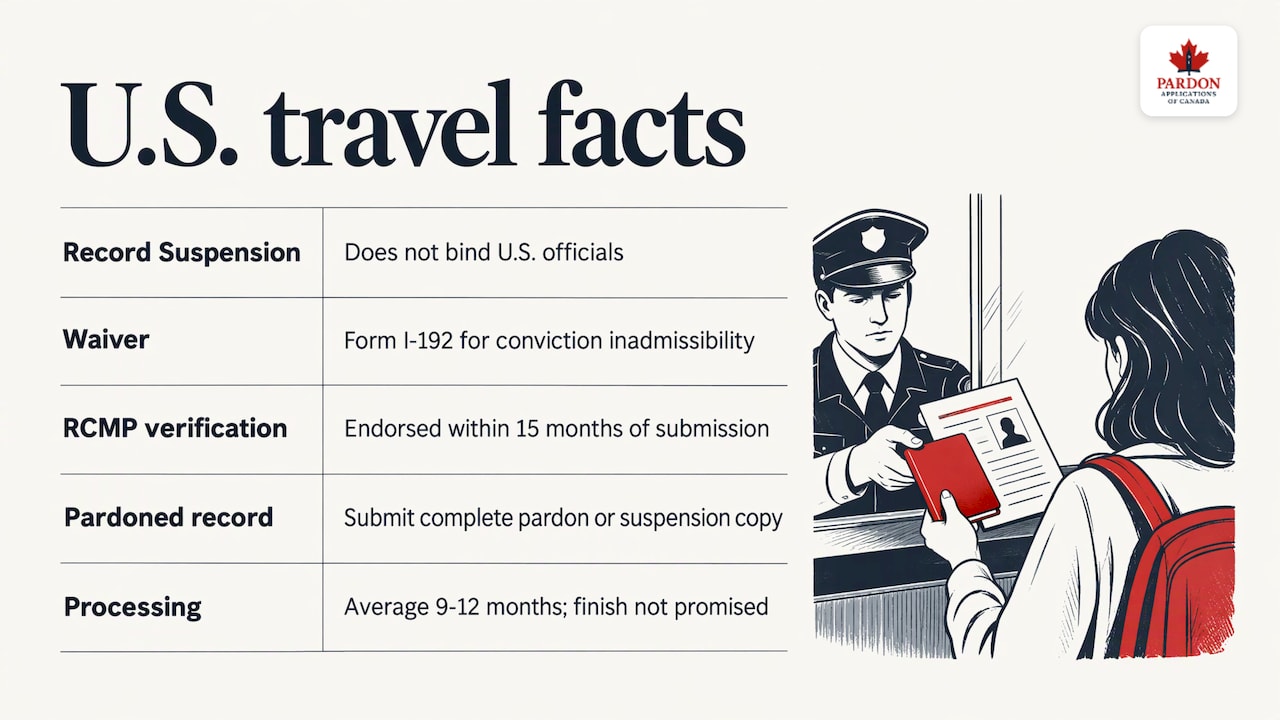
Canadian records matter at the border, but the United States makes its own entry decisions. A Canadian Record Suspension does not bind U.S. officials.
For people who are inadmissible because of a conviction, the usual route is the U.S. Entry Waiver (Form I-192). The U.S. Customs and Border Protection e-SAFE portal says Canadians must provide an RCMP verification of their criminal record, or lack of one, endorsed within 15 months of submitting. Applicants with a pardoned record must submit a complete copy of the pardon or Record Suspension. The portal describes average processing time for Form I-192 as 9 to 12 months, and that is not a promise of when yours will finish.
If a stayed charge is the only thing on your record, your situation is different from a conviction, and an I-192 is generally about convictions and other inadmissibility grounds. For an honest read on your own file, our guides on U.S. Entry Waivers and I-192 processing time are a good start.
How we help if you have a conviction
If there is a conviction behind your search, we can take the application off your hands. Our accredited officers assess your eligibility in a personal consultation and prepare a complete, accurate application, which is how we aim to reduce delays and denials. We also offer dedicated support channels, so you stay informed. We also prepare U.S. Entry Waivers (I-192) and I-192 renewals.

Start with a free consultation on our Canadian Pardon and U.S. Entry Waiver service page. Our step-by-step Pardon process shows what happens after you sign up. We never promise a result, but we do promise careful preparation.
A short checklist for your own situation
- Find out who entered the stay and when. The date starts the one-year clock for a Crown stay.
- Get your court records. They show which charges were stayed and which ended in convictions.
- Request your own police record check. See what is actually showing, and under which check type.
- Contact the police service that laid the charge. Ask about its policy on non-conviction records, and keep the reply.
- Check for convictions. If you have one, count your waiting period from the end of your sentence.
- Plan for the U.S. separately. Canadian records and U.S. entry rules are two systems.
FAQ
Can I get a Pardon for a stayed charge?
No. A Pardon (Record Suspension) is for people who were convicted. A stayed charge is a non-conviction, so there is nothing to suspend. Whether it appears on police checks is a separate issue, handled by the police service that holds the file.
Does a stayed charge show up on a background check?
It can. Non-convictions, including stays, can appear on local police record checks. Vulnerable Sector Checks can include them in exceptional cases that meet the legal tests. A standard employer check may not show them, but you should check your own record first.
Can the Crown restart a stayed charge?
A Crown stay can be restarted within one year. After that, the proceedings are deemed never to have been commenced. If you are within the year, speak to a criminal lawyer about your case.
Do I need a Pardon if all my charges were stayed or dismissed?
No. Charges that were dismissed, stayed or withdrawn are non-conviction outcomes and do not require a Record Suspension. A conviction on any other count is what a Pardon addresses.
Is the Pardon fee really $50?
The Parole Board’s filing fee is $50, but that is only one cost. Fingerprints, police checks and court documents are extra, and they vary by location.
Sources
- RCMP: Managing criminal records
- Steps to Justice: How can I get my criminal charges dropped?
- Nova Scotia: Staying proceedings and recommencing stayed proceedings
- Criminal Code Help: What is a stay of proceedings?
- Parole Board of Canada: Who is eligible for a record suspension?
- Legalline: Can an employer find stayed charges?
- Clicklaw: Resolving criminal matters prior to trial
- CCLA fact sheet on police record checks
- Guelph Police Service: Vulnerable Sector Check
- Alberta alis: Applying for Record Suspensions
- Parole Board of Canada: Applying for a Record Suspension
- Ottawa Police Service: Fees
- CBP e-SAFE
Recommended
- How to Get a Pardon in Canada
- What’s the Difference Between a Pardon in Canada Compared to the U.S?
- Applying for a Canadian Pardon? 3 Recent Changes You Should Know
- Expungement vs Pardon in Canada: What Actually Applies
This content brings together contributions from PAC, our content team, and AI tools, with PAC retaining editorial responsibility. It is shared for general information, not legal advice. Laws and procedures may change; seek qualified legal advice for your circumstances.