
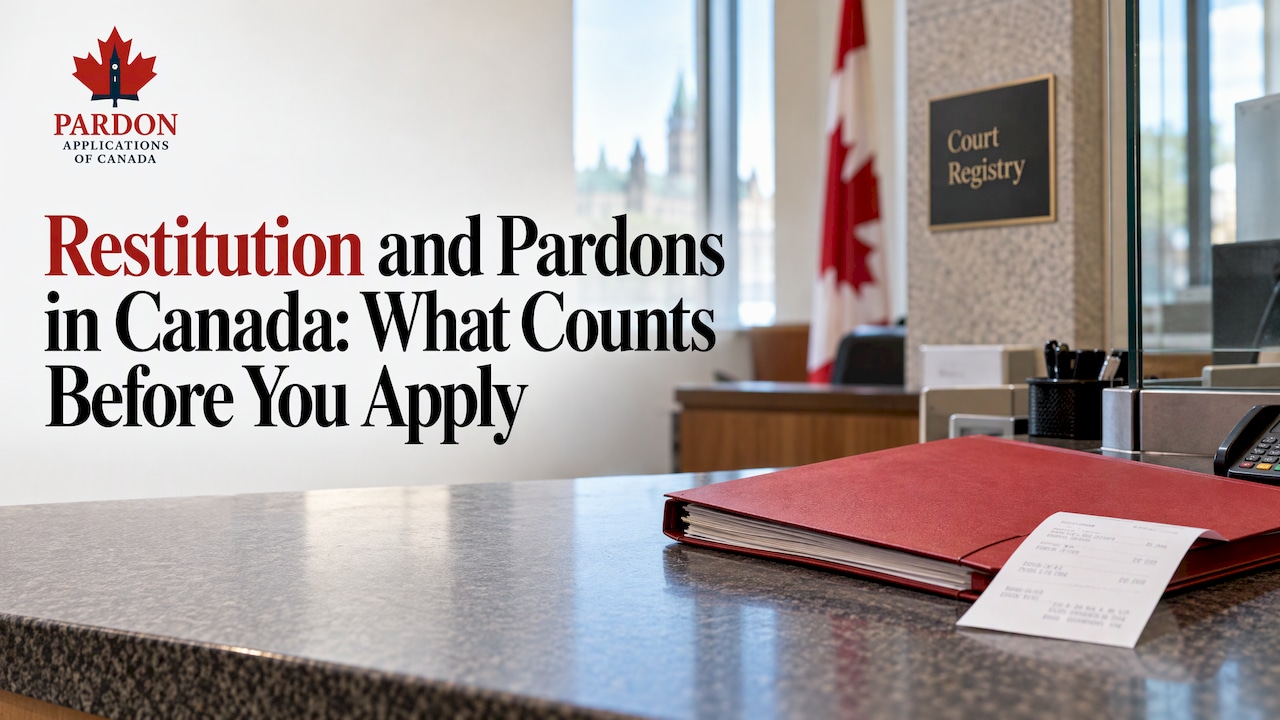
If a court ordered you to pay restitution, that order is part of your sentence, and your Pardon clock does not start until the sentence is fully served. In Canada, a Pardon is now legally called a record suspension. The Parole Board of Canada (PBC) will only accept an application once you have completed every part of your sentence, including fines, surcharges, costs, restitution and compensation orders, and then waited the required number of years.
That can feel like a shadow of a past conviction that refuses to lift. It does lift, but only when the paperwork behind it is complete. This guide explains how restitution fits into the Pardon process, how the waiting periods work, what you will actually spend, and what a Pardon does and does not change.
TL;DR
- Restitution is part of your sentence. You must finish paying it, along with fines, costs and probation, before the waiting period for a Pardon (record suspension) begins.
- The wait is 5 years for summary convictions and 10 years for offences prosecuted by indictment, counted from the end of your whole sentence.
- The PBC’s filing fee is $50, but that is only one cost. Police record checks, court documents, fingerprints and preparation time add up.
- A Canadian Pardon does not guarantee entry to the United States. A separate U.S. Entry Waiver (I-192) may be needed.
- No outcome is guaranteed: the PBC has full discretion over every application.
Table of Contents
- Does Canada still grant Pardons?
- Where restitution fits in your sentence
- Waiting periods
- Who cannot apply
- What a Pardon costs: the $50 fee and everything else
- What a Pardon changes
- Pardon and travel to the United States
- The other kind of Pardon: free and conditional
- A practical path forward
- Get help with your application
- FAQ
- Sources
Does Canada still grant Pardons?
Yes, though the name has changed. On March 13, 2012, the Safe Streets and Communities Act amended the Criminal Records Act to replace the word “pardon” with “record suspension”. Most people still say Pardon, and so do we. The two terms describe the same federal process for most readers today.
The PBC is the only federal agency that orders, refuses to order and revokes record suspensions for convictions under federal acts or regulations. Its own annual report to Parliament states that it holds exclusive jurisdiction and absolute discretion over these decisions. That is why a complete, accurate file matters so much. We never promise a result, because the decision is not ours or yours to guarantee.
The same report notes that, following a Federal Court decision in March 2020, the PBC no longer applies the 2010 and 2012 amendments retroactively and processes both Pardons and record suspensions, depending on when the offence occurred.
Why the wording matters
When Parliament changed the term, the government’s reasoning, recorded in the Library of Parliament summary, was that “record suspension” better reflects what the system does: it conditionally seals a record from public view rather than erasing it. Knowing this sets honest expectations. Your conviction still happened, but its record is kept separate and apart from other criminal records.
Where restitution fits in your sentence
Restitution is a court order to repay a victim for a loss, often property damage, theft or fraud. For Pardon purposes it is treated as a sentence obligation, not a side issue. The PBC’s eligibility page lists what you must complete: fines, surcharges, costs, restitution and compensation orders, imprisonment, conditional sentences and probation. It also notes that some victim surcharges are excluded.
In practice, this means three things:
- An unpaid balance stops the clock. If restitution is still owing, your sentence has not expired, so the waiting period has not started.
- Paying it off is the starting line. The 5 or 10 years run from the day the last obligation is satisfied, not from the date of conviction or release.
- You need proof. Expect to show that every financial obligation is closed. Ask the court or the agency that collects the payments for written confirmation, and keep it with your file.
This is the reason many people find that their Pardon eligibility date is later than they assumed. A sentence that ended in 2015 with a final restitution payment in 2018 starts its waiting period in 2018. Our article on why the 5 or 10 year clock starts late walks through how this plays out in practice.
If you are still paying
Do not wait to find out where you stand. Gather your court documents, find the exact amount outstanding and confirm how payments are recorded. Once you know your real completion date, you can calculate your eligibility date and plan around it. A short eligibility assessment with an accredited officer can confirm this before you spend money on anything else.
Waiting periods
Under section 4(1) of the Criminal Records Act, you cannot apply until 10 years have passed after the end of any sentence for an offence prosecuted by indictment, or 5 years for a summary conviction. The PBC confirms the same periods for offences committed on or after March 13, 2012.
| Type of offence | Waiting period | When the clock starts |
|---|---|---|
| Summary conviction | 5 years | When your entire sentence is complete, including restitution and fines |
| Offence prosecuted by indictment | 10 years | When your entire sentence is complete, including restitution and fines |
If you are unsure whether your offence was summary or indictable, your court records will say so. Offences that can be prosecuted either way are treated according to how the Crown proceeded.
Who cannot apply
Some people are barred altogether. Under section 4(2) of the Criminal Records Act, you are ineligible if you were convicted of an offence listed in Schedule 1, or of more than three offences prosecuted by indictment, each with a sentence of two years or more.
There is a narrow exception for some Schedule 1 offences. Under section 4(3), the Board must be satisfied that you were not in a position of trust or authority over the victim, the victim was not dependent on you, you did not use or threaten violence, intimidation or coercion, and you were less than five years older than the victim.
Two groups do not need to apply at all: people who received only an absolute or conditional discharge, and people convicted only in youth court.
What a Pardon costs: the $50 fee and everything else
The PBC’s application processing fee is $50. You can apply directly to the Parole Board without a lawyer or third-party company. That fee is only one part of the total, and it is not the cost of a complete application.
The other costs are real, and they are where most people get stuck:
- Local police records checks. You need one for where you live now and for each place you lived for three months or more in the last five years. Each police service sets its own fee.
- Court documents. Certified records of your conviction and proof that the sentence, including restitution, is complete may come from different courts and agencies.
- Fingerprints and RCMP records. These are part of the national record check.
- Photocopies, postage and your time. A missing document can send an application back, so careful tracking matters.
If you want expert help, our Pardon Only plan is $80 per month. That plan covers our application preparation service, and the PBC’s $50 fee and third-party charges such as police checks are separate items. Our record suspension process guide lists the eight documents to check before you submit.
What a Pardon changes
The emotional weight of a record often shows up as a hiring ceiling you cannot see. A record suspension removes your record from the CPIC database, which helps with employment and educational opportunities.
More specifically:
- It requires that the judicial record be kept separate and removes disqualifications or obligations under Acts of Parliament, subject to listed exceptions, unless the suspension is revoked or ceases to have effect.
- Under section 8, an employment application for a federal department, Crown corporation or federally regulated business cannot require you to disclose a conviction for which a record suspension has been ordered.
- It can remove federal disqualifications such as the ability to contract with the federal government or eligibility for Canadian citizenship, but it has no effect on a prohibition order under section 109 of the Criminal Code.
- For federally regulated employers such as banks and airlines, the Canadian Human Rights Act protects you from discrimination once a record suspension is granted.
Provincial employers are a different matter. Alberta’s career information service notes that most employers in the province can legally ask about convictions and run checks, so rules vary by jurisdiction and employer.
One safety point: a record suspension for a sexual offence is flagged in CPIC so that a vulnerable sector check will still identify the conviction, as the PBC explains. If you work or volunteer with children or vulnerable people, expect that screening.
Record clearing is a different process in each jurisdiction. California, for instance, has its own expungement system, outlined on this page about record clearing in California. A Canadian record suspension should be understood on its own terms: it seals, it does not erase.
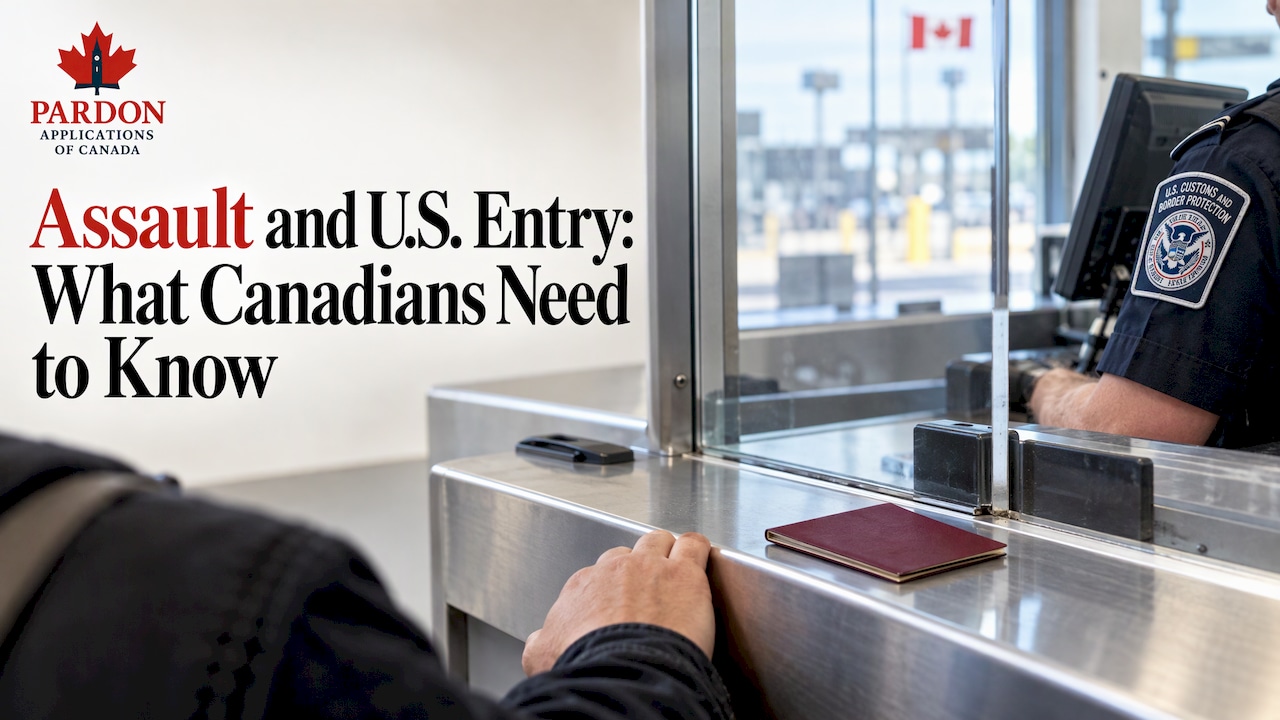
Pardon and travel to the United States
This is the part many people learn too late. A Canadian Pardon does not guarantee entry or visa privileges in another country. The PBC says so plainly, and Courthouse Libraries BC adds that under U.S. law a Canadian pardon is not recognized for entry purposes, so a person with a record may be refused regardless of how minor or old the offence is.
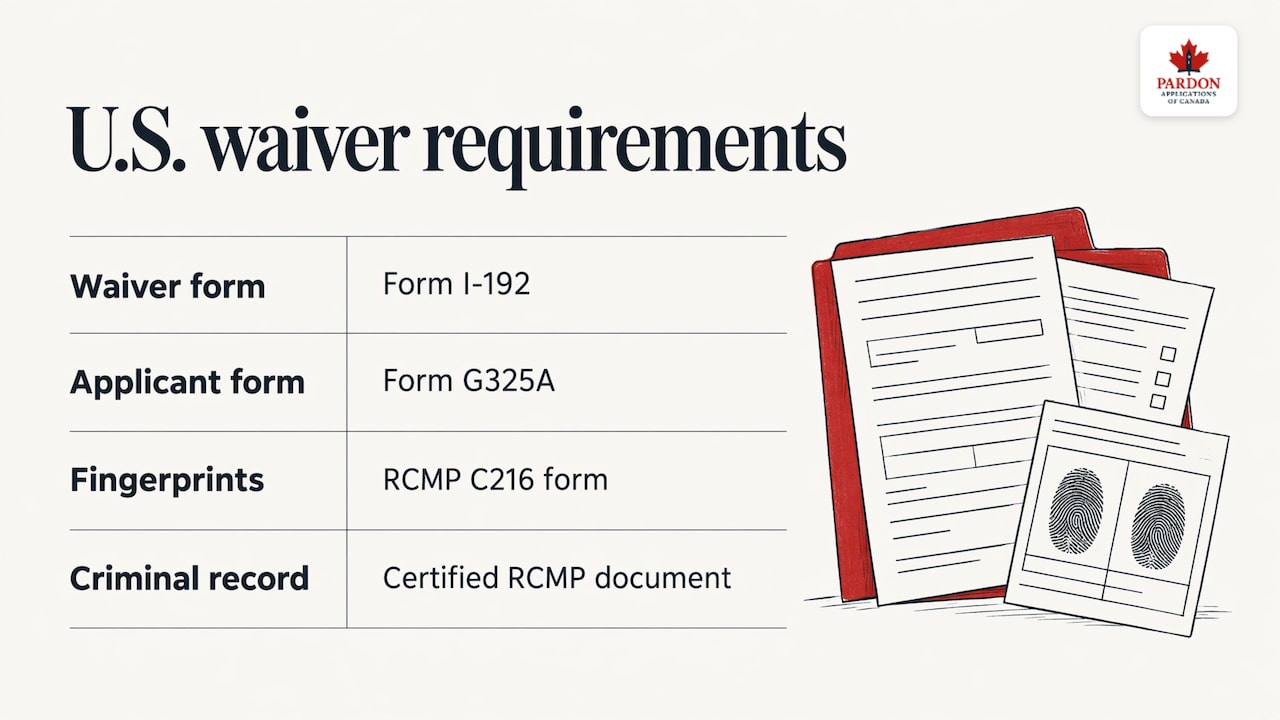
The route for most people is a waiver of inadmissibility. The application requires form I-192, form G325A, fingerprints on an RCMP C216 form and a certified RCMP criminal record document.
We prepare these applications as well. Read why a Pardon will not get you into the United States, see the step-by-step waiver process, or check I-192 processing time for planning. If you already hold a waiver, our I-192 Renewal service is built for that stage.
The other kind of Pardon: free and conditional
People searching this topic sometimes ask about the “two kinds” of Pardon. These are separate from the record suspension most Canadians apply for.
- Free Pardon. The Library of Parliament explains that this treats a person as never having committed the offence, erasing the record and cancelling any consequence of the conviction.
- Conditional Pardon. This has the same effect as a record suspension and may be granted before the waiting period ends where undue hardship is shown.
The PBC’s Ministerial Guidelines say a free Pardon may recognize an erroneous conviction or be granted where justice, humanity and compassion warrant. It is exceptional, not an alternative to the standard route.
A practical path forward
- Confirm your offence type and sentence. Find out if each conviction was summary or indictable, and whether any Schedule 1 offence applies.
- Close out every obligation. Pay restitution, fines and surcharges in full, finish probation, and get written confirmation.
- Calculate your eligibility date. Add 5 or 10 years from the date the last obligation ended.
- Gather your documents. Order police checks, court records and fingerprints early. Our full PAC process outlines each stage.
- Submit a complete, accurate application. Errors and missing items are what cause delays.
- Plan for travel separately. If you want to enter the U.S., prepare the I-192 alongside or after your Pardon.
Get help with your application
Restitution and sentence paperwork is where many applications stall. At Pardon Applications of Canada, accredited Pardon and Waiver officers assess your eligibility, help assemble complete documentation and keep you informed through dedicated support channels. We have helped people move forward for more than 55 years. We cannot promise a result, since the Parole Board decides, but a complete file gives your application the best footing.
Start with a free consultation on our Canadian Pardon applications page, or see Pardon Only pricing.
FAQ
Do I have to pay restitution before I apply for a Pardon?
Yes. The PBC requires you to complete all sentences, including restitution and compensation orders, before the waiting period can run. Get written proof from the court or collecting agency that the balance is closed.
How long do I wait after my restitution is paid?
The wait is 5 years for a summary conviction and 10 years for an offence prosecuted by indictment, counted from the end of your whole sentence. Final restitution payments move that start date.
Does a Pardon erase my criminal record?
No. A record suspension keeps your record separate and apart from other criminal records and removes it from CPIC, but the conviction is not erased. It can also be revoked or cease to have effect.
Does a Pardon let me cross into the United States?
Not by itself. The U.S. does not recognize a Canadian Pardon for entry purposes. Many people need a U.S. Entry Waiver (I-192), which we prepare.
What does it cost to apply?
The PBC filing fee is $50, but there are many other costs, including police record checks, court documents and fingerprints. Our Pardon Only plan is $80 per month.
Sources
- Who is eligible for a record suspension? (Canada.ca)
- What is a record suspension? (Canada.ca)
- Applying for a record suspension (Canada.ca)
- Record Suspension Program 2025-2026 Report to Parliament
- Criminal Records Act, section 4
- Criminal Records Act, full text
- Record Suspensions (Pardons), Courthouse Libraries BC
- Legislative Summary for Bill C-31, Library of Parliament
- Royal Prerogative of Mercy, Ministerial Guidelines
- Finding Work With a Criminal Record, ALIS Alberta
Recommended
- Applying for a Canadian Pardon? 3 Recent Changes You Should Know
- How to Get a Pardon in Canada
- The Legal Process Behind a Pardon Application in Canada
This content brings together contributions from PAC, our content team, and AI tools, with PAC retaining editorial responsibility. It is shared for general information, not legal advice. Laws and procedures may change; seek qualified legal advice for your circumstances.