
A good Pardon consultation answers four things: whether you are eligible now, which documents you still need, what the whole process will cost, and how long it will take. Bring your court and sentence details, and ask direct questions about each of those four. Then you leave with a plan instead of a vague sense of hope. At Pardon Applications of Canada, a personalized consultation with an accredited Pardon and Waiver officer is built around exactly these questions, so you can find out where you stand before you commit to anything.
This guide walks you through what to ask, what to bring and what a straight answer sounds like, for both a Canadian Pardon (the Record Suspension) and a U.S. Entry Waiver (Form I-192).
TL;DR
- Ask first whether you qualify today: all sentences must be fully completed before the waiting period starts, and it is 5 years for summary offences and 10 years for indictable offences committed on or after March 13, 2012.
- Bring your court information, proof of every fine and surcharge paid, and dates of completion. A U.S. Entry Waiver also needs official court records for every offence and a recent RCMP record verification.
- The Parole Board of Canada’s filing fee is $50, but that is only one cost in the process. Ask for a full written breakdown.
- A Canadian Pardon does not erase your record and is not recognized by U.S. border authorities, so ask how each application fits your goal: work, volunteering or travel.
- No honest provider can guarantee a result. Ask what happens if your file is returned, questioned or refused.
Table of Contents
- Start with eligibility: the questions that come first
- What to bring to your consultation
- Questions about what the process involves
- Questions about cost
- Questions about timing
- Questions about what a Pardon changes
- Questions to ask about the people you are talking to
- Your consultation checklist
- Talk it through with PAC
- FAQ
- Sources
Start with eligibility: the questions that come first
Eligibility is the question everything else depends on, so it belongs at the top of the conversation. If you are not yet eligible, you want to know that before paying for anything.
“Have all my sentences been completed?”
The Parole Board of Canada (PBC) is the federal body that decides Record Suspension applications. It requires that all sentences are completed before the waiting period begins. That includes fines, surcharges, costs, restitution and compensation orders, any prison sentence including parole and statutory release, and any probation order. A single unpaid victim surcharge can mean your waiting period has not started yet.
A useful consultation asks you to list every conviction and confirm, for each one, the date the last part of the sentence ended.
“How long is my waiting period?”
For offences committed on or after March 13, 2012, the PBC sets a 10-year waiting period for an offence prosecuted by indictment and 5 years for a summary conviction, counted from the completion of all sentences. Whether your offence was summary or indictable is not always obvious from memory, and it changes the answer by five years. Ask the consultant to confirm it from your court documents, not from what you recall.
If you want a deeper look at how the clock works, our guide to the Record Suspension waiting period covers it, and you can also read whether you can start the application process before being eligible.
“Is there anything that could make me ineligible?”
Some records are not eligible. The PBC’s 2024 application guide explains that, where the first offence was committed on or after March 13, 2012, you may not be eligible if you were sentenced to two years or more in prison for more than three indictable offences, or convicted of a Schedule I offence and do not meet the exception criteria. Ask the consultant to check your record against these rules explicitly, and to tell you which version of the rules applies, since the application is assessed under the Criminal Records Act criteria in place at the time of your first offence.
“Which application is actually right for me?”
This one is easy to overlook. A Canadian Pardon and a U.S. Entry Waiver do different jobs. The first deals with your record in Canada. The second is permission to enter the United States despite being inadmissible there. Many people need both, and a good consultation sorts out which comes first for your situation.
What to bring to your consultation
The more complete your information, the more precise the answers. You do not need everything in perfect order, but the following will speed things up.
For a Canadian Pardon
The PBC’s application page asks for proof and the date of last payment for fines, victim surcharges, restitution and compensation on each conviction, plus court information for each conviction, including the method of trial. Bring or note:
- Every offence, with the approximate date of conviction and the court location
- The sentence imposed for each one (fine, probation, jail time, conditional sentence)
- Receipts or confirmation showing fines and surcharges are paid
- Dates your probation or parole ended
- Every city or town where you have lived during the past 5 years
- Government photo identification
That last point matters because the PBC requires a Local Police Records Check for the place where you live now and each city or town where you lived in the last 5 years for three months or more. Original documents with original signatures and official seals are required from courts and police.
We lay out the paperwork in more detail in Record Suspension Process in Canada: 8 Documents to Check.
For a U.S. Entry Waiver (I-192)
U.S. Customs and Border Protection (CBP) has its own list. Its Form I-192 page states that you need a copy of the official court record from the actual court of conviction showing plea, indictment, conviction and disposition for every crime committed anywhere in the world. Canadians must also obtain RCMP criminal record verification by submitting fingerprints on Form C216C, and the result must be dated and endorsed by the RCMP within 15 months of submission. The same page warns that incomplete packages will not be processed.
The e-SAFE portal adds that the package must include a statement concerning your inadmissibility and any evidence or explanation of reformation or rehabilitation, such as counselling or rehabilitation programs you have completed. So, also bring:
- Proof of citizenship
- Any certificates from courses, treatment or counselling
- Letters or records showing steady work, education or community involvement
- A complete copy of any existing Pardon or Record Suspension
If your court records are hard to find, say so at the start. Tracking down a decades-old file is often the slowest part of a waiver, and it is better to know that on day one.
Questions about what the process involves
Once eligibility is clear, ask who does what. Applications are rarely refused over big legal arguments. They stall over small gaps.
“What are the steps, and which of them will you handle?”
A Record Suspension application is a package, not a single form. The PBC’s checklist runs to ten items, including the application form, your criminal record or a certification of no criminal record, court information forms, local police records check forms, a photocopy of identification and the processing fee. Each piece comes from a different office, with its own wait.
At PAC, the service is personalized application preparation: an eligibility assessment, complete documentation and ongoing support. Ask any provider you speak with to describe in plain terms which of these tasks they take on and which stay with you. Our own step-by-step is on the PAC Record Suspension process page.
“How will the application be submitted and tracked?”
The PBC offers an online route. Applicants who use the PBC Service Portal have their application received automatically, avoiding delays and issues that can occur with regular mail or courier, and can track the stage of the application. Ask how your file will be sent and how you will be kept informed once it is.
“What happens if something is missing or wrong?”
This is where complete preparation pays off. The PBC states that if the fee is missing, incomplete or inaccurate, the application may not be processed and may be returned to you. On the U.S. side, CBP notes that failing to respond to a request for evidence can result in an application being denied. Ask how responses to these requests are handled and how quickly you will hear about them.
If a waiver has been refused, our page on what an I-192 denial means and your next steps is a good place to start.
Questions about cost
This is the part of the conversation where vague answers cost you the most.
The PBC’s own filing fee is $50. It is a government processing fee, payable by credit card, certified cheque, money order or bank draft to the Receiver General for Canada. It is not the total cost of a Pardon application. Around it sit other costs: court record searches, police records checks in each place you have lived, fingerprinting, document fees, couriers and, if you use a preparation service, that provider’s fee.
So ask for the full figure in writing before you begin:
- What is included in your fee, and what is paid separately to courts, police and government?
- Is the fee one amount or spread over monthly payments?
- Are there extra charges if a document needs to be re-ordered or an application is returned?
- Is there a faster option, and what does it cost?
For reference, PAC’s Pardon Only plan is published at $80 per month, with the details on our Pardon costs page. Priority processing for U.S. waivers is published as a one-off $95 to $150, explained on our U.S. waiver costs page.
For a U.S. Entry Waiver, the government filing fee is set out in the U.S. Citizenship and Immigration Services fee schedule, which CBP’s Form I-192 page points to, and CBP only accepts electronic forms of payment for it. Fees change, so check the current schedule rather than relying on any article, including this one.
Questions about timing
Ask for a timeline in stages, not one hopeful number.
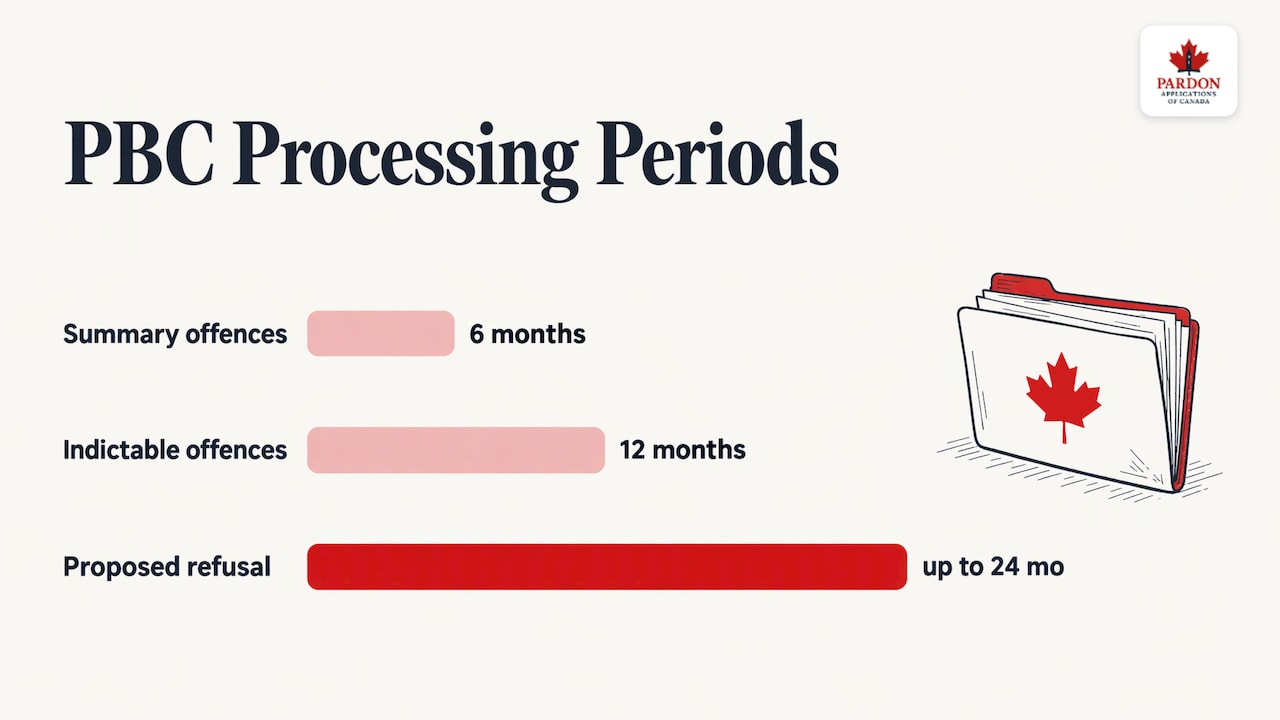
For a Canadian Pardon, the PBC’s official application guide says that once an application is accepted as eligible and complete, summary offence applications are processed within 6 months and indictable offence applications within 12 months. Where the PBC proposes to refuse, the process can take up to 24 months. Those are the board’s processing periods. They do not include the weeks or months it takes you to collect court and police documents beforehand.
For a U.S. Entry Waiver filed through e-SAFE, CBP states that processing times range from 90 to 120 days from the day biometrics are completed. Our own article on I-192 processing time separates the preparation weeks from the decision wait, and the Pardon timeline guide does the same for Record Suspensions.
Good questions here: When will my documents be ordered? What is the slowest step in my case? How will I know the day my application goes in?
Questions about what a Pardon changes
This is the question that turns a hopeful conversation into a realistic one. Ask it early, and tie it to your actual goal.
Work and volunteering
A Record Suspension sets your record aside from the public criminal record, which can remove a significant barrier when employers, landlords or licensing bodies ask. The PBC is clear that it does not erase the record. Sexual offences continue to be flagged in vulnerable sector checks.
A Vulnerable Sector Check is a deeper police check required for roles working with children or other vulnerable people. Police services explain that it includes record suspensions authorized for release by the Minister of Public Safety. If your goal is a job in teaching, health care or similar fields, ask how your specific offence is treated.
For many people, though, the biggest change is practical: standard background checks stop surfacing the conviction, and the “shadow of a past conviction” no longer has to come up at every application.
Travel to the United States
A Canadian Pardon does not open the U.S. border. The PBC says a Record Suspension does not guarantee entry or a visa to another country. Courthouse Libraries BC explains that under U.S. law a pardon issued by Canadian authorities is not recognized for purposes of entry into the United States, that any past record must be declared, and that trying to enter without declaring an arrest could result in permanent ineligibility or detention.
That is why the I-192 exists. Ask the consultant to explain, for your offence, whether you need a waiver at all, and how the waiver and the Pardon work together. Our pages on why you may need a U.S. waiver and what you need to know about U.S. Entry Waivers are written for exactly this question. If you already hold an approved waiver that is close to expiring, see our I-192 Renewal service.
And if you have an approved waiver that was lost, stolen or damaged, CBP says Form I-824 is the form used to request a duplicate.
Questions to ask about the people you are talking to
A consultation goes both ways. You are also deciding whom you trust with your most personal paperwork. Reasonable things to ask any provider:
- Who will be my main contact, and how do I reach them with questions?
- Will someone explain my eligibility in writing?
- How will I be updated as my application moves?
- What do you need from me, and by when?
At PAC, you speak with accredited Pardon and Waiver officers, and dedicated support channels are there to keep you informed throughout the process. You can also see how we approach the question of using a lawyer for a Pardon.
Your consultation checklist
Print or copy this list before your call:
- Offences, convictions and dates, as best you can recall
- Whether each offence was summary or indictable, if you know
- Sentences, and proof every fine and surcharge was paid
- Dates probation, parole or jail ended
- Places you have lived in the past 5 years
- Your travel goal: occasional trips, work travel or a move
- Your employment goal: a specific job, licence or volunteer role
- A written list of costs, timing and responsibilities, which you ask for before agreeing to anything
No one can promise you an outcome. The PBC and CBP make the decisions, and a strong application simply gives you the best preparation behind it.
Talk it through with PAC
If you are ready to find out where you stand, PAC’s accredited officers will assess your eligibility and walk you through what a complete Pardon or U.S. Entry Waiver application involves for your record. Our Canadian Pardon and U.S. Entry Waiver services cover eligibility, complete documentation and ongoing support.
You can schedule a free consultation through our site and bring the checklist above. You will leave knowing your waiting period, your next document and your total cost. For a wider overview, see our complete guide to Canadian Pardons and Record Suspensions.
FAQ
How long do I have to wait before I can apply for a Pardon?
For offences committed on or after March 13, 2012, the waiting period is 5 years for summary offences and 10 years for indictable offences. It starts only after every sentence, including fines, surcharges and probation, is complete. A consultation can confirm the right category from your court documents.
Is the $50 fee the full cost of a Pardon application?
No. The $50 is the Parole Board of Canada’s processing fee. Court records, police checks, fingerprinting, document and courier costs, and any preparation service come on top. Ask for a written total before you start.
Will a Canadian Pardon let me enter the United States?
Not on its own. U.S. authorities do not recognize a Canadian Pardon for entry purposes, and any past record must be declared at the border. Many people with a record apply for a U.S. Entry Waiver (I-192) for permission to enter.
What should I bring to my first consultation?
Bring your offence details, dates, sentences, proof that fines and surcharges were paid, and a list of where you have lived in the past 5 years. For a waiver, add court records for every offence and any rehabilitation or work documents.
Sources
- Who is eligible for a record suspension? (Parole Board of Canada)
- Applying for a record suspension (Parole Board of Canada)
- Official PBC Application Guide and forms
- Record Suspension Application Guide 2024 (Parole Board of Canada)
- Applying for a Record Suspension (Parole Board of Canada publication)
- PBC Service Portal Frequently Asked Questions
- Form I-192 (U.S. Customs and Border Protection)
- Form I-824 (U.S. Customs and Border Protection)
- e-SAFE (U.S. Customs and Border Protection)
- Record Suspensions (Pardons) (Courthouse Libraries BC)
- Vulnerable Sector Check (Guelph Police Service)
Recommended
This content brings together contributions from PAC, our content team, and AI tools, with PAC retaining editorial responsibility. It is shared for general information, not legal advice. Laws and procedures may change; seek qualified legal advice for your circumstances.