
In early 2025, a qualified project manager in Toronto lost a C$95,000 job offer because a minor incident from 2012 appeared during a routine background check. This scenario is increasingly common as digital screening becomes standard for 92% of Canadian employers. If you’ve felt the sting of a past mistake blocking your career or faced anxiety at the U.S. border, you know that time alone doesn’t heal a criminal record. Obtaining a Canadian pardon, officially known as a Record Suspension, is the only way to ensure your private history stays private.
You deserve to be judged on who you are today, not who you were years ago. We understand the weight of carrying this burden and the profound relief that comes with a clean slate. This complete 2026 guide explains exactly how to meet the Parole Board of Canada’s rigorous requirements, from calculating your specific eligibility dates to submitting a flawless application. You’ll learn the precise steps to remove barriers to employment, restore your travel freedom, and finally secure the fresh start you’ve earned.
Key Takeaways
- Understand the legal evolution of the Canadian pardon into the modern Record Suspension and how the Criminal Records Act governs the sealing of your past.
- Identify the specific statutory waiting periods and sentence completion requirements you must meet before becoming eligible for a clean slate.
- Discover how a cleared record restores your “Bondable” status, removing barriers to high-level employment and providing a psychological fresh start.
- Learn the precise steps for gathering essential documentation, including RCMP-accredited fingerprints and court records from every jurisdiction you have lived in.
- Explore the critical benefits of professional application management to avoid common errors that lead to a denied status and a mandatory one-year waiting period.
Understanding the Canadian Pardon in 2026
For over five decades, the Canadian pardon has served as a vital bridge between a past mistake and a future of full participation in society. As we look at the landscape in 2026, the process remains a rigorous federal procedure designed to reward law-abiding citizenship. If you’ve completed every part of your sentence, including fines and probation, and demonstrated a crime-free life for a set period, you’re eligible to apply for this formal recognition of your rehabilitation. It’s a structured path toward personal freedom that requires patience and precision.
The foundation for this entire process is the Criminal Records Act, which was first introduced in 1970. This legislation provides the legal framework for sealing convictions, ensuring that your past doesn’t permanently dictate your future. The Parole Board of Canada acts as the sole decision-making authority in these matters. They’re the only federal agency with the power to grant or deny these applications. Their officers perform a deep dive into your conduct since your last conviction to ensure that granting a suspension won’t bring the administration of justice into disrepute. This isn’t a rubber-stamp process; it’s a comprehensive evaluation of your character and your commitment to a fresh start.
While the government shifted its vocabulary years ago, the word “Pardon” remains the primary term for those seeking a clean slate. It carries an emotional weight that administrative terms lack. It signals a restoration of character and the removal of the stigma associated with a criminal record. For the thousands of Canadians who apply annually, the Canadian pardon represents the removal of a heavy weight that often hinders career growth and personal travel.
Pardon vs. Record Suspension: What is the Difference?
In March 2012, the Canadian government implemented Bill C-10, which officially renamed the “Pardon” to a “Record Suspension.” This change was largely symbolic and administrative. If you apply today, the legal protection you receive is identical to what was offered before 2012. The “Record Suspension” is the administrative reality of the process, but the term “Pardon” is what people use when they talk about hope and opportunity. Both terms refer to the same outcome: your record is set aside and kept separate from active criminal files.
How the Sealing of a Record Works
Once the Parole Board of Canada grants your request, your record undergoes a significant transformation. It’s moved from the active files in the Canadian Police Information Centre (CPIC) database and stored in a restricted section. A Record Suspension is the removal of a criminal record from the public domain. After this occurs, most public and private sector employers won’t see your past convictions during a standard background check. This privacy is essential for 92% of our clients who cite employment as their primary reason for applying. Only the Minister of Public Safety can authorize the disclosure of a sealed record in very rare, specific circumstances. This ensures your privacy remains protected while you pursue new career paths or volunteer opportunities in your community.
The process is methodical. It begins with identifying the specific barriers your record creates and ends with the peace of mind that comes from a clean CPIC search. By moving your records into this restricted status, the government acknowledges that you’ve successfully reintegrated into society. It’s a formal end to the cycle of punishment and the beginning of a life defined by your current contributions rather than your past errors.
Eligibility Criteria: Can You Apply for a Pardon?
Before you can secure a Canadian pardon, you must meet strict legal benchmarks set by the Parole Board of Canada. The process doesn’t begin the moment a judge delivers a sentence; it begins only after you’ve fully satisfied every condition of that sentence. This includes paying all C$ fines, completing restitution payments, finishing any probation periods, and serving any required jail time. If you still owe C$100 in court costs or victim surcharges, your eligibility clock hasn’t started yet.
Parole Board officials examine your life since your conviction to determine if you’ve demonstrated “good conduct.” This isn’t just about avoiding new charges. It’s an assessment of whether you’re a law-abiding citizen who contributes to your community. To ensure you meet the official eligibility criteria, you must prove that the suspension of your record will provide a measurable benefit to your life while not bringing the administration of justice into disrepute.
Waiting Periods Explained
The time you must wait depends entirely on how the Crown chose to prosecute your offense. For summary convictions, which are typically less serious matters, the statutory waiting period is 5 years. For indictable convictions, which involve more serious charges, the wait extends to 10 years.
Your “clock” only starts ticking once your entire sentence is complete. If you were sentenced to two years of probation and a C$500 fine, your 5 or 10-year wait begins only after the probation ends and the fine is paid in full. If you finished probation in 2024 but didn’t pay the fine until 2025, your eligibility date is calculated from that 2025 payment. You can check your specific eligibility date with a specialist to avoid filing too early and facing a mandatory one-year rejection penalty.
Offenses Ineligible for a Record Suspension
Not every record can be sealed. Under current 2026 Canadian law, certain offenses create a permanent barrier to obtaining a Record Suspension. Most notably, Schedule 1 offenses involving sexual crimes against minors generally result in permanent ineligibility. There are very rare exceptions for specific cases, but for 95% of applicants in this category, a Canadian pardon is not an option.
Canada also enforces a “Three Strikes” rule for serious crimes. If you’ve been convicted of three or more indictable offenses, each of which resulted in a prison sentence of two years or more, you’re permanently ineligible for a Record Suspension. This rule emphasizes the Board’s focus on long-term rehabilitation rather than habitual patterns of serious crime. It’s a rigid standard that leaves no room for administrative appeal.
There’s often confusion regarding impaired driving. Many believe a DUI makes them permanently ineligible. That’s incorrect. While a DUI is a serious criminal offense, it’s eligible for a Record Suspension once the 5 or 10-year waiting period is met. Since the 2018 changes to impaired driving laws, most DUIs are treated as serious offenses, but they remain part of the pardon process. Dealing with these complexities requires precision, as even a minor error in calculating your end-of-sentence date can lead to a rejected application and lost filing fees.
The Life-Changing Benefits of a Cleared Record
Obtaining a Canadian pardon represents a definitive shift in your life story. It’s the moment the legal system acknowledges your rehabilitation, moving your criminal record into a separate, sealed database. This change is as much psychological as it is legal. For many, the “criminal” label creates a persistent sense of shame that limits social interactions and personal growth. Removing this barrier often leads to a measurable increase in self-confidence. You’re no longer defined by a past mistake; you’re defined by who you’ve become today.
Beyond the internal shift, the practical advantages are immediate. In 2026, community involvement requires higher levels of scrutiny than ever before. Approximately 85% of volunteer positions in coaching, school councils, and local charities now mandate a Vulnerable Sector Check or a standard background search. A record suspension allows you to pass these checks, letting you give back to your community without the fear of a digital footprint blocking your path. It restores your ability to lead, mentor, and participate in the activities that give life meaning.
Career Advancement and Professional Licensing
The 2026 job market relies heavily on automated screening. Statistics show that 92% of Canadian employers now utilize third-party background checks for even entry-level roles. If you’re pursuing a career in finance, healthcare, or government contracting, being “bondable” is a non-negotiable requirement. This status means an insurance company is willing to insure you against potential losses, a feat nearly impossible with an active record. Once your Canadian pardon is granted, you gain the legal right under the Canadian Human Rights Act to state “No” when asked if you have a criminal record for which a pardon hasn’t been issued. This protection is vital for professional licensing in sectors like real estate or law, where “good character” assessments are standard. Understanding the Pardon application process is the first step toward securing these high-level employment opportunities.
Travel Freedom and Border Security
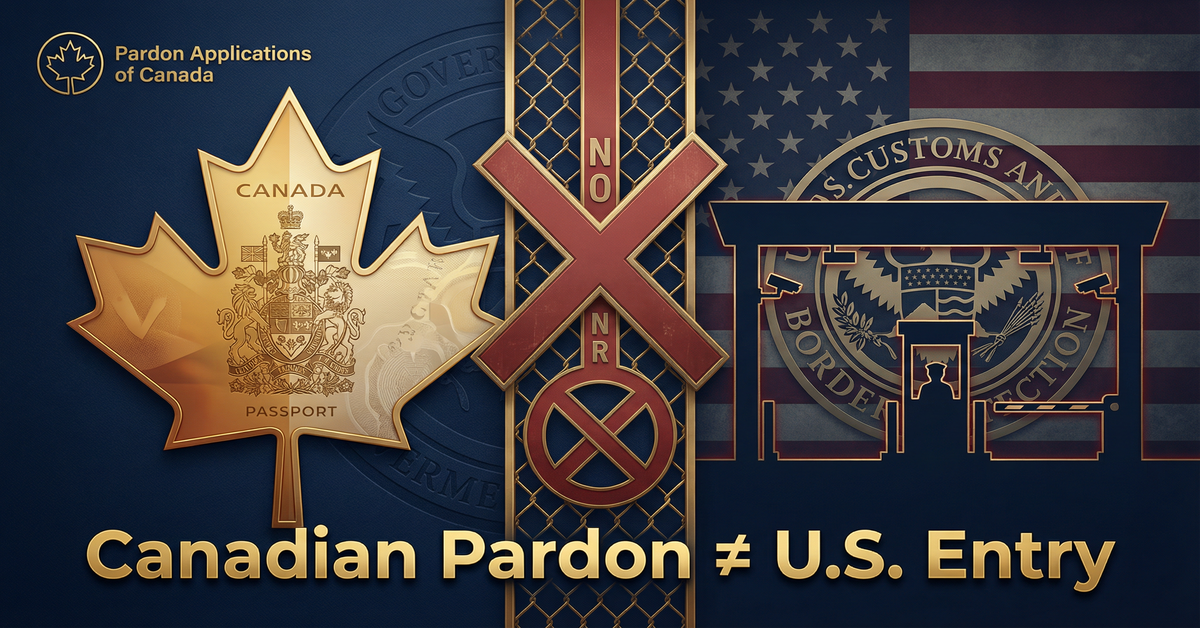
It’s a common misconception that a Canadian pardon automatically grants you entry into the United States. It doesn’t. While a pardon seals your record within the Canadian Police Information Centre (CPIC) database, it doesn’t erase information already indexed by U.S. Customs and Border Protection (CBP). If you’ve been denied entry or flagged at the border previously, the U.S. government maintains its own permanent file. In these cases, you’ll likely still require a U.S. Entry Waiver (Form I-192) alongside your pardon. The pardon is still essential, however, because it demonstrates your rehabilitation to U.S. officials, significantly strengthening your waiver application. It ensures that when CPIC is queried by foreign agencies, the response comes back clean. This clarity is crucial for anyone planning international travel or cross-border business in an era of heightened digital surveillance.
The process of clearing your name is a structured journey toward privacy. It stops the public disclosure of your past and ensures that your private life stays private. Whether it’s signing a new apartment lease or applying for a mortgage, a clean record removes the “red flags” that often lead to rejection. It’s a strategic investment in your future that pays dividends in every area of your life, from your bank account to your peace of mind.
The Step-by-Step Pardon Application Process
Securing a Canadian pardon is a structured legal journey that requires precision at every stage. It isn’t merely a matter of submitting a request; it’s a comprehensive demonstration of your rehabilitation and good conduct since your last conviction. The Parole Board of Canada (PBC) maintains a rigorous standard for every file. If your application contains even a minor clerical error or a missing local police check, the government will return the entire package. This bureaucratic marathon typically lasts between 6 and 12 months from the moment of final submission, so getting it right the first time is crucial for your peace of mind.
RCMP-Accredited Fingerprinting
Your application starts with an official criminal record. In 2026, digital fingerprinting is the mandatory standard for all accredited agencies. You must visit a certified provider to have prints scanned and sent to the RCMP’s identification services. This ensures your identity is verified before the file proceeds. Digital fingerprints are processed by the RCMP in as little as 72 hours. This rapid turnaround allows for a faster transition into the intensive document gathering phase that follows.
Document Procurement: The “Heavy Lifting”
Gathering paperwork is where most applicants encounter obstacles. You need specific court transcripts and police records from every jurisdiction where you’ve lived for the past five years. Court records are the most common cause of application rejection. They must confirm the exact date your sentence ended, including all fine payments. Professional procurement services prevent administrative delays by navigating different provincial systems to secure these archived records correctly, ensuring your file meets the Parole Board’s strict criteria.
The final stage involves completing the official Parole Board of Canada application forms. These documents require a delicate balance of legal accuracy and personal narrative. You’ll need to explain the circumstances of your past and how a Canadian pardon will impact your future opportunities for employment, travel, and community involvement. Once the PBC receives your completed file and the C$50 government filing fee, the formal review begins. During this 6 to 12 month waiting period, maintaining a clean record is vital. Any new interaction with the law can immediately void your progress.
Submitting the file is the culmination of months of preparation. Once your fingerprints, court documents, and local police checks are compiled, they’re bound with your completed application and sent to the Parole Board of Canada in Ottawa. The Board’s investigators then conduct their own background checks to confirm the information you’ve provided. If they find any discrepancies, the process stalls. By ensuring your application is exhaustive and professionally audited, you significantly reduce the risk of a 12-month delay and move closer to your goal of total privacy.
Ready to start your journey toward a clean slate? You can apply for a Canadian Pardon today and let our specialists handle the bureaucratic complexity for you.
Why Choose Professional Management for Your Application?
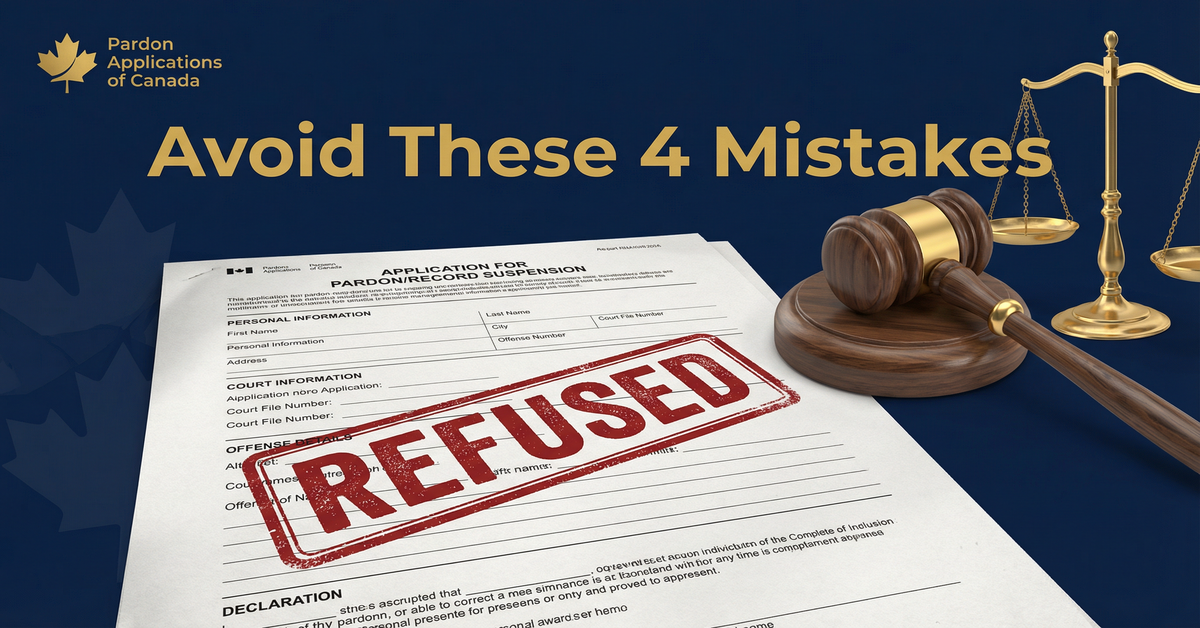
If you attempt to secure a Canadian pardon on your own, you are stepping into a complex bureaucratic environment where a single clerical oversight leads to a formal denial. Under current Parole Board of Canada regulations, a rejected application triggers a mandatory 365-day waiting period before you can re-apply. This 12-month penalty stalls your progress toward career advancement or international travel, effectively extending the lifespan of your criminal record. Professional management eliminates this risk by ensuring every detail is scrutinized before submission.
Pardon Applications of Canada operates as a high-level consultancy to manage the end-to-end legal paperwork required for a successful file. The process involves coordinating with local police services, the RCMP, and various court jurisdictions across the country. If you choose professional management, our specialists handle the retrieval of your criminal record, court transcripts, and local police record checks. This ensures every document meets the exact standards of the Parole Board. As an A+ rated specialist with the Better Business Bureau, the agency provides a layer of security that self-represented applicants often lack. We transform a multi-year legal process into a series of manageable, predictable steps.
Avoiding Common Application Mistakes
Statistical data suggests that self-managed applications have a failure rate significantly higher than those handled by accredited professionals. Small errors, such as missing a previous residential address from a decade ago or providing an outdated court document, result in immediate file returns. The most critical component is often the “Measurable Benefit” statement. You must clearly articulate how a Canadian pardon will improve your life, whether through specific employment opportunities or community involvement. If this statement is vague or fails to meet legal criteria, the board will likely reject the request. Our team helps you craft a compelling, fact-based narrative that aligns with government expectations and proves your rehabilitation.
Your Journey to Freedom Starts Here
Regaining your personal freedom requires a methodical approach and a partner who values your privacy. We offer a non-judgmental environment where your past stays in the past. Our service is designed to alleviate the anxiety that comes with legal paperwork. The first step is determining if you meet the statutory waiting periods, which are currently 5 years for summary offenses and 10 years for indictable offenses. Once eligibility is confirmed, we move your file from a simple consultation to a fully managed legal package. You don’t have to navigate this system alone. Start your Canadian Pardon application with a free assessment to begin your path toward a clean record today. Our commitment to your privacy and our deep understanding of border protocols ensure your application is in the most capable hands in Canada.
Secure Your Second Chance and Reclaim Your Freedom
Obtaining a Canadian pardon represents more than a legal milestone; it’s the definitive path to reclaiming your privacy and expanding your career opportunities. The 2026 regulatory environment for Record Suspensions demands total compliance with the Parole Board of Canada’s evolving criteria. Even a minor administrative error can result in a rejected application and years of unnecessary waiting. Pardon Applications of Canada brings over 10 years of professional management experience to your case, ensuring every statutory requirement is met with precision.
Our A+ Better Business Bureau rating and partnership with RCMP-accredited fingerprinting services provide the security and reliability you need during this sensitive transition. You’ve already done the hard work of moving past your mistakes. Let us handle the complex paperwork and heavy lifting so you can focus on your fresh start. Your history doesn’t have to define your future any longer. Take the first step toward total personal freedom today.
Start your free Pardon eligibility check now
Frequently Asked Questions About Canadian Pardons
How long does it take to get a Canadian Pardon in 2026?
The total timeline to secure a Canadian pardon typically spans 12 to 24 months from the moment you begin the process. This duration includes 6 to 12 months for the Parole Board of Canada to review your file once it’s submitted; however, you must also account for the 6 to 10 months required to gather court documents and military records. If your application contains errors, these timelines often extend, so accuracy is vital for a swift result.
Will a Pardon remove my record from the internet or news articles?
A Canadian pardon doesn’t remove information from the internet, social media, or archived news articles. While it legally seals your criminal record within the National Repository of Criminal Records maintained by the RCMP, it has no jurisdiction over private media companies or search engines like Google. If a news outlet published a story about your conviction in 2015, that digital footprint remains visible unless the publisher chooses to remove it.
Can I apply for a Pardon if I still owe money to the court?
You can’t apply for a Record Suspension until you’ve paid every cent of your court-ordered financial obligations. This includes all fines, victim surcharges, costs, and restitution orders. Your mandatory 5 or 10-year waiting period only starts after the final payment is processed by the court. If you owe even C$1.00 in outstanding fees, the Parole Board will return your application as ineligible.
Does a Canadian Pardon guarantee entry into the United States?
A Canadian pardon doesn’t guarantee entry into the United States because U.S. Customs and Border Protection doesn’t recognize foreign record suspensions. If U.S. officials have already scanned your record into their system, they’ll see the conviction regardless of your pardon status. To travel legally and with confidence, you’ll likely need a U.S. Entry Waiver (I-192) in addition to your pardon if you have a history of inadmissibility.
What happens if my Record Suspension application is denied?
If the Parole Board of Canada intends to deny your application, they’ll send you a written notice explaining their concerns. You have 90 days to submit a written response to persuade the Board to change their mind. If they issue a final refusal, you must wait 12 months before you’re eligible to submit a new application. Most denials stem from incomplete documentation or a failure to demonstrate good conduct since your last conviction.
Is a Pardon permanent, or can it be revoked later?
Your pardon is permanent as long as you remain a law-abiding citizen. The Parole Board of Canada has the authority to revoke a Record Suspension if you’re later convicted of a new indictable offense or certain summary offenses. It can also be voided if the Board discovers you provided false or misleading information during your initial application. Maintaining your fresh start depends entirely on your continued commitment to a crime-free life.
How much does the government charge for a Record Suspension application?
The current government filing fee for a Record Suspension application is C$50.00 — but this is only 1 fee in a larger set of costs. You should prepare for additional costs beyond this administrative fee, including approximately C$75.00 to C$125.00 for digital fingerprints and C$50.00 to C$150.00 for local police checks and a similar cost for court transcripts. There may also be addition costs for special requests with the court. Thus, while the Parole Board of Canada filing fee is low, the total investment for a complete and professional application package often ranges between C$600.00 and C$1,500.00 depending on your record’s complexity.
Do I need a lawyer to apply for a Canadian Pardon?
You aren’t legally required to hire a lawyer to apply for a Canadian pardon, but many applicants choose professional assistance to navigate the bureaucracy. The process involves coordinating with multiple police detachments and courthouses, which can be overwhelming if you aren’t familiar with legal terminology and processes. Using a specialized processing service ensures your paperwork meets the strict 2026 standards of the Parole Board, reducing the risk of a rejection or multi-year delay.